

212
important observation was the butane selectivity decreases with the hydrogen
pressure. Yoon et al. [31] studied the isomerization and hydrogenation reactions of
cis-2-butene and 1-butene on Pt foil and Pt(111), Pt(100), Pt(755) single-crystal
surfaces and reported that the reaction selectivity was independent of reactant
mixture but changes slightly with reaction temperature.
2.3 DFT Studies on Catalytic Hydrogenation of Butadiene
Catalytic hydrogenation of 1,3-butadiene is considered as a model catalytic process
for olefin/diene hydrogenation in refining/petrochemical industry and adsorption
studies of these unsaturated hydrocarbons on metallic surfaces are of basic and
practical interest. Therefore, the majority of studies [19, 29, 34–41] have focused on
the use of DFT calculations in comparison with experimental data to investigate the
interaction of 1,3-butadiene, 2-cis/trans-butenes and 1-butene on various metal
surfaces. Valcárcel et al. first studied the interaction of different hydrocarbons
(1,3-butadiene, 1-butene and 2-cis/trans-butenes) over various Pd(111) and Pt (111)
surfaces using DFT calculations [41, 42].
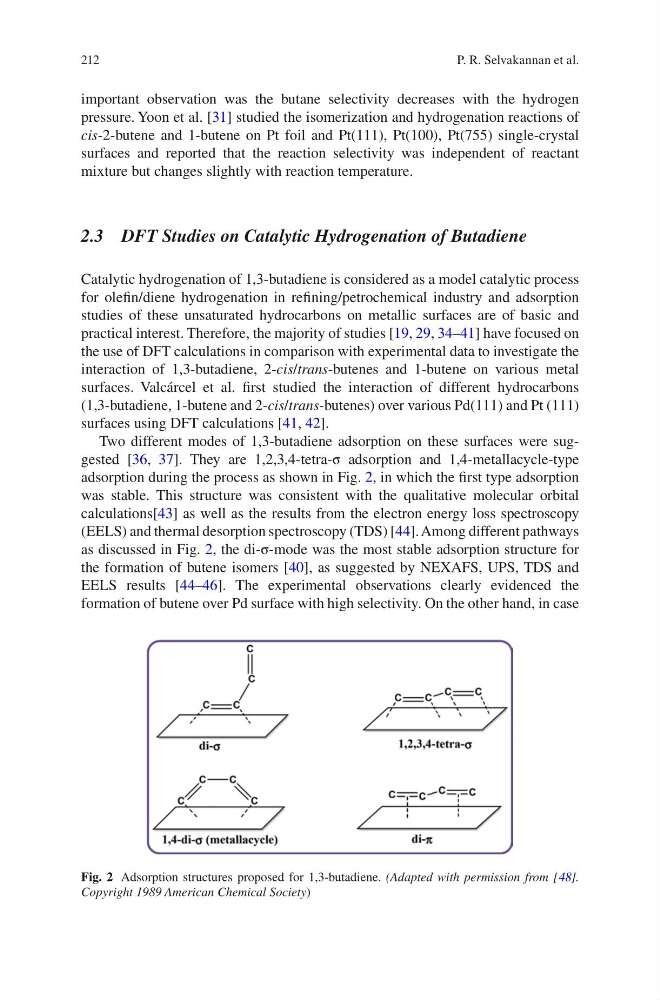
Two different modes of 1,3-butadiene adsorption on these surfaces were suggested [36, 37]. They are 1,2,3,4-tetra-σ adsorption and 1,4-metallacycle-type
adsorption during the process as shown in Fig. 2, in which the first type adsorption
was stable. This structure was consistent with the qualitative molecular orbital
calculations[43] as well as the results from the electron energy loss spectroscopy
(EELS) and thermal desorption spectroscopy (TDS) [44]. Among different pathways
as discussed in Fig. 2, the di-σ-mode was the most stable adsorption structure for
the formation of butene isomers [40], as suggested by NEXAFS, UPS, TDS and
EELS results [44–46]. The experimental observations clearly evidenced the
formation of butene over Pd surface with high selectivity. On the other hand, in case
Fig. 2 Adsorption structures proposed for 1,3-butadiene. (Adapted with permission from [48].
Copyright 1989 American Chemical Society)
P. R. Selvakannan et al.
important observation was the butane selectivity decreases with the hydrogen
pressure. Yoon et al. [31] studied the isomerization and hydrogenation reactions of
cis-2-butene and 1-butene on Pt foil and Pt(111), Pt(100), Pt(755) single-crystal
surfaces and reported that the reaction selectivity was independent of reactant
mixture but changes slightly with reaction temperature.
2.3 DFT Studies on Catalytic Hydrogenation of Butadiene
Catalytic hydrogenation of 1,3-butadiene is considered as a model catalytic process
for olefin/diene hydrogenation in refining/petrochemical industry and adsorption
studies of these unsaturated hydrocarbons on metallic surfaces are of basic and
practical interest. Therefore, the majority of studies [19, 29, 34–41] have focused on
the use of DFT calculations in comparison with experimental data to investigate the
interaction of 1,3-butadiene, 2-cis/trans-butenes and 1-butene on various metal
surfaces. Valcárcel et al. first studied the interaction of different hydrocarbons
(1,3-butadiene, 1-butene and 2-cis/trans-butenes) over various Pd(111) and Pt (111)
surfaces using DFT calculations [41, 42].
Two different modes of 1,3-butadiene adsorption on these surfaces were suggested [36, 37]. They are 1,2,3,4-tetra-σ adsorption and 1,4-metallacycle-type
adsorption during the process as shown in Fig. 2, in which the first type adsorption
was stable. This structure was consistent with the qualitative molecular orbital
calculations[43] as well as the results from the electron energy loss spectroscopy
(EELS) and thermal desorption spectroscopy (TDS) [44]. Among different pathways
as discussed in Fig. 2, the di-σ-mode was the most stable adsorption structure for
the formation of butene isomers [40], as suggested by NEXAFS, UPS, TDS and
EELS results [44–46]. The experimental observations clearly evidenced the
formation of butene over Pd surface with high selectivity. On the other hand, in case
Fig. 2 Adsorption structures proposed for 1,3-butadiene. (Adapted with permission from [48].
Copyright 1989 American Chemical Society)
P. R. Selvakannan et al.