

194
distribution of products and by-products from each process are similar, and systems
for refining IPA are essentially the same. Depends on the intended applications, IPA
is upgraded through isotopic distillation. Other post purification steps such as aqueous extractive distillation or treatment by a fixed bed adsorption process using activated carbon or molecular sieves are employed to improve further quality of IPA for
medical purposes.
Emerging Alternative: IPA from Acetone
Acetone hydrogenation is an emerging alternative route which is gaining popularity
in recent times for IPA production [192]. This route accounted for only 2% of total
global IPA production in 2000, which jumped to nearly 25% by 2018. This increase
is attributed to the oversupply of acetone from the phenol production process. In the
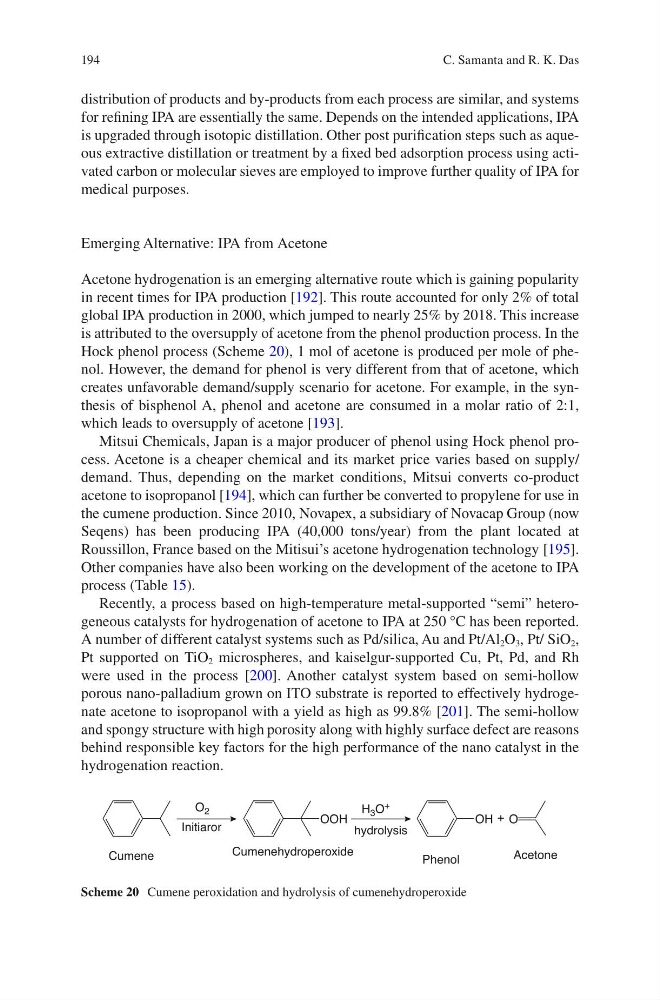
Hock phenol process (Scheme 20), 1 mol of acetone is produced per mole of phenol. However, the demand for phenol is very different from that of acetone, which
creates unfavorable demand/supply scenario for acetone. For example, in the synthesis of bisphenol A, phenol and acetone are consumed in a molar ratio of 2:1,
which leads to oversupply of acetone [193].
Mitsui Chemicals, Japan is a major producer of phenol using Hock phenol process. Acetone is a cheaper chemical and its market price varies based on supply/
demand. Thus, depending on the market conditions, Mitsui converts co-product
acetone to isopropanol [194], which can further be converted to propylene for use in
the cumene production. Since 2010, Novapex, a subsidiary of Novacap Group (now
Seqens) has been producing IPA (40,000 tons/year) from the plant located at
Roussillon, France based on the Mitisui’s acetone hydrogenation technology [195].
Other companies have also been working on the development of the acetone to IPA
process (Table 15).
Recently, a process based on high-temperature metal-supported “semi” heterogeneous catalysts for hydrogenation of acetone to IPA at 250 °C has been reported.
A number of different catalyst systems such as Pd/silica, Au and Pt/Al 2 O 3 , Pt/ SiO 2 ,
Pt supported on TiO 2 microspheres, and kaiselgur-supported Cu, Pt, Pd, and Rh
were used in the process [200]. Another catalyst system based on semi-hollow
porous nano-palladium grown on ITO substrate is reported to effectively hydrogenate acetone to isopropanol with a yield as high as 99.8% [201]. The semi-hollow
and spongy structure with high porosity along with highly surface defect are reasons
behind responsible key factors for the high performance of the nano catalyst in the
hydrogenation reaction.
Cumene
Initiaror
O 2
OOH
Cumenehydroperoxide
hydrolysis
Phenol
Acetone
OH O
+
H 3 O
+
Scheme 20 Cumene peroxidation and hydrolysis of cumenehydroperoxide
C. Samanta and R. K. Das
distribution of products and by-products from each process are similar, and systems
for refining IPA are essentially the same. Depends on the intended applications, IPA
is upgraded through isotopic distillation. Other post purification steps such as aqueous extractive distillation or treatment by a fixed bed adsorption process using activated carbon or molecular sieves are employed to improve further quality of IPA for
medical purposes.
Emerging Alternative: IPA from Acetone
Acetone hydrogenation is an emerging alternative route which is gaining popularity
in recent times for IPA production [192]. This route accounted for only 2% of total
global IPA production in 2000, which jumped to nearly 25% by 2018. This increase
is attributed to the oversupply of acetone from the phenol production process. In the
Hock phenol process (Scheme 20), 1 mol of acetone is produced per mole of phenol. However, the demand for phenol is very different from that of acetone, which
creates unfavorable demand/supply scenario for acetone. For example, in the synthesis of bisphenol A, phenol and acetone are consumed in a molar ratio of 2:1,
which leads to oversupply of acetone [193].
Mitsui Chemicals, Japan is a major producer of phenol using Hock phenol process. Acetone is a cheaper chemical and its market price varies based on supply/
demand. Thus, depending on the market conditions, Mitsui converts co-product
acetone to isopropanol [194], which can further be converted to propylene for use in
the cumene production. Since 2010, Novapex, a subsidiary of Novacap Group (now
Seqens) has been producing IPA (40,000 tons/year) from the plant located at
Roussillon, France based on the Mitisui’s acetone hydrogenation technology [195].
Other companies have also been working on the development of the acetone to IPA
process (Table 15).
Recently, a process based on high-temperature metal-supported “semi” heterogeneous catalysts for hydrogenation of acetone to IPA at 250 °C has been reported.
A number of different catalyst systems such as Pd/silica, Au and Pt/Al 2 O 3 , Pt/ SiO 2 ,
Pt supported on TiO 2 microspheres, and kaiselgur-supported Cu, Pt, Pd, and Rh
were used in the process [200]. Another catalyst system based on semi-hollow
porous nano-palladium grown on ITO substrate is reported to effectively hydrogenate acetone to isopropanol with a yield as high as 99.8% [201]. The semi-hollow
and spongy structure with high porosity along with highly surface defect are reasons
behind responsible key factors for the high performance of the nano catalyst in the
hydrogenation reaction.
Cumene
Initiaror
O 2
OOH
Cumenehydroperoxide
hydrolysis
Phenol
Acetone
OH O
+
H 3 O
+
Scheme 20 Cumene peroxidation and hydrolysis of cumenehydroperoxide
C. Samanta and R. K. Das