

195
Upcoming Trend with Respect to Current Research
As production of renewable electricity is increasing drastically because of worldwide adoption of solar and wind energy to drive decarbonization of chemical, transportation, and energy sectors, cost of electricity is coming down steadily. As a result,
electrochemical processes are becoming popular and several big plants are coming
up for the production of green hydrogen using renewable electricity. In this regard,
electrochemical hydrogenation (ECH) of acetone is also being explored to produce
isopropanol [202]. This route provides an alternative way of upgrading biofuels
with less energy consumption and chemical waste as compared to conventional
methods. Polymer electrolyte membrane fuel cell (PEMFC) hardware was used as
an electrochemical reactor to hydrogenate acetone to produce isopropanol. The process produces diisopropyl ether (DIPE) as a by-product. It is reported that when
ECH was carried out at 65 °C and atmospheric pressure, selectivity (>90%) was
achieved at a current efficiency of 59.7%.
5 Concluding Remarks and Industrial Outlook
Worldwide demand for propylene and propylene-derived chemicals is increasing to
support economic development. This book chapter presents an overview of important commercial technologies and catalysts used in the production of propylene in
traditional and various emerging on-purpose production routes. The industrial
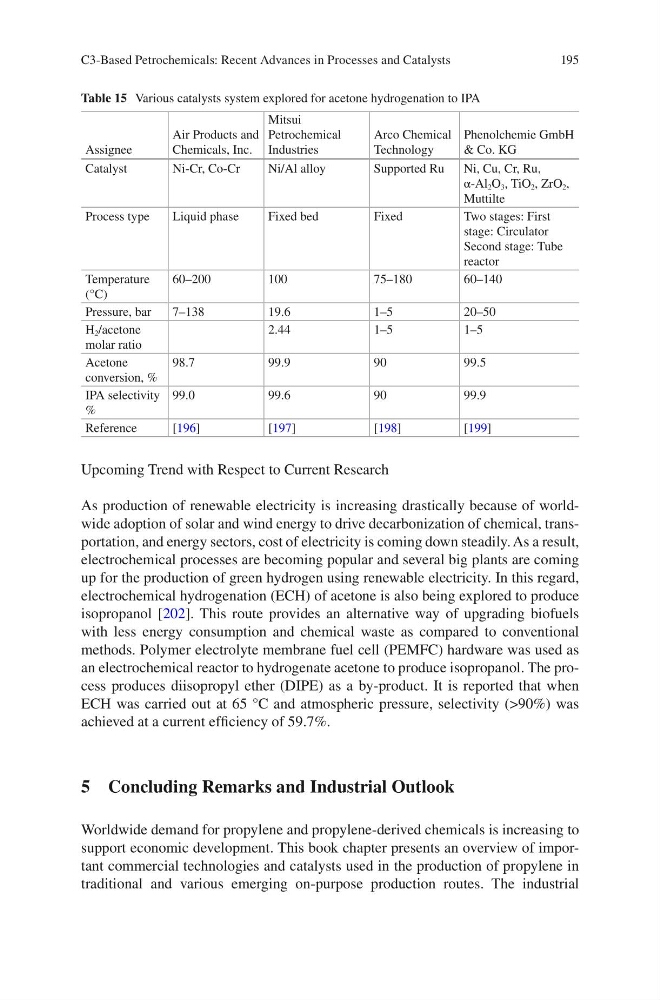
Table 15 Various catalysts system explored for acetone hydrogenation to IPA
Assignee
Air Products and
Chemicals, Inc.
Mitsui
Petrochemical
Industries
Arco Chemical
Technology
Phenolchemie GmbH
& Co. KG
Catalyst
Ni-Cr, Co-Cr
Ni/Al alloy
Supported Ru
Ni, Cu, Cr, Ru,
α-Al 2 O 3 , TiO 2 , ZrO 2 ,
Muttilte
Process type
Liquid phase
Fixed bed
Fixed
Two stages: First
stage: Circulator
Second stage: Tube
reactor
Temperature
(°C)
60–200
100
75–180
60–140
Pressure, bar
7–138
19.6
1–5
20–50
H 2 /acetone
molar ratio
2.44
1–5
1–5
Acetone
conversion, %
98.7
99.9
90
99.5
IPA selectivity
%
99.0
99.6
90
99.9
Reference
[196]
[197]
[198]
[199]
C3-Based Petrochemicals: Recent Advances in Processes and Catalysts
Upcoming Trend with Respect to Current Research
As production of renewable electricity is increasing drastically because of worldwide adoption of solar and wind energy to drive decarbonization of chemical, transportation, and energy sectors, cost of electricity is coming down steadily. As a result,
electrochemical processes are becoming popular and several big plants are coming
up for the production of green hydrogen using renewable electricity. In this regard,
electrochemical hydrogenation (ECH) of acetone is also being explored to produce
isopropanol [202]. This route provides an alternative way of upgrading biofuels
with less energy consumption and chemical waste as compared to conventional
methods. Polymer electrolyte membrane fuel cell (PEMFC) hardware was used as
an electrochemical reactor to hydrogenate acetone to produce isopropanol. The process produces diisopropyl ether (DIPE) as a by-product. It is reported that when
ECH was carried out at 65 °C and atmospheric pressure, selectivity (>90%) was
achieved at a current efficiency of 59.7%.
5 Concluding Remarks and Industrial Outlook
Worldwide demand for propylene and propylene-derived chemicals is increasing to
support economic development. This book chapter presents an overview of important commercial technologies and catalysts used in the production of propylene in
traditional and various emerging on-purpose production routes. The industrial
Table 15 Various catalysts system explored for acetone hydrogenation to IPA
Assignee
Air Products and
Chemicals, Inc.
Mitsui
Petrochemical
Industries
Arco Chemical
Technology
Phenolchemie GmbH
& Co. KG
Catalyst
Ni-Cr, Co-Cr
Ni/Al alloy
Supported Ru
Ni, Cu, Cr, Ru,
α-Al 2 O 3 , TiO 2 , ZrO 2 ,
Muttilte
Process type
Liquid phase
Fixed bed
Fixed
Two stages: First
stage: Circulator
Second stage: Tube
reactor
Temperature
(°C)
60–200
100
75–180
60–140
Pressure, bar
7–138
19.6
1–5
20–50
H 2 /acetone
molar ratio
2.44
1–5
1–5
Acetone
conversion, %
98.7
99.9
90
99.5
IPA selectivity
%
99.0
99.6
90
99.9
Reference
[196]
[197]
[198]
[199]
C3-Based Petrochemicals: Recent Advances in Processes and Catalysts