

193
to propylene was about 12.5:1 to 15:1 and the conversion of propylene was at least
75% per pass. An acidic ion exchange resin was used to catalyze the process. Due
to lower concentration of propylene in the feed, there is a complete conversion of
organic phase, i.e., propylene. As a result, IPA is formed in a dilute aqueous phase
(approx. 5–7 mol% of isopropyl alcohol). The diluted IPA containing aqueous phase
needs to be concentrated to the near of the alcohol-water azeotrope by conventional
distillation followed by an azeotropic distillation to recover dry isopropyl alcohol.
Few limitations of Deutsche Texaco process were further improved in the Tokuyama
Soda process. The disadvantages of the gas-phase processes are largely avoided by
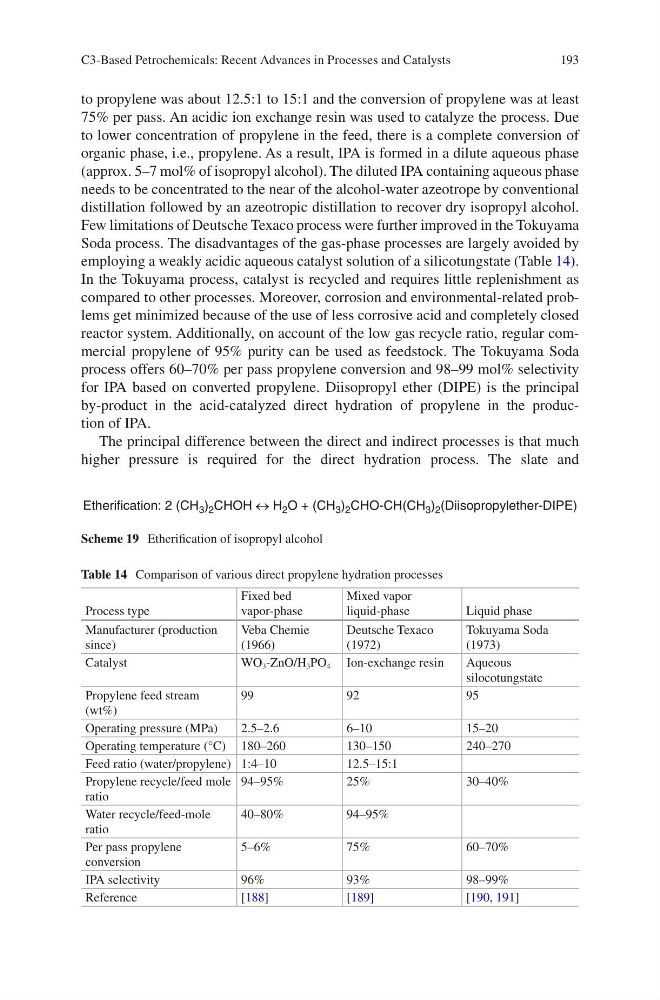
employing a weakly acidic aqueous catalyst solution of a silicotungstate (Table 14).
In the Tokuyama process, catalyst is recycled and requires little replenishment as
compared to other processes. Moreover, corrosion and environmental-related problems get minimized because of the use of less corrosive acid and completely closed
reactor system. Additionally, on account of the low gas recycle ratio, regular commercial propylene of 95% purity can be used as feedstock. The Tokuyama Soda
process offers 60–70% per pass propylene conversion and 98–99 mol% selectivity
for IPA based on converted propylene. Diisopropyl ether (DIPE) is the principal
by- product in the acid-catalyzed direct hydration of propylene in the production of IPA.
The principal difference between the direct and indirect processes is that much
higher pressure is required for the direct hydration process. The slate and
Etherification: 2 (CH 3 ) 2 CHOH ↔ H 2 O + (CH 3 ) 2 CHO-CH(CH 3 ) 2 (Diisopropylether-DIPE)
Scheme 19 Etherification of isopropyl alcohol
Table 14 Comparison of various direct propylene hydration processes
Process type
Fixed bed
vapor-phase
Mixed vapor
liquid-phase
Liquid phase
Manufacturer (production
since)
Veba Chemie
(1966)
Deutsche Texaco
(1972)
Tokuyama Soda
(1973)
Catalyst
WO 3 -ZnO/H 3 PO 4 Ion-exchange resin
Aqueous
silocotungstate
Propylene feed stream
(wt%)
99
92
95
Operating pressure (MPa)
2.5–2.6
6–10
15–20
Operating temperature (°C) 180–260
130–150
240–270
Feed ratio (water/propylene) 1:4–10
12.5–15:1
Propylene recycle/feed mole
ratio
94–95%
25%
30–40%
Water recycle/feed-mole
ratio
40–80%
94–95%
Per pass propylene
conversion
5–6%
75%
60–70%
IPA selectivity
96%
93%
98–99%
Reference
[188]
[189]
[190, 191]
C3-Based Petrochemicals: Recent Advances in Processes and Catalysts
to propylene was about 12.5:1 to 15:1 and the conversion of propylene was at least
75% per pass. An acidic ion exchange resin was used to catalyze the process. Due
to lower concentration of propylene in the feed, there is a complete conversion of
organic phase, i.e., propylene. As a result, IPA is formed in a dilute aqueous phase
(approx. 5–7 mol% of isopropyl alcohol). The diluted IPA containing aqueous phase
needs to be concentrated to the near of the alcohol-water azeotrope by conventional
distillation followed by an azeotropic distillation to recover dry isopropyl alcohol.
Few limitations of Deutsche Texaco process were further improved in the Tokuyama
Soda process. The disadvantages of the gas-phase processes are largely avoided by
employing a weakly acidic aqueous catalyst solution of a silicotungstate (Table 14).
In the Tokuyama process, catalyst is recycled and requires little replenishment as
compared to other processes. Moreover, corrosion and environmental-related problems get minimized because of the use of less corrosive acid and completely closed
reactor system. Additionally, on account of the low gas recycle ratio, regular commercial propylene of 95% purity can be used as feedstock. The Tokuyama Soda
process offers 60–70% per pass propylene conversion and 98–99 mol% selectivity
for IPA based on converted propylene. Diisopropyl ether (DIPE) is the principal
by- product in the acid-catalyzed direct hydration of propylene in the production of IPA.
The principal difference between the direct and indirect processes is that much
higher pressure is required for the direct hydration process. The slate and
Etherification: 2 (CH 3 ) 2 CHOH ↔ H 2 O + (CH 3 ) 2 CHO-CH(CH 3 ) 2 (Diisopropylether-DIPE)
Scheme 19 Etherification of isopropyl alcohol
Table 14 Comparison of various direct propylene hydration processes
Process type
Fixed bed
vapor-phase
Mixed vapor
liquid-phase
Liquid phase
Manufacturer (production
since)
Veba Chemie
(1966)
Deutsche Texaco
(1972)
Tokuyama Soda
(1973)
Catalyst
WO 3 -ZnO/H 3 PO 4 Ion-exchange resin
Aqueous
silocotungstate
Propylene feed stream
(wt%)
99
92
95
Operating pressure (MPa)
2.5–2.6
6–10
15–20
Operating temperature (°C) 180–260
130–150
240–270
Feed ratio (water/propylene) 1:4–10
12.5–15:1
Propylene recycle/feed mole
ratio
94–95%
25%
30–40%
Water recycle/feed-mole
ratio
40–80%
94–95%
Per pass propylene
conversion
5–6%
75%
60–70%
IPA selectivity
96%
93%
98–99%
Reference
[188]
[189]
[190, 191]
C3-Based Petrochemicals: Recent Advances in Processes and Catalysts