

192
acid and the process suffers from low selectivity, i.e., the use of sulfuric acid as a
catalyst leads to the formation of large amounts of secondary dialkyl ethers and
oligomers. Moreover, with increasing temperature, olefin undergoes polymerization
reaction which can seriously affect downstream operation. The other major limitation of the process is the dilution of sulfuric acid with water which makes the recovery of sulfuric acid from the diluted solution difficult and energy-intensive. Although
the indirect process has several limitations, utilization of low alkene containing raffinate streams seems to be the only advantageous as compared to the direct hydration process which requires propylene rich steam [187].
Direct Hydration of Propylene
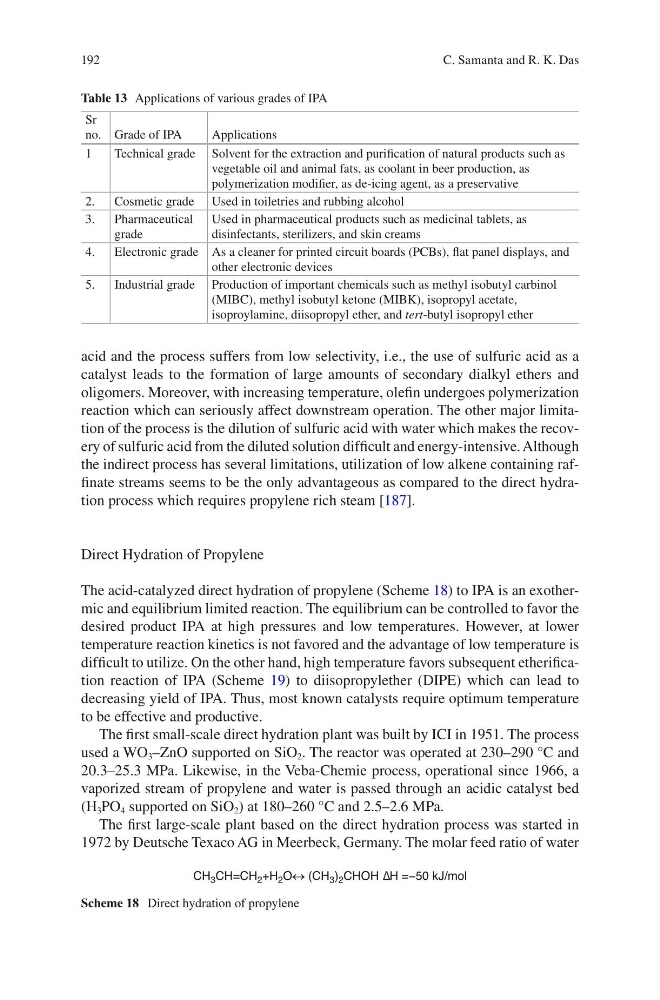
The acid-catalyzed direct hydration of propylene (Scheme 18) to IPA is an exothermic and equilibrium limited reaction. The equilibrium can be controlled to favor the
desired product IPA at high pressures and low temperatures. However, at lower
temperature reaction kinetics is not favored and the advantage of low temperature is
difficult to utilize. On the other hand, high temperature favors subsequent etherification reaction of IPA (Scheme 19) to diisopropylether (DIPE) which can lead to
decreasing yield of IPA. Thus, most known catalysts require optimum temperature
to be effective and productive.
The first small-scale direct hydration plant was built by ICI in 1951. The process
used a WO 3 –ZnO supported on SiO 2 . The reactor was operated at 230–290 °C and
20.3–25.3 MPa. Likewise, in the Veba-Chemie process, operational since 1966, a
vaporized stream of propylene and water is passed through an acidic catalyst bed
(H 3 PO 4 supported on SiO 2 ) at 180–260 °C and 2.5–2.6 MPa.
The first large-scale plant based on the direct hydration process was started in
1972 by Deutsche Texaco AG in Meerbeck, Germany. The molar feed ratio of water
Table 13 Applications of various grades of IPA
Sr
no. Grade of IPA
Applications
1
Technical grade Solvent for the extraction and purification of natural products such as
vegetable oil and animal fats, as coolant in beer production, as
polymerization modifier, as de-icing agent, as a preservative
2.
Cosmetic grade Used in toiletries and rubbing alcohol
3.
Pharmaceutical
grade
Used in pharmaceutical products such as medicinal tablets, as
disinfectants, sterilizers, and skin creams
4.
Electronic grade As a cleaner for printed circuit boards (PCBs), flat panel displays, and
other electronic devices
5.
Industrial grade Production of important chemicals such as methyl isobutyl carbinol
(MIBC), methyl isobutyl ketone (MIBK), isopropyl acetate,
isoproylamine, diisopropyl ether, and tert-butyl isopropyl ether
CH 3 CH=CH 2 +H 2 Ol (CH 3 ) 2 CHOH ∆H =−50 kJ/mol
Scheme 18 Direct hydration of propylene
C. Samanta and R. K. Das
acid and the process suffers from low selectivity, i.e., the use of sulfuric acid as a
catalyst leads to the formation of large amounts of secondary dialkyl ethers and
oligomers. Moreover, with increasing temperature, olefin undergoes polymerization
reaction which can seriously affect downstream operation. The other major limitation of the process is the dilution of sulfuric acid with water which makes the recovery of sulfuric acid from the diluted solution difficult and energy-intensive. Although
the indirect process has several limitations, utilization of low alkene containing raffinate streams seems to be the only advantageous as compared to the direct hydration process which requires propylene rich steam [187].
Direct Hydration of Propylene
The acid-catalyzed direct hydration of propylene (Scheme 18) to IPA is an exothermic and equilibrium limited reaction. The equilibrium can be controlled to favor the
desired product IPA at high pressures and low temperatures. However, at lower
temperature reaction kinetics is not favored and the advantage of low temperature is
difficult to utilize. On the other hand, high temperature favors subsequent etherification reaction of IPA (Scheme 19) to diisopropylether (DIPE) which can lead to
decreasing yield of IPA. Thus, most known catalysts require optimum temperature
to be effective and productive.
The first small-scale direct hydration plant was built by ICI in 1951. The process
used a WO 3 –ZnO supported on SiO 2 . The reactor was operated at 230–290 °C and
20.3–25.3 MPa. Likewise, in the Veba-Chemie process, operational since 1966, a
vaporized stream of propylene and water is passed through an acidic catalyst bed
(H 3 PO 4 supported on SiO 2 ) at 180–260 °C and 2.5–2.6 MPa.
The first large-scale plant based on the direct hydration process was started in
1972 by Deutsche Texaco AG in Meerbeck, Germany. The molar feed ratio of water
Table 13 Applications of various grades of IPA
Sr
no. Grade of IPA
Applications
1
Technical grade Solvent for the extraction and purification of natural products such as
vegetable oil and animal fats, as coolant in beer production, as
polymerization modifier, as de-icing agent, as a preservative
2.
Cosmetic grade Used in toiletries and rubbing alcohol
3.
Pharmaceutical
grade
Used in pharmaceutical products such as medicinal tablets, as
disinfectants, sterilizers, and skin creams
4.
Electronic grade As a cleaner for printed circuit boards (PCBs), flat panel displays, and
other electronic devices
5.
Industrial grade Production of important chemicals such as methyl isobutyl carbinol
(MIBC), methyl isobutyl ketone (MIBK), isopropyl acetate,
isoproylamine, diisopropyl ether, and tert-butyl isopropyl ether
CH 3 CH=CH 2 +H 2 Ol (CH 3 ) 2 CHOH ∆H =−50 kJ/mol
Scheme 18 Direct hydration of propylene
C. Samanta and R. K. Das