

191
4.4.1 Industrial Journey of IPA Production Processes
Indirect Hydration of Propylene
The indirect hydration of propylene was the only process for IPA production until
the first commercial direct-hydration process introduced in 1951 [186]. The indirect
hydration process consists of two steps (Schemes 16 and 17). The first step is the
reaction between propylene and sulfuric acid to produce monoisopropyl and diisopropyl sulfates followed by the reaction with water that hydrolyzes these intermediates into isopropyl alcohol. The first step involves the absorption of propylene-rich
gases into 85% sulfuric acid at 20–25 °C to form isopropyl hydrogen sulfate via the
addition of the acid across the double bond (Scheme 16).
In the indirect process, both reaction temperature and concentration of the acid
play an important role for the selective production of IPA. Higher concentration of
acid favors olefin absorption and higher temperature promote higher conversion. In
the subsequent step, hydrolysis of the intermediate monoester with water gives isopropanol and diluted sulfuric acid (Scheme 17). The second step is carried out in a
lead-lined vessel to counter corrosive nature of sulfuric acid.
The indirect hydration process has a serious operational and environmental
impact. Almost all units of the plant are subjected to the highly corrosive sulfuric
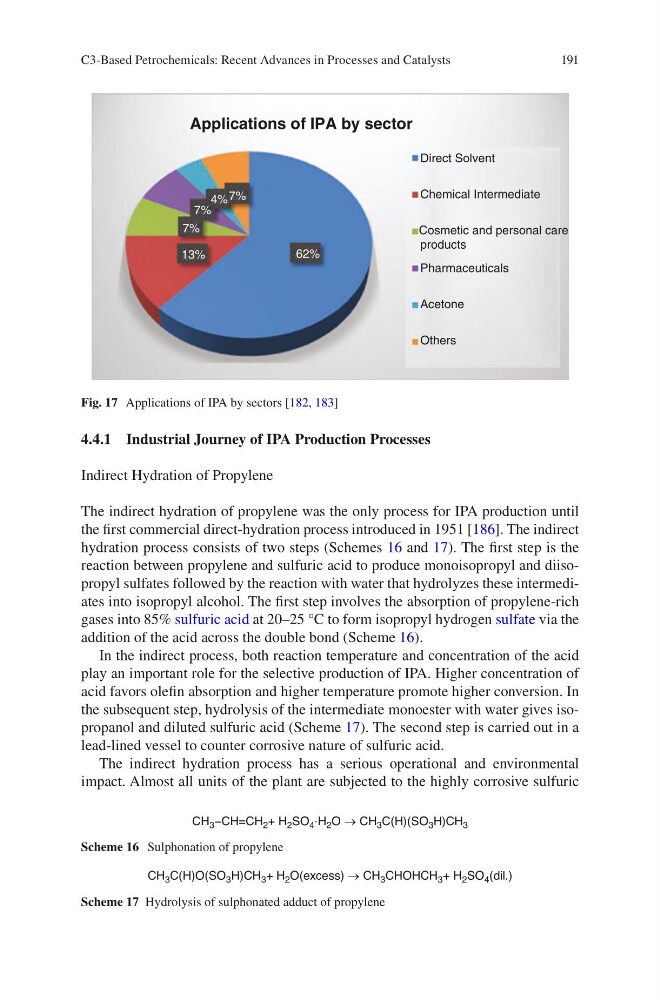
62%
13%
7%
7%
4% 7%
Applications of IPA by sector
Direct Solvent
Chemical Intermediate
Cosmetic and personal care
products
Pharmaceuticals
Acetone
Others
Fig. 17 Applications of IPA by sectors [182, 183]
CH 3 −CH=CH 2 + H 2 SO 4 . H 2 O o CH 3 C(H)(SO 3 H)CH 3
Scheme 16 Sulphonation of propylene
CH 3 C(H)O(SO 3 H)CH 3 + H 2 O(excess) o CH 3 CHOHCH 3 + H 2 SO 4 (dil.)
Scheme 17 Hydrolysis of sulphonated adduct of propylene
C3-Based Petrochemicals: Recent Advances in Processes and Catalysts
4.4.1 Industrial Journey of IPA Production Processes
Indirect Hydration of Propylene
The indirect hydration of propylene was the only process for IPA production until
the first commercial direct-hydration process introduced in 1951 [186]. The indirect
hydration process consists of two steps (Schemes 16 and 17). The first step is the
reaction between propylene and sulfuric acid to produce monoisopropyl and diisopropyl sulfates followed by the reaction with water that hydrolyzes these intermediates into isopropyl alcohol. The first step involves the absorption of propylene-rich
gases into 85% sulfuric acid at 20–25 °C to form isopropyl hydrogen sulfate via the
addition of the acid across the double bond (Scheme 16).
In the indirect process, both reaction temperature and concentration of the acid
play an important role for the selective production of IPA. Higher concentration of
acid favors olefin absorption and higher temperature promote higher conversion. In
the subsequent step, hydrolysis of the intermediate monoester with water gives isopropanol and diluted sulfuric acid (Scheme 17). The second step is carried out in a
lead-lined vessel to counter corrosive nature of sulfuric acid.
The indirect hydration process has a serious operational and environmental
impact. Almost all units of the plant are subjected to the highly corrosive sulfuric
62%
13%
7%
7%
4% 7%
Applications of IPA by sector
Direct Solvent
Chemical Intermediate
Cosmetic and personal care
products
Pharmaceuticals
Acetone
Others
Fig. 17 Applications of IPA by sectors [182, 183]
CH 3 −CH=CH 2 + H 2 SO 4 . H 2 O o CH 3 C(H)(SO 3 H)CH 3
Scheme 16 Sulphonation of propylene
CH 3 C(H)O(SO 3 H)CH 3 + H 2 O(excess) o CH 3 CHOHCH 3 + H 2 SO 4 (dil.)
Scheme 17 Hydrolysis of sulphonated adduct of propylene
C3-Based Petrochemicals: Recent Advances in Processes and Catalysts