

190
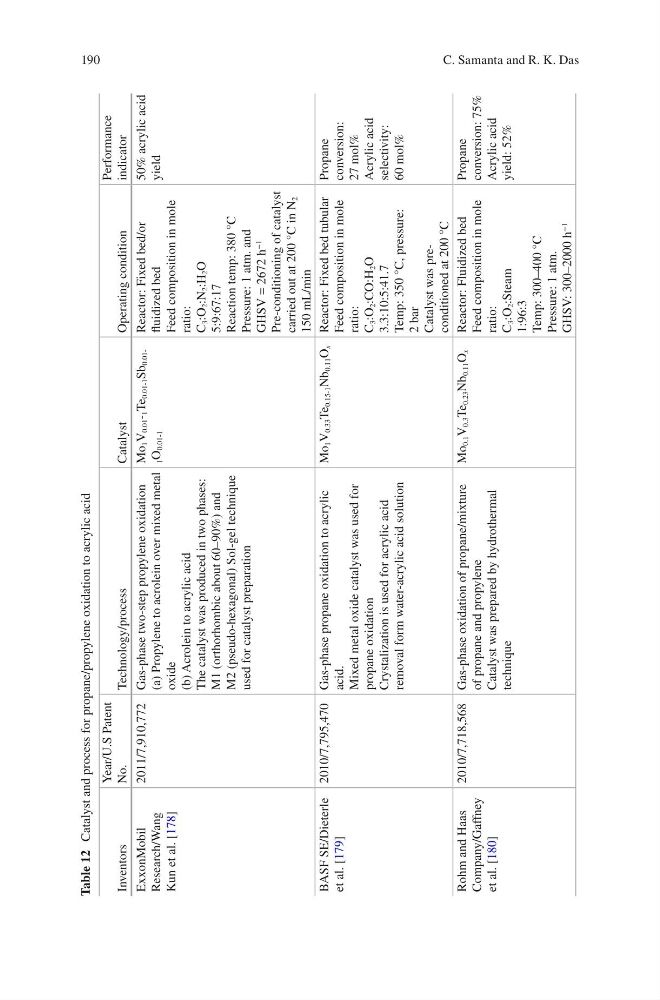
Table 12 Catalyst and process for propane/propylene oxidation to acrylic acid
Inventors
Year/U.S Patent
No.
Technology/process
Catalyst
Operating condition
Performance
indicator
ExxonMobil
Research/Wang
Kun et al. [178]
2011/7,910,772 Gas-phase two-step propylene oxidation
(a) Propylene to acrolein over mixed metal
oxide
(b) Acrolein to acrylic acid
The catalyst was produced in two phases:
M1 (orthorhombic about 60–90%) and
M2 (pseudo-hexagonal) Sol-gel technique
used for catalyst preparation
Mo
1 V
0.01 -
1 Te
0.01-1 Sb
0.011 O
0.01-1
Reactor: Fixed bed/or
fluidized bed
Feed composition in mole
ratio:
C
3 :O
2 :N
2 :H
2 O
5:9:67:17
Reaction temp: 380 °C
Pressure: 1 atm. and
GHSV = 2672 h
−1
Pre-conditioning of catalyst
carried out at 200 °C in N
2
150 mL/min
50% acrylic acid
yield
BASF SE/Dieterle
et al. [179]
2010/7,795,470 Gas-phase propane oxidation to acrylic
acid.
Mixed metal oxide catalyst was used for
propane oxidation
Crystalization is used for acrylic acid
removal form water-acrylic acid solution
Mo
1 V
0.33 Te
0.15-1 Nb
0.11 O
x
Reactor: Fixed bed tubular
Feed composition in mole
ratio:
C
3 :O
2 :CO:H
2 O
3.3:10:5:41.7
Temp: 350 °C, pressure:
2 bar
Catalyst was preconditioned at 200 °C
Propane
conversion:
27 mol%
Acrylic acid
selectivity:
60 mol%
Rohm and Haas
Company/Gaffney
et al. [180]
2010/7,718,568 Gas-phase oxidation of propane/mixture
of propane and propylene
Catalyst was prepared by hydrothermal
technique
Mo
0.1 V
0.3 Te
0.23 Nb
0.11 O
x
Reactor: Fluidized bed
Feed composition in mole
ratio:
C
3 :O
2 :Steam
1:96:3
Temp: 300–400 °C
Pressure: 1 atm.
GHSV: 300–2000 h
−1
Propane
conversion: 75%
Acrylic acid
yield: 52%
C. Samanta and R. K. Das
Table 12 Catalyst and process for propane/propylene oxidation to acrylic acid
Inventors
Year/U.S Patent
No.
Technology/process
Catalyst
Operating condition
Performance
indicator
ExxonMobil
Research/Wang
Kun et al. [178]
2011/7,910,772 Gas-phase two-step propylene oxidation
(a) Propylene to acrolein over mixed metal
oxide
(b) Acrolein to acrylic acid
The catalyst was produced in two phases:
M1 (orthorhombic about 60–90%) and
M2 (pseudo-hexagonal) Sol-gel technique
used for catalyst preparation
Mo
1 V
0.01 -
1 Te
0.01-1 Sb
0.011 O
0.01-1
Reactor: Fixed bed/or
fluidized bed
Feed composition in mole
ratio:
C
3 :O
2 :N
2 :H
2 O
5:9:67:17
Reaction temp: 380 °C
Pressure: 1 atm. and
GHSV = 2672 h
−1
Pre-conditioning of catalyst
carried out at 200 °C in N
2
150 mL/min
50% acrylic acid
yield
BASF SE/Dieterle
et al. [179]
2010/7,795,470 Gas-phase propane oxidation to acrylic
acid.
Mixed metal oxide catalyst was used for
propane oxidation
Crystalization is used for acrylic acid
removal form water-acrylic acid solution
Mo
1 V
0.33 Te
0.15-1 Nb
0.11 O
x
Reactor: Fixed bed tubular
Feed composition in mole
ratio:
C
3 :O
2 :CO:H
2 O
3.3:10:5:41.7
Temp: 350 °C, pressure:
2 bar
Catalyst was preconditioned at 200 °C
Propane
conversion:
27 mol%
Acrylic acid
selectivity:
60 mol%
Rohm and Haas
Company/Gaffney
et al. [180]
2010/7,718,568 Gas-phase oxidation of propane/mixture
of propane and propylene
Catalyst was prepared by hydrothermal
technique
Mo
0.1 V
0.3 Te
0.23 Nb
0.11 O
x
Reactor: Fluidized bed
Feed composition in mole
ratio:
C
3 :O
2 :Steam
1:96:3
Temp: 300–400 °C
Pressure: 1 atm.
GHSV: 300–2000 h
−1
Propane
conversion: 75%
Acrylic acid
yield: 52%
C. Samanta and R. K. Das