

178
during 1960–1995 for improving the catalyst stability and ACN yield ranging from
55% to 82%. In second-generation catalyst [112, 113], ACN yield was improved
from 55% to 65% by introducing redox element Fe into the bi-phosphomolybdates
(first- generation catalyst). Though ammoxidation yield improvement was significant in second-generation catalyst, at high O 2 partial pressure, Fe 2 Mo 3 O 12 was produced from the catalyst system which promoted overoxidation of propylene
(complete combustion to CO x ). To circumvent such an issue, redox chemistry was
re-thought and divalent element such as Ni, Co, and alkali metal such as K was
incorporated into the structure to prepare first multiphase catalyst system for ammoxidation reaction. The yield was improved significantly to 75–79% (commercial
yield 75%). Fe(II) is stabilized in presence of divalent Ni(II) and Co(II) at oxidizing
condition. From stabilized iron-molybdate, oxygen is dissociated, incorporated, and
transmitted in lattice site for effective ammoxidation reaction. Alkali is incorporated
to kill the surface acidity and thereby acrylonitrile selectivity improvement is
achieved. Accordingly, several multicomponent mixed oxide catalyst developed by
SOHIO from 1969 to 1995 and acrylonitrile yield reached to >80% [114–117].
Interestingly, the seventh and subsequent generation of catalysts are still based on
Bi 2 O 3 ·MoO 3 , but the catalyst system is much more complex than the first generation
and are based on multicomponent, multiphase catalytic system, e.g., (K,Cs)
(Ni,Co,Mg,Mn)(Fe,Cr)BiMoO. The advanced catalysts can give about 83% acrylonitrile yield and with catalyst life of about 10 years. It is interesting to mention that
although the current catalyst can offer 83% yield of acrylonitrile, there is still room
for further improvement since the thermodynamic limit can yield 100% acrylonitrile [104].
Notably, most of the commercial catalyst comprises bi-phosphomolybdates as an
active component. Without bismuth, catalytic activity was not obtained. Montedison
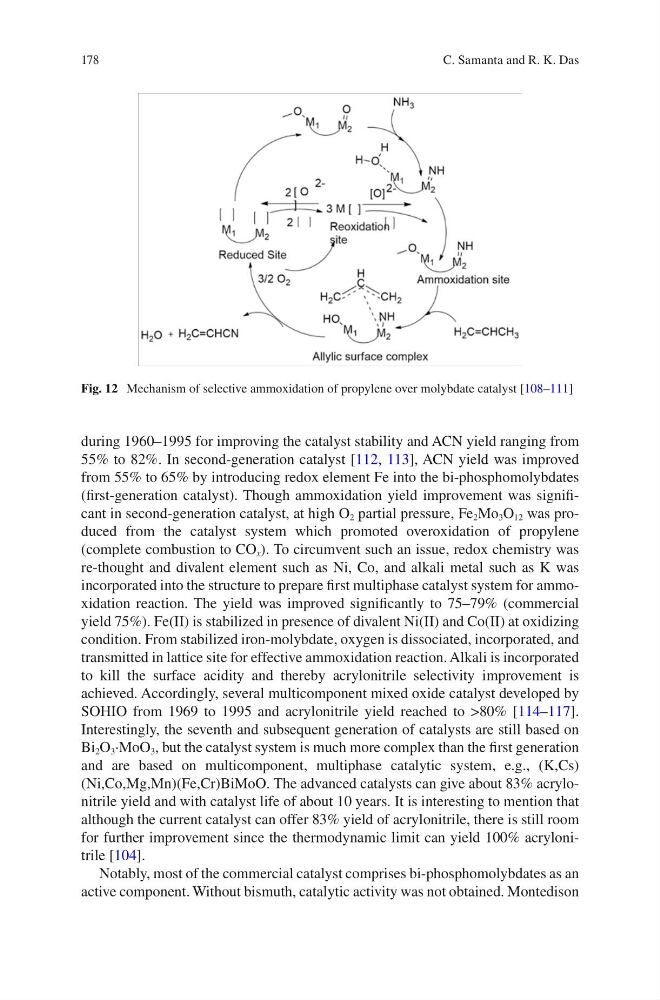
Fig. 12 Mechanism of selective ammoxidation of propylene over molybdate catalyst [108–111]
C. Samanta and R. K. Das
during 1960–1995 for improving the catalyst stability and ACN yield ranging from
55% to 82%. In second-generation catalyst [112, 113], ACN yield was improved
from 55% to 65% by introducing redox element Fe into the bi-phosphomolybdates
(first- generation catalyst). Though ammoxidation yield improvement was significant in second-generation catalyst, at high O 2 partial pressure, Fe 2 Mo 3 O 12 was produced from the catalyst system which promoted overoxidation of propylene
(complete combustion to CO x ). To circumvent such an issue, redox chemistry was
re-thought and divalent element such as Ni, Co, and alkali metal such as K was
incorporated into the structure to prepare first multiphase catalyst system for ammoxidation reaction. The yield was improved significantly to 75–79% (commercial
yield 75%). Fe(II) is stabilized in presence of divalent Ni(II) and Co(II) at oxidizing
condition. From stabilized iron-molybdate, oxygen is dissociated, incorporated, and
transmitted in lattice site for effective ammoxidation reaction. Alkali is incorporated
to kill the surface acidity and thereby acrylonitrile selectivity improvement is
achieved. Accordingly, several multicomponent mixed oxide catalyst developed by
SOHIO from 1969 to 1995 and acrylonitrile yield reached to >80% [114–117].
Interestingly, the seventh and subsequent generation of catalysts are still based on
Bi 2 O 3 ·MoO 3 , but the catalyst system is much more complex than the first generation
and are based on multicomponent, multiphase catalytic system, e.g., (K,Cs)
(Ni,Co,Mg,Mn)(Fe,Cr)BiMoO. The advanced catalysts can give about 83% acrylonitrile yield and with catalyst life of about 10 years. It is interesting to mention that
although the current catalyst can offer 83% yield of acrylonitrile, there is still room
for further improvement since the thermodynamic limit can yield 100% acrylonitrile [104].
Notably, most of the commercial catalyst comprises bi-phosphomolybdates as an
active component. Without bismuth, catalytic activity was not obtained. Montedison
Fig. 12 Mechanism of selective ammoxidation of propylene over molybdate catalyst [108–111]
C. Samanta and R. K. Das