

179
Corporation developed Te-molybdate-based catalyst [118–120]. However, the volatility of Te made the catalyst system commercially less important [104].
Apart from molybdate, there is few commercial success with antimonite-based
catalyst for propylene ammoxidation. Non-radioactive uranium-based antimonate
catalyst system [121–124] was also developed by SOHIO in late 1960 and ACN
yield was higher than firsst- and second-generation catalyst. However, the catalyst
was phased out later in 1970 due to the residual radioactivity and heavy uranium
contamination. Fe-based antimonate [125] is also somewhat successful commercially; however, loss of antimony from the catalyst is the reason for the low popularity. Another multicomponent antimonate-based ammoxidation catalyst [126] is
used in commercial unit by Nitto Corporation. However, for SOHIO process (now
BP), so far bi-phosphomolybdates remain the dominant ammoxidation catalyst.
Even with the most sophisticated multicomponent Bi-Mo-O x catalysts (SOHIO
Catalyst-49 and C-49-C) the acrylonitrile yields lie between 80% and 82%, because
of the unavoidable high number of by-products generated from the undesired reactions at the complete conversion of propylene.
4.2.3 Emerging Alternatives: Propane Ammoxidation and Its Catalyst
Since propane is a readily available and inexpensive feedstock than propylene, the
obvious choice for ACN production would be based on propane. However, propane
is a thermodynamically stable molecule than propylene and requires improved catalyst or higher operating temperature for its activation. Several companies such as
Asahi, Mitsubishi, and BP chemicals have been developing the propane ammoxidation process as a replacement to propylene ammoxidation process. Two routes can
be employed for technological development for propane ammoxidation: (a) propane
dehydrogenation followed by traditional ACN production through SOHIO process:
integration of two-step process, (b) direct ammoxidation of propane. However, propane dehydrogenation is expensive and thus integration of dehydrogenation and
ammoxidation is a major bottleneck to the solution. Naturally direct ammoxidation
of propane is more attractive choice to the researcher across the globe.
BP commissioned a demonstration plant in 1997 for making acrylonitrile using
propane as feedstock and as per the company’s estimation, it could reduce the production cost further by at least 20% in comparison to propylene-based ammoxidation [127]. The major limiting step for this process is to activate propane for
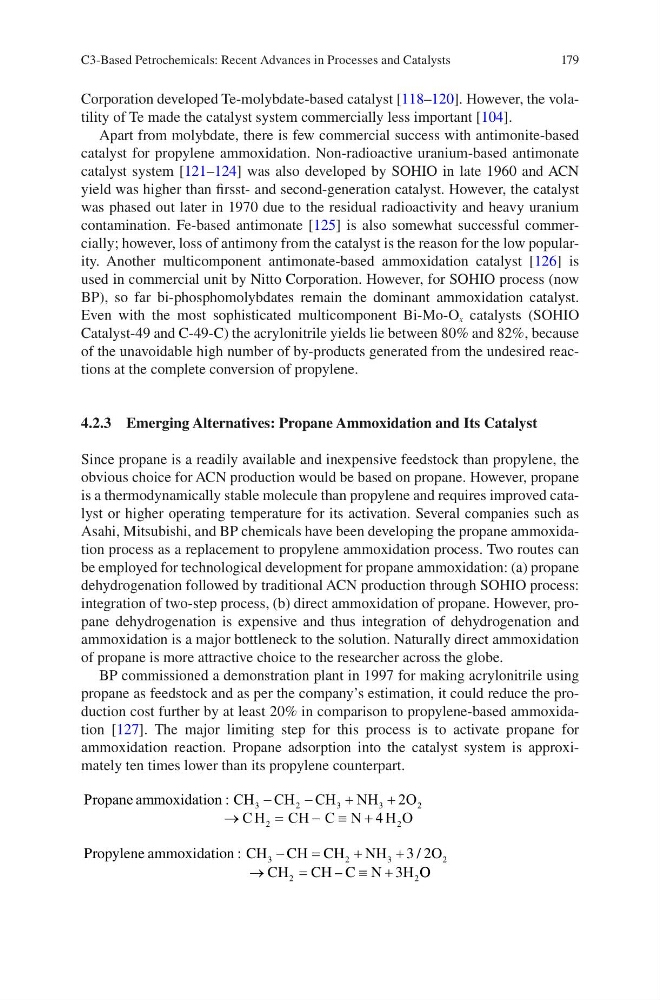
ammoxidation reaction. Propane adsorption into the catalyst system is approximately ten times lower than its propylene counterpart.
Propane ammoxidation : CH CH CH NH 2O
C H
CH C
HO
3
2
3
3
2
2
2
−
−
+
+
→
=
− ≡ Ν + 4
Propylene ammoxidation : CH
CH NH 3 / 2O
CH CH
3H
3
2
3
2
2
2
−
=
+
+
→
=
≡ +
CH
C N
–
O
O
C3-Based Petrochemicals: Recent Advances in Processes and Catalysts
Corporation developed Te-molybdate-based catalyst [118–120]. However, the volatility of Te made the catalyst system commercially less important [104].
Apart from molybdate, there is few commercial success with antimonite-based
catalyst for propylene ammoxidation. Non-radioactive uranium-based antimonate
catalyst system [121–124] was also developed by SOHIO in late 1960 and ACN
yield was higher than firsst- and second-generation catalyst. However, the catalyst
was phased out later in 1970 due to the residual radioactivity and heavy uranium
contamination. Fe-based antimonate [125] is also somewhat successful commercially; however, loss of antimony from the catalyst is the reason for the low popularity. Another multicomponent antimonate-based ammoxidation catalyst [126] is
used in commercial unit by Nitto Corporation. However, for SOHIO process (now
BP), so far bi-phosphomolybdates remain the dominant ammoxidation catalyst.
Even with the most sophisticated multicomponent Bi-Mo-O x catalysts (SOHIO
Catalyst-49 and C-49-C) the acrylonitrile yields lie between 80% and 82%, because
of the unavoidable high number of by-products generated from the undesired reactions at the complete conversion of propylene.
4.2.3 Emerging Alternatives: Propane Ammoxidation and Its Catalyst
Since propane is a readily available and inexpensive feedstock than propylene, the
obvious choice for ACN production would be based on propane. However, propane
is a thermodynamically stable molecule than propylene and requires improved catalyst or higher operating temperature for its activation. Several companies such as
Asahi, Mitsubishi, and BP chemicals have been developing the propane ammoxidation process as a replacement to propylene ammoxidation process. Two routes can
be employed for technological development for propane ammoxidation: (a) propane
dehydrogenation followed by traditional ACN production through SOHIO process:
integration of two-step process, (b) direct ammoxidation of propane. However, propane dehydrogenation is expensive and thus integration of dehydrogenation and
ammoxidation is a major bottleneck to the solution. Naturally direct ammoxidation
of propane is more attractive choice to the researcher across the globe.
BP commissioned a demonstration plant in 1997 for making acrylonitrile using
propane as feedstock and as per the company’s estimation, it could reduce the production cost further by at least 20% in comparison to propylene-based ammoxidation [127]. The major limiting step for this process is to activate propane for
ammoxidation reaction. Propane adsorption into the catalyst system is approximately ten times lower than its propylene counterpart.
Propane ammoxidation : CH CH CH NH 2O
C H
CH C
HO
3
2
3
3
2
2
2
−
−
+
+
→
=
− ≡ Ν + 4
Propylene ammoxidation : CH
CH NH 3 / 2O
CH CH
3H
3
2
3
2
2
2
−
=
+
+
→
=
≡ +
CH
C N
–
O
O
C3-Based Petrochemicals: Recent Advances in Processes and Catalysts