

177
Table 7 Various molybdate-based commercial catalysts and their performance in acrylonitrile
production
Improvement of
catalyst’s version
Catalyst formulation
Acrylonitrile yield
(%)
1st generation
(1960–1963)
Bi 9 PMo 12 O 52 (50% support)
55
2nd generation
(1963–1965)
Fe 4.5 Bi 4.5 PMo 12 O 52 -SiO 2 (50% support)
65
Advanced multicomponent catalyst:
1. 1969–1970
1. K 0.1 (Ni, Co) 9 Fe 3 BiPMo 12 O 3 -SiO 2 (50%
support)
75
2. 1975–1991
2. (K, Cs) 0.15 (Ni, Co, Mn) 8 (Fe, Cr) 2.5 BiMo 13.2 O x -
SiO 2 (50% support)
78–80
3. 1992–1995
3. (K, Cs) 0.15 (Ni, Mg, Mn) 7.5 (Fe,
Cr) 2.3 Bi 0.5 Mo 12 O x -SiO 2 (50% support)
>80
Table 8 Various antimonate-based commercial catalyst and the yield of acrylonitrile
Improvement of
catalyst’s version
Catalyst formulation
Acrylonitrile
yield (%)
Early catalyst
Fe 4.5 Sb 8.6 O x -supported with 40% SiO 2
65
USb 4.6 O x -supported with 40% SiO 2
70
Advanced
multicomponent catalyst
Na 0.3 (Cu, Mg, Zn, Ni) 0-4 (v, W) 0.5-1 Mo 0.5–2.5 Te 0.25 Fe 10 Sb 13- 20 O x supported with 40% SiO 2
75
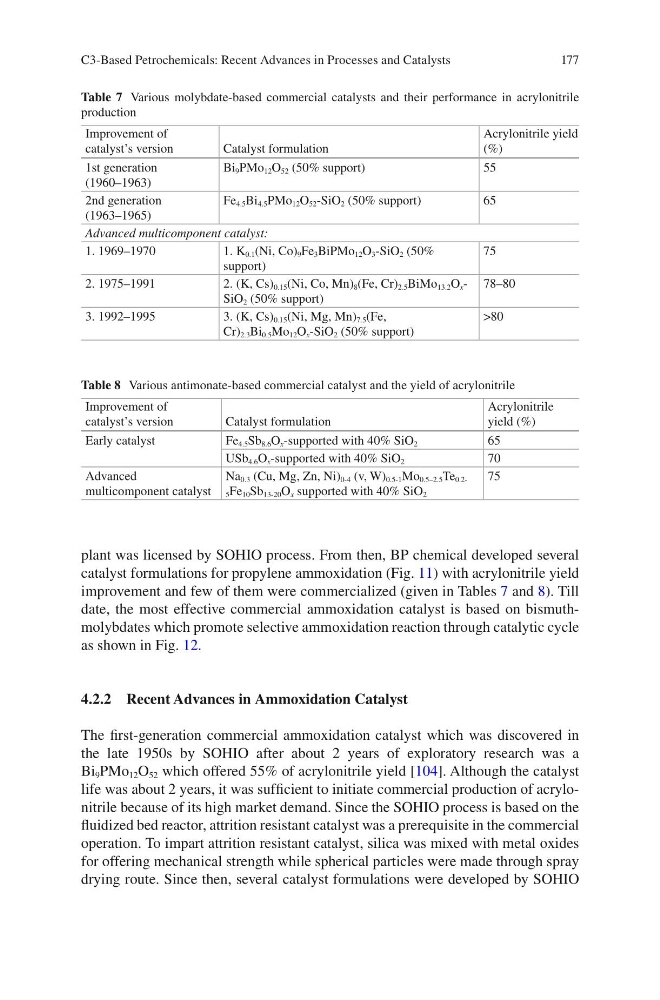
plant was licensed by SOHIO process. From then, BP chemical developed several
catalyst formulations for propylene ammoxidation (Fig. 11) with acrylonitrile yield
improvement and few of them were commercialized (given in Tables 7 and 8). Till
date, the most effective commercial ammoxidation catalyst is based on bismuthmolybdates which promote selective ammoxidation reaction through catalytic cycle
as shown in Fig. 12.
4.2.2 Recent Advances in Ammoxidation Catalyst
The first-generation commercial ammoxidation catalyst which was discovered in
the late 1950s by SOHIO after about 2 years of exploratory research was a
Bi 9 PMo 12 O 52 which offered 55% of acrylonitrile yield [104]. Although the catalyst
life was about 2 years, it was sufficient to initiate commercial production of acrylonitrile because of its high market demand. Since the SOHIO process is based on the
fluidized bed reactor, attrition resistant catalyst was a prerequisite in the commercial
operation. To impart attrition resistant catalyst, silica was mixed with metal oxides
for offering mechanical strength while spherical particles were made through spray
drying route. Since then, several catalyst formulations were developed by SOHIO
C3-Based Petrochemicals: Recent Advances in Processes and Catalysts
Table 7 Various molybdate-based commercial catalysts and their performance in acrylonitrile
production
Improvement of
catalyst’s version
Catalyst formulation
Acrylonitrile yield
(%)
1st generation
(1960–1963)
Bi 9 PMo 12 O 52 (50% support)
55
2nd generation
(1963–1965)
Fe 4.5 Bi 4.5 PMo 12 O 52 -SiO 2 (50% support)
65
Advanced multicomponent catalyst:
1. 1969–1970
1. K 0.1 (Ni, Co) 9 Fe 3 BiPMo 12 O 3 -SiO 2 (50%
support)
75
2. 1975–1991
2. (K, Cs) 0.15 (Ni, Co, Mn) 8 (Fe, Cr) 2.5 BiMo 13.2 O x -
SiO 2 (50% support)
78–80
3. 1992–1995
3. (K, Cs) 0.15 (Ni, Mg, Mn) 7.5 (Fe,
Cr) 2.3 Bi 0.5 Mo 12 O x -SiO 2 (50% support)
>80
Table 8 Various antimonate-based commercial catalyst and the yield of acrylonitrile
Improvement of
catalyst’s version
Catalyst formulation
Acrylonitrile
yield (%)
Early catalyst
Fe 4.5 Sb 8.6 O x -supported with 40% SiO 2
65
USb 4.6 O x -supported with 40% SiO 2
70
Advanced
multicomponent catalyst
Na 0.3 (Cu, Mg, Zn, Ni) 0-4 (v, W) 0.5-1 Mo 0.5–2.5 Te 0.25 Fe 10 Sb 13- 20 O x supported with 40% SiO 2
75
plant was licensed by SOHIO process. From then, BP chemical developed several
catalyst formulations for propylene ammoxidation (Fig. 11) with acrylonitrile yield
improvement and few of them were commercialized (given in Tables 7 and 8). Till
date, the most effective commercial ammoxidation catalyst is based on bismuthmolybdates which promote selective ammoxidation reaction through catalytic cycle
as shown in Fig. 12.
4.2.2 Recent Advances in Ammoxidation Catalyst
The first-generation commercial ammoxidation catalyst which was discovered in
the late 1950s by SOHIO after about 2 years of exploratory research was a
Bi 9 PMo 12 O 52 which offered 55% of acrylonitrile yield [104]. Although the catalyst
life was about 2 years, it was sufficient to initiate commercial production of acrylonitrile because of its high market demand. Since the SOHIO process is based on the
fluidized bed reactor, attrition resistant catalyst was a prerequisite in the commercial
operation. To impart attrition resistant catalyst, silica was mixed with metal oxides
for offering mechanical strength while spherical particles were made through spray
drying route. Since then, several catalyst formulations were developed by SOHIO
C3-Based Petrochemicals: Recent Advances in Processes and Catalysts