

163
olefin cracking process (OCP). OCP process takes the heavier olefins from the MTO
unit and converts them into lighter olefins, particularly to propylene. UOP-Total has
started licensing integrated MTO/OCP process. Various features of commercial
MTO/MTP process, their operating conditions, reactor system, and catalyst system
used are given in Table 4 [55]. MTP process has advantage of producing polymer
grade propylene independent of feedstock, the process also allows in situ regeneration of catalyst and thereby offers continuous operation and minimum downtime.
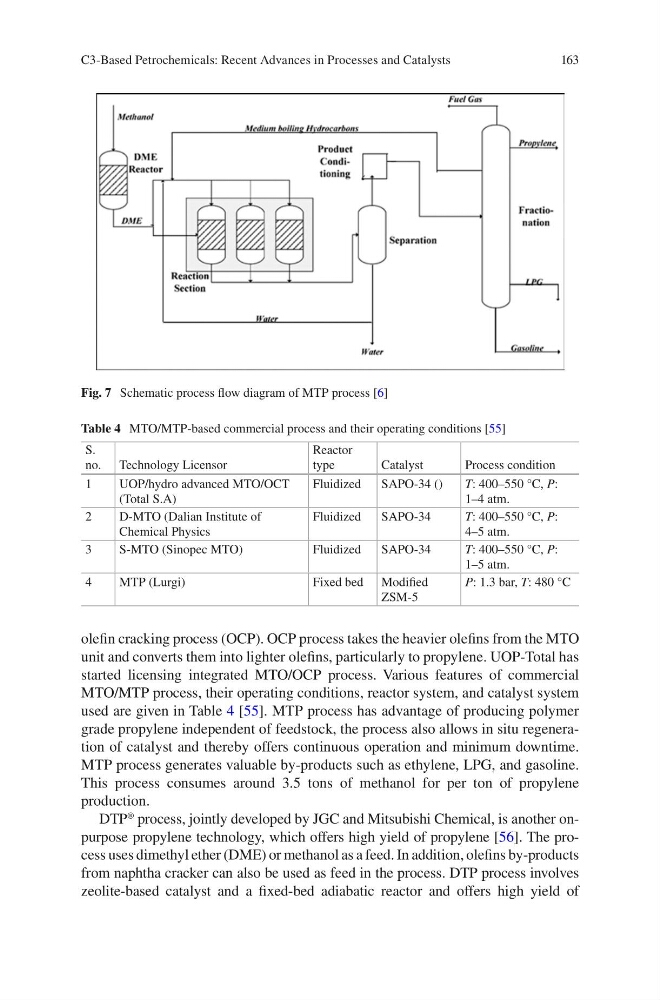
MTP process generates valuable by-products such as ethylene, LPG, and gasoline.
This process consumes around 3.5 tons of methanol for per ton of propylene
production.
DTP
®
process, jointly developed by JGC and Mitsubishi Chemical, is another onpurpose propylene technology, which offers high yield of propylene [56]. The process uses dimethyl ether (DME) or methanol as a feed. In addition, olefins by- products
from naphtha cracker can also be used as feed in the process. DTP process involves
zeolite-based catalyst and a fixed-bed adiabatic reactor and offers high yield of
Fig. 7 Schematic process flow diagram of MTP process [6]
Table 4 MTO/MTP-based commercial process and their operating conditions [55]
S.
no. Technology Licensor
Reactor
type
Catalyst
Process condition
1
UOP/hydro advanced MTO/OCT
(Total S.A)
Fluidized
SAPO-34 ()
T: 400–550 °C, P:
1–4 atm.
2
D-MTO (Dalian Institute of
Chemical Physics
Fluidized
SAPO-34
T: 400–550 °C, P:
4–5 atm.
3
S-MTO (Sinopec MTO)
Fluidized
SAPO-34
T: 400–550 °C, P:
1–5 atm.
4
MTP (Lurgi)
Fixed bed Modified
ZSM-5
P: 1.3 bar, T: 480 °C
C3-Based Petrochemicals: Recent Advances in Processes and Catalysts
olefin cracking process (OCP). OCP process takes the heavier olefins from the MTO
unit and converts them into lighter olefins, particularly to propylene. UOP-Total has
started licensing integrated MTO/OCP process. Various features of commercial
MTO/MTP process, their operating conditions, reactor system, and catalyst system
used are given in Table 4 [55]. MTP process has advantage of producing polymer
grade propylene independent of feedstock, the process also allows in situ regeneration of catalyst and thereby offers continuous operation and minimum downtime.
MTP process generates valuable by-products such as ethylene, LPG, and gasoline.
This process consumes around 3.5 tons of methanol for per ton of propylene
production.
DTP
®
process, jointly developed by JGC and Mitsubishi Chemical, is another onpurpose propylene technology, which offers high yield of propylene [56]. The process uses dimethyl ether (DME) or methanol as a feed. In addition, olefins by- products
from naphtha cracker can also be used as feed in the process. DTP process involves
zeolite-based catalyst and a fixed-bed adiabatic reactor and offers high yield of
Fig. 7 Schematic process flow diagram of MTP process [6]
Table 4 MTO/MTP-based commercial process and their operating conditions [55]
S.
no. Technology Licensor
Reactor
type
Catalyst
Process condition
1
UOP/hydro advanced MTO/OCT
(Total S.A)
Fluidized
SAPO-34 ()
T: 400–550 °C, P:
1–4 atm.
2
D-MTO (Dalian Institute of
Chemical Physics
Fluidized
SAPO-34
T: 400–550 °C, P:
4–5 atm.
3
S-MTO (Sinopec MTO)
Fluidized
SAPO-34
T: 400–550 °C, P:
1–5 atm.
4
MTP (Lurgi)
Fixed bed Modified
ZSM-5
P: 1.3 bar, T: 480 °C
C3-Based Petrochemicals: Recent Advances in Processes and Catalysts