

164
propylene with hydrocarbon recycling. DTP
®
technology has been demonstrated at
Mitsubishi Chemical’s Mizushima Plant. Various features of commercial MTO/MTP
processes [57–59] and their operating condition are summarized in Table 4.
3 Commercial Propylene Production with Feed Suitability
In summary, all the propylene production processes have its own merits and demerits for producing propylene in commercial scale. Since the on-purpose production
route is taking frontline to reduce the gap between the world propylene demand and
its supply, various feedstocks such as naphtha, light olefins (ethylene and butene),
propane, and methanol (oxygenates) are being valorized based on the availability of
the feedstocks by various selective processes for high purity propylene production.
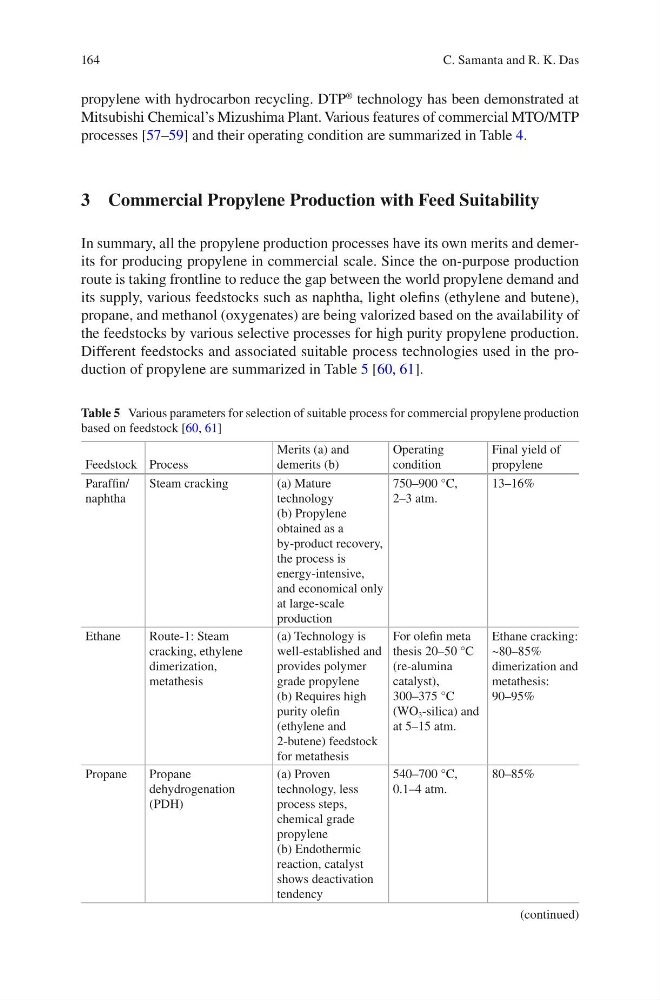
Different feedstocks and associated suitable process technologies used in the production of propylene are summarized in Table 5 [60, 61].
Table 5 Various parameters for selection of suitable process for commercial propylene production
based on feedstock [60, 61]
Feedstock Process
Merits (a) and
demerits (b)
Operating
condition
Final yield of
propylene
Paraffin/
naphtha
Steam cracking
(a) Mature
technology
(b) Propylene
obtained as a
by-product recovery,
the process is
energy-intensive,
and economical only
at large-scale
production
750–900 °C,
2–3 atm.
13–16%
Ethane
Route-1: Steam
cracking, ethylene
dimerization,
metathesis
(a) Technology is
well-established and
provides polymer
grade propylene
(b) Requires high
purity olefin
(ethylene and
2-butene) feedstock
for metathesis
For olefin meta
thesis 20–50 °C
(re-alumina
catalyst),
300–375 °C
(WO 3 -silica) and
at 5–15 atm.
Ethane cracking:
~80–85%
dimerization and
metathesis:
90–95%
Propane
Propane
dehydrogenation
(PDH)
(a) Proven
technology, less
process steps,
chemical grade
propylene
(b) Endothermic
reaction, catalyst
shows deactivation
tendency
540–700 °C,
0.1–4 atm.
80–85%
(continued)
C. Samanta and R. K. Das
propylene with hydrocarbon recycling. DTP
®
technology has been demonstrated at
Mitsubishi Chemical’s Mizushima Plant. Various features of commercial MTO/MTP
processes [57–59] and their operating condition are summarized in Table 4.
3 Commercial Propylene Production with Feed Suitability
In summary, all the propylene production processes have its own merits and demerits for producing propylene in commercial scale. Since the on-purpose production
route is taking frontline to reduce the gap between the world propylene demand and
its supply, various feedstocks such as naphtha, light olefins (ethylene and butene),
propane, and methanol (oxygenates) are being valorized based on the availability of
the feedstocks by various selective processes for high purity propylene production.
Different feedstocks and associated suitable process technologies used in the production of propylene are summarized in Table 5 [60, 61].
Table 5 Various parameters for selection of suitable process for commercial propylene production
based on feedstock [60, 61]
Feedstock Process
Merits (a) and
demerits (b)
Operating
condition
Final yield of
propylene
Paraffin/
naphtha
Steam cracking
(a) Mature
technology
(b) Propylene
obtained as a
by-product recovery,
the process is
energy-intensive,
and economical only
at large-scale
production
750–900 °C,
2–3 atm.
13–16%
Ethane
Route-1: Steam
cracking, ethylene
dimerization,
metathesis
(a) Technology is
well-established and
provides polymer
grade propylene
(b) Requires high
purity olefin
(ethylene and
2-butene) feedstock
for metathesis
For olefin meta
thesis 20–50 °C
(re-alumina
catalyst),
300–375 °C
(WO 3 -silica) and
at 5–15 atm.
Ethane cracking:
~80–85%
dimerization and
metathesis:
90–95%
Propane
Propane
dehydrogenation
(PDH)
(a) Proven
technology, less
process steps,
chemical grade
propylene
(b) Endothermic
reaction, catalyst
shows deactivation
tendency
540–700 °C,
0.1–4 atm.
80–85%
(continued)
C. Samanta and R. K. Das