

162
system, (b) catalyst regeneration section, and (c) production separation section for
separating propylene from ethylene and heavier hydrocarbon (C4 or above). Catalyst
in fluidized reactor undergoes an acid-catalyzed reaction at 400–500 °C and
0.1–0.3 MPa pressure and the reaction is exothermic in nature. Both S-MTO and
D-MTO/D-MTO-II technology uses SAPO-34-based zeolite catalyst system and
the major difference in the technological front is that S-MTO process uses novel
type of SAPO-34 which can maximize propylene over ethylene production by modifying the zeolite’s pore. About 43% of propylene yield can be achieved through
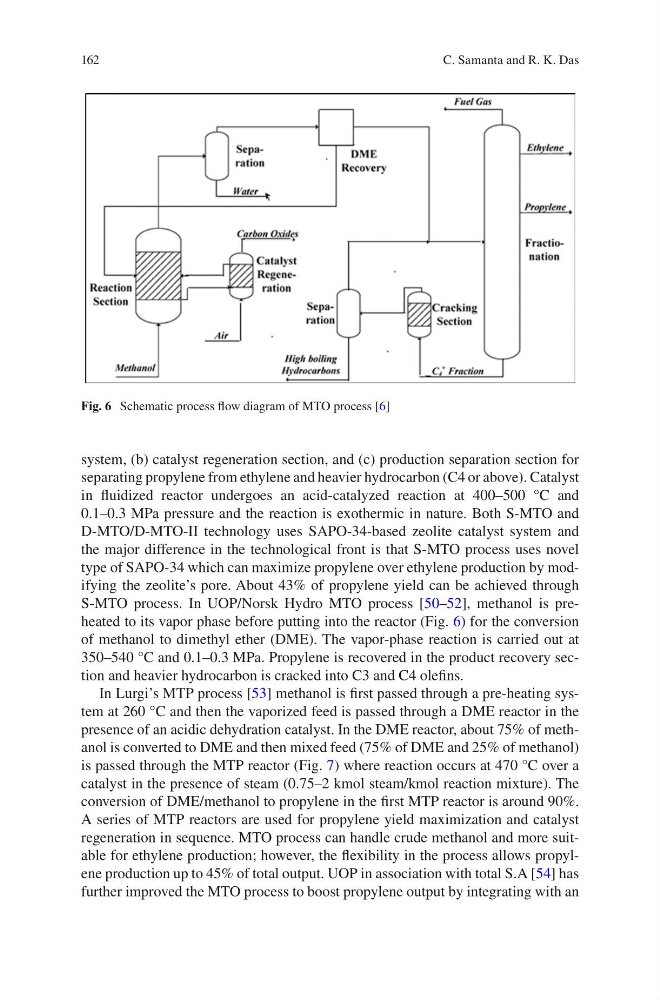
S-MTO process. In UOP/Norsk Hydro MTO process [50–52], methanol is preheated to its vapor phase before putting into the reactor (Fig. 6) for the conversion
of methanol to dimethyl ether (DME). The vapor-phase reaction is carried out at
350–540 °C and 0.1–0.3 MPa. Propylene is recovered in the product recovery section and heavier hydrocarbon is cracked into C3 and C4 olefins.
In Lurgi’s MTP process [53] methanol is first passed through a pre-heating system at 260 °C and then the vaporized feed is passed through a DME reactor in the
presence of an acidic dehydration catalyst. In the DME reactor, about 75% of methanol is converted to DME and then mixed feed (75% of DME and 25% of methanol)
is passed through the MTP reactor (Fig. 7) where reaction occurs at 470 °C over a
catalyst in the presence of steam (0.75–2 kmol steam/kmol reaction mixture). The
conversion of DME/methanol to propylene in the first MTP reactor is around 90%.
A series of MTP reactors are used for propylene yield maximization and catalyst
regeneration in sequence. MTO process can handle crude methanol and more suitable for ethylene production; however, the flexibility in the process allows propylene production up to 45% of total output. UOP in association with total S.A [54] has
further improved the MTO process to boost propylene output by integrating with an
Fig. 6 Schematic process flow diagram of MTO process [6]
C. Samanta and R. K. Das
system, (b) catalyst regeneration section, and (c) production separation section for
separating propylene from ethylene and heavier hydrocarbon (C4 or above). Catalyst
in fluidized reactor undergoes an acid-catalyzed reaction at 400–500 °C and
0.1–0.3 MPa pressure and the reaction is exothermic in nature. Both S-MTO and
D-MTO/D-MTO-II technology uses SAPO-34-based zeolite catalyst system and
the major difference in the technological front is that S-MTO process uses novel
type of SAPO-34 which can maximize propylene over ethylene production by modifying the zeolite’s pore. About 43% of propylene yield can be achieved through
S-MTO process. In UOP/Norsk Hydro MTO process [50–52], methanol is preheated to its vapor phase before putting into the reactor (Fig. 6) for the conversion
of methanol to dimethyl ether (DME). The vapor-phase reaction is carried out at
350–540 °C and 0.1–0.3 MPa. Propylene is recovered in the product recovery section and heavier hydrocarbon is cracked into C3 and C4 olefins.
In Lurgi’s MTP process [53] methanol is first passed through a pre-heating system at 260 °C and then the vaporized feed is passed through a DME reactor in the
presence of an acidic dehydration catalyst. In the DME reactor, about 75% of methanol is converted to DME and then mixed feed (75% of DME and 25% of methanol)
is passed through the MTP reactor (Fig. 7) where reaction occurs at 470 °C over a
catalyst in the presence of steam (0.75–2 kmol steam/kmol reaction mixture). The
conversion of DME/methanol to propylene in the first MTP reactor is around 90%.
A series of MTP reactors are used for propylene yield maximization and catalyst
regeneration in sequence. MTO process can handle crude methanol and more suitable for ethylene production; however, the flexibility in the process allows propylene production up to 45% of total output. UOP in association with total S.A [54] has
further improved the MTO process to boost propylene output by integrating with an
Fig. 6 Schematic process flow diagram of MTO process [6]
C. Samanta and R. K. Das