

161
2-butene-dominated feed (90% 2-butene) in presence of Phillip’s nickel-based
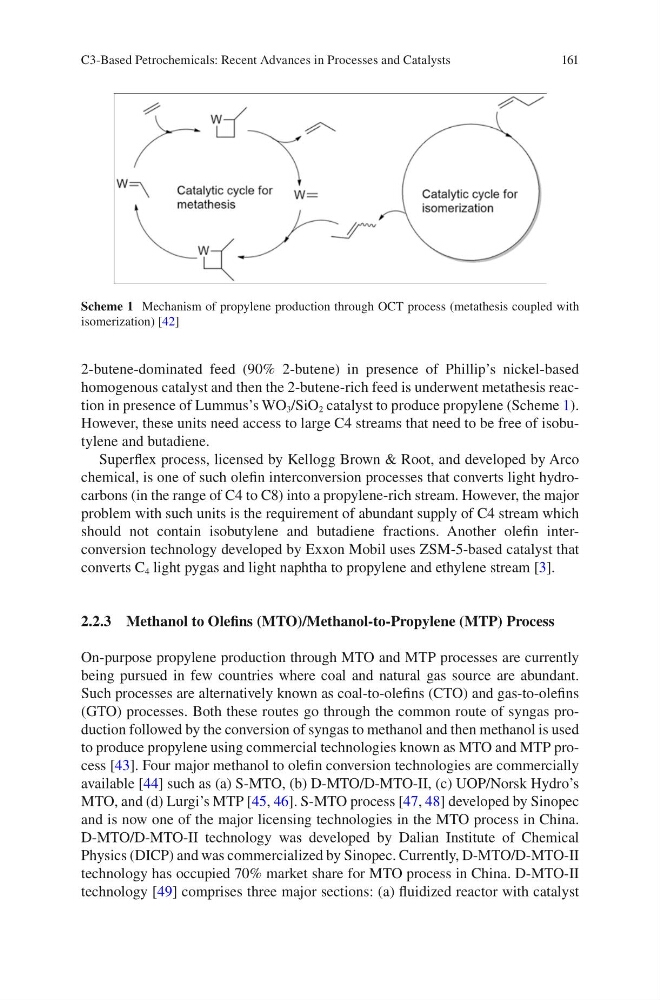
homogenous catalyst and then the 2-butene-rich feed is underwent metathesis reaction in presence of Lummus’s WO 3 /SiO 2 catalyst to produce propylene (Scheme 1).
However, these units need access to large C4 streams that need to be free of isobutylene and butadiene.
Superflex process, licensed by Kellogg Brown & Root, and developed by Arco
chemical, is one of such olefin interconversion processes that converts light hydrocarbons (in the range of C4 to C8) into a propylene-rich stream. However, the major
problem with such units is the requirement of abundant supply of C4 stream which
should not contain isobutylene and butadiene fractions. Another olefin interconversion technology developed by Exxon Mobil uses ZSM-5-based catalyst that
converts C 4 light pygas and light naphtha to propylene and ethylene stream [3].
2.2.3 Methanol to Olefins (MTO)/Methanol-to-Propylene (MTP) Process
On-purpose propylene production through MTO and MTP processes are currently
being pursued in few countries where coal and natural gas source are abundant.
Such processes are alternatively known as coal-to-olefins (CTO) and gas-to-olefins
(GTO) processes. Both these routes go through the common route of syngas production followed by the conversion of syngas to methanol and then methanol is used
to produce propylene using commercial technologies known as MTO and MTP process [43]. Four major methanol to olefin conversion technologies are commercially
available [44] such as (a) S-MTO, (b) D-MTO/D-MTO-II, (c) UOP/Norsk Hydro’s
MTO, and (d) Lurgi’s MTP [45, 46]. S-MTO process [47, 48] developed by Sinopec
and is now one of the major licensing technologies in the MTO process in China.
D-MTO/D-MTO-II technology was developed by Dalian Institute of Chemical
Physics (DICP) and was commercialized by Sinopec. Currently, D-MTO/D-MTO-II
technology has occupied 70% market share for MTO process in China. D-MTO-II
technology [49] comprises three major sections: (a) fluidized reactor with catalyst
Scheme 1 Mechanism of propylene production through OCT process (metathesis coupled with
isomerization) [42]
C3-Based Petrochemicals: Recent Advances in Processes and Catalysts
2-butene-dominated feed (90% 2-butene) in presence of Phillip’s nickel-based
homogenous catalyst and then the 2-butene-rich feed is underwent metathesis reaction in presence of Lummus’s WO 3 /SiO 2 catalyst to produce propylene (Scheme 1).
However, these units need access to large C4 streams that need to be free of isobutylene and butadiene.
Superflex process, licensed by Kellogg Brown & Root, and developed by Arco
chemical, is one of such olefin interconversion processes that converts light hydrocarbons (in the range of C4 to C8) into a propylene-rich stream. However, the major
problem with such units is the requirement of abundant supply of C4 stream which
should not contain isobutylene and butadiene fractions. Another olefin interconversion technology developed by Exxon Mobil uses ZSM-5-based catalyst that
converts C 4 light pygas and light naphtha to propylene and ethylene stream [3].
2.2.3 Methanol to Olefins (MTO)/Methanol-to-Propylene (MTP) Process
On-purpose propylene production through MTO and MTP processes are currently
being pursued in few countries where coal and natural gas source are abundant.
Such processes are alternatively known as coal-to-olefins (CTO) and gas-to-olefins
(GTO) processes. Both these routes go through the common route of syngas production followed by the conversion of syngas to methanol and then methanol is used
to produce propylene using commercial technologies known as MTO and MTP process [43]. Four major methanol to olefin conversion technologies are commercially
available [44] such as (a) S-MTO, (b) D-MTO/D-MTO-II, (c) UOP/Norsk Hydro’s
MTO, and (d) Lurgi’s MTP [45, 46]. S-MTO process [47, 48] developed by Sinopec
and is now one of the major licensing technologies in the MTO process in China.
D-MTO/D-MTO-II technology was developed by Dalian Institute of Chemical
Physics (DICP) and was commercialized by Sinopec. Currently, D-MTO/D-MTO-II
technology has occupied 70% market share for MTO process in China. D-MTO-II
technology [49] comprises three major sections: (a) fluidized reactor with catalyst
Scheme 1 Mechanism of propylene production through OCT process (metathesis coupled with
isomerization) [42]
C3-Based Petrochemicals: Recent Advances in Processes and Catalysts