

160
has outsmarted other PDH technologies and 18 Oleflex units out of the 28 operating
PDH units are currently running with world’s largest propylene Oleflex plant having
production capacity of 750,000 tons/year [36].
2.2.2 Olefin Inter-conversion and Metathesis
Propylene production through olefin inter-conversion/metathesis techniques is a
proven and emerging on-purpose propylene production process. It is obvious that
the typical steam cracker which produced ethylene as a major product stream is not
able to supply the necessary propylene demand. To some extent, propylene demand
can be met through on-purpose and standalone propylene production facilities.
Catalytic olefin inter-conversion and olefin metathesis technologies can provide a
flexible option to the refiners to integrate existing cracker unit for augmenting net
propylene production. CB&I Lummus developed olefin conversion technology
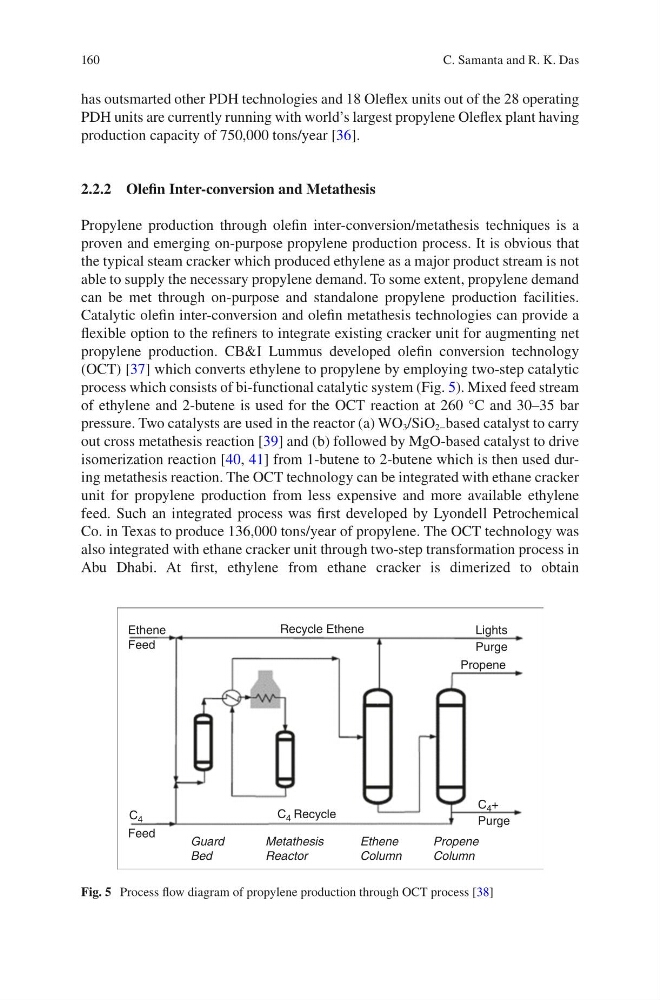
(OCT) [37] which converts ethylene to propylene by employing two-step catalytic
process which consists of bi-functional catalytic system (Fig. 5). Mixed feed stream
of ethylene and 2-butene is used for the OCT reaction at 260 °C and 30–35 bar
pressure. Two catalysts are used in the reactor (a) WO 3 /SiO 2− based catalyst to carry
out cross metathesis reaction [39] and (b) followed by MgO-based catalyst to drive
isomerization reaction [40, 41] from 1-butene to 2-butene which is then used during metathesis reaction. The OCT technology can be integrated with ethane cracker
unit for propylene production from less expensive and more available ethylene
feed. Such an integrated process was first developed by Lyondell Petrochemical
Co. in Texas to produce 136,000 tons/year of propylene. The OCT technology was
also integrated with ethane cracker unit through two-step transformation process in
Abu Dhabi. At first, ethylene from ethane cracker is dimerized to obtain
Ethene
Recycle Ethene
Metathesis
Reactor
Lights
Purge
Purge
Propene
Propene
Column
Ethene
Column
Guard
Bed
Feed
Feed
C 4
C 4 +
C 4 Recycle
Fig. 5 Process flow diagram of propylene production through OCT process [38]
C. Samanta and R. K. Das
has outsmarted other PDH technologies and 18 Oleflex units out of the 28 operating
PDH units are currently running with world’s largest propylene Oleflex plant having
production capacity of 750,000 tons/year [36].
2.2.2 Olefin Inter-conversion and Metathesis
Propylene production through olefin inter-conversion/metathesis techniques is a
proven and emerging on-purpose propylene production process. It is obvious that
the typical steam cracker which produced ethylene as a major product stream is not
able to supply the necessary propylene demand. To some extent, propylene demand
can be met through on-purpose and standalone propylene production facilities.
Catalytic olefin inter-conversion and olefin metathesis technologies can provide a
flexible option to the refiners to integrate existing cracker unit for augmenting net
propylene production. CB&I Lummus developed olefin conversion technology
(OCT) [37] which converts ethylene to propylene by employing two-step catalytic
process which consists of bi-functional catalytic system (Fig. 5). Mixed feed stream
of ethylene and 2-butene is used for the OCT reaction at 260 °C and 30–35 bar
pressure. Two catalysts are used in the reactor (a) WO 3 /SiO 2− based catalyst to carry
out cross metathesis reaction [39] and (b) followed by MgO-based catalyst to drive
isomerization reaction [40, 41] from 1-butene to 2-butene which is then used during metathesis reaction. The OCT technology can be integrated with ethane cracker
unit for propylene production from less expensive and more available ethylene
feed. Such an integrated process was first developed by Lyondell Petrochemical
Co. in Texas to produce 136,000 tons/year of propylene. The OCT technology was
also integrated with ethane cracker unit through two-step transformation process in
Abu Dhabi. At first, ethylene from ethane cracker is dimerized to obtain
Ethene
Recycle Ethene
Metathesis
Reactor
Lights
Purge
Purge
Propene
Propene
Column
Ethene
Column
Guard
Bed
Feed
Feed
C 4
C 4 +
C 4 Recycle
Fig. 5 Process flow diagram of propylene production through OCT process [38]
C. Samanta and R. K. Das