

152
countries. However, propylene demand has outpaced its supply from the conventional sources because of the two major reasons: (a) steam cracker route mostly
produce ethylene as a major product and (b) due to shift in the lighter feedstock in
steam cracker after the advent of shale gas. Ethane has become an inexpensive
source of steam cracker unit which limits the production of propylene [2]. Most of
the recent crackers commissioned and some are under construction in the North
America and Western Europe are using and expected to use ethane predominantly
or exclusively. The changing scenarios of feedstock and the growing demand for
propylene have forced petrochemicals manufacturers to build on-purpose plant and
search for alternative options wherein crude can be processed directly for light olefins production, such as crude to chemicals process.
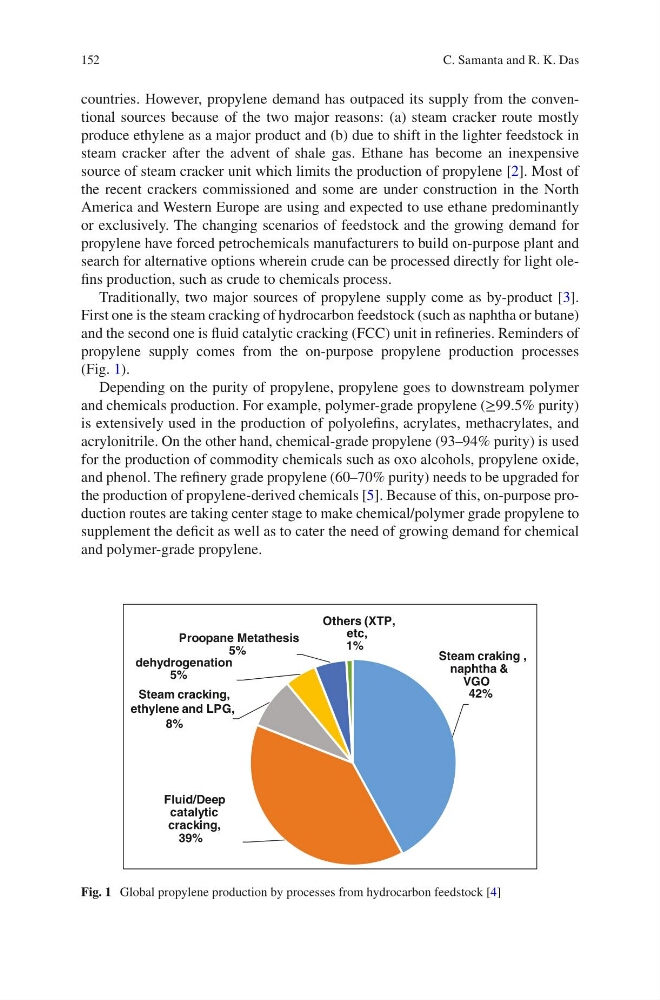
Traditionally, two major sources of propylene supply come as by-product [3].
First one is the steam cracking of hydrocarbon feedstock (such as naphtha or butane)
and the second one is fluid catalytic cracking (FCC) unit in refineries. Reminders of
propylene supply comes from the on-purpose propylene production processes
(Fig. 1).
Depending on the purity of propylene, propylene goes to downstream polymer
and chemicals production. For example, polymer-grade propylene (≥99.5% purity)
is extensively used in the production of polyolefins, acrylates, methacrylates, and
acrylonitrile. On the other hand, chemical-grade propylene (93–94% purity) is used
for the production of commodity chemicals such as oxo alcohols, propylene oxide,
and phenol. The refinery grade propylene (60–70% purity) needs to be upgraded for
the production of propylene-derived chemicals [5]. Because of this, on-purpose production routes are taking center stage to make chemical/polymer grade propylene to
supplement the deficit as well as to cater the need of growing demand for chemical
and polymer-grade propylene.
Steam craking ,
naphtha &
VGO
Fluid/Deep
catalytic
cracking,
Others (XTP,
etc,
8%
5%
1%
Proopane Metathesis
dehydrogenation
5%
Steam cracking,
ethylene and LPG,
39%
42%
Fig. 1 Global propylene production by processes from hydrocarbon feedstock [4]
C. Samanta and R. K. Das
countries. However, propylene demand has outpaced its supply from the conventional sources because of the two major reasons: (a) steam cracker route mostly
produce ethylene as a major product and (b) due to shift in the lighter feedstock in
steam cracker after the advent of shale gas. Ethane has become an inexpensive
source of steam cracker unit which limits the production of propylene [2]. Most of
the recent crackers commissioned and some are under construction in the North
America and Western Europe are using and expected to use ethane predominantly
or exclusively. The changing scenarios of feedstock and the growing demand for
propylene have forced petrochemicals manufacturers to build on-purpose plant and
search for alternative options wherein crude can be processed directly for light olefins production, such as crude to chemicals process.
Traditionally, two major sources of propylene supply come as by-product [3].
First one is the steam cracking of hydrocarbon feedstock (such as naphtha or butane)
and the second one is fluid catalytic cracking (FCC) unit in refineries. Reminders of
propylene supply comes from the on-purpose propylene production processes
(Fig. 1).
Depending on the purity of propylene, propylene goes to downstream polymer
and chemicals production. For example, polymer-grade propylene (≥99.5% purity)
is extensively used in the production of polyolefins, acrylates, methacrylates, and
acrylonitrile. On the other hand, chemical-grade propylene (93–94% purity) is used
for the production of commodity chemicals such as oxo alcohols, propylene oxide,
and phenol. The refinery grade propylene (60–70% purity) needs to be upgraded for
the production of propylene-derived chemicals [5]. Because of this, on-purpose production routes are taking center stage to make chemical/polymer grade propylene to
supplement the deficit as well as to cater the need of growing demand for chemical
and polymer-grade propylene.
Steam craking ,
naphtha &
VGO
Fluid/Deep
catalytic
cracking,
Others (XTP,
etc,
8%
5%
1%
Proopane Metathesis
dehydrogenation
5%
Steam cracking,
ethylene and LPG,
39%
42%
Fig. 1 Global propylene production by processes from hydrocarbon feedstock [4]
C. Samanta and R. K. Das