

153
2 Propylene Production
2.1 Traditional Sources
As per market research firm IHS Markit, in 2013, around 55% of propylene production was based on the steam cracking process, 34% was from combined refinery
processes such as FCC, RFCC, and DCC and the remaining 11% production was
from on-purpose routes. This scenario is changing rapidly because of the growing
demand for propylene and advancement in the catalytic technologies for on-purpose
propylene production routes. It is estimated that by 2025, the contribution from onpurpose routes will rise significantly to 25–30%, while the steam cracking process
will contribute 40–45% and combined refinery processes will contribute 30–35%. A
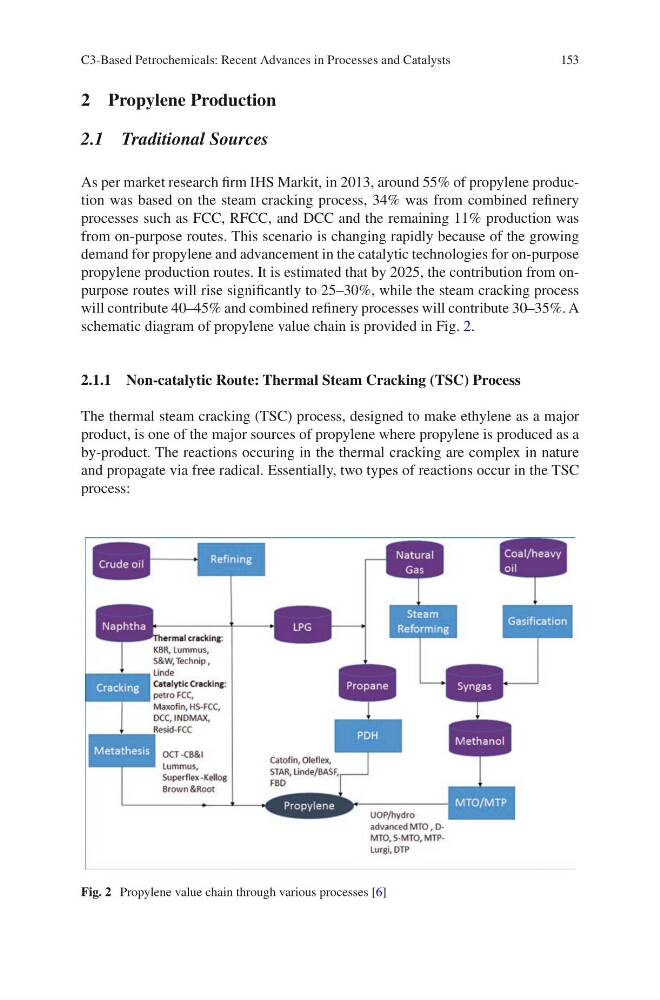
schematic diagram of propylene value chain is provided in Fig. 2.
2.1.1 Non-catalytic Route: Thermal Steam Cracking (TSC) Process
The thermal steam cracking (TSC) process, designed to make ethylene as a major
product, is one of the major sources of propylene where propylene is produced as a
by-product. The reactions occuring in the thermal cracking are complex in nature
and propagate via free radical. Essentially, two types of reactions occur in the TSC
process:
Fig. 2 Propylene value chain through various processes [6]
C3-Based Petrochemicals: Recent Advances in Processes and Catalysts
2 Propylene Production
2.1 Traditional Sources
As per market research firm IHS Markit, in 2013, around 55% of propylene production was based on the steam cracking process, 34% was from combined refinery
processes such as FCC, RFCC, and DCC and the remaining 11% production was
from on-purpose routes. This scenario is changing rapidly because of the growing
demand for propylene and advancement in the catalytic technologies for on-purpose
propylene production routes. It is estimated that by 2025, the contribution from onpurpose routes will rise significantly to 25–30%, while the steam cracking process
will contribute 40–45% and combined refinery processes will contribute 30–35%. A
schematic diagram of propylene value chain is provided in Fig. 2.
2.1.1 Non-catalytic Route: Thermal Steam Cracking (TSC) Process
The thermal steam cracking (TSC) process, designed to make ethylene as a major
product, is one of the major sources of propylene where propylene is produced as a
by-product. The reactions occuring in the thermal cracking are complex in nature
and propagate via free radical. Essentially, two types of reactions occur in the TSC
process:
Fig. 2 Propylene value chain through various processes [6]
C3-Based Petrochemicals: Recent Advances in Processes and Catalysts