

123
benzene (CHB) as a valuable product. CHB can be the potential replacement of
cumene for the phenol production process.
Typically, Brönsted acids such as HF, H 2 SO 4 , and H 3 PO 4 and Lewis acids such as
AlCl 3 , AlMe 3 , and BF 3 are the common acids for such alkylation. However, these
acids are very strong in nature, and thus carbocations undergo various associations
and dissociation reaction resulting in several byproducts. Furthermore, these acids
are corrosive in nature and pose challenges in process operation and handling process effluent. Therefore, solid acid catalysts have gained significant importance in
developing eco-friendly alkylation processes. In this context, zeolites have gained
significant attention owing to their nature, framework structure, and pore architecture, which provide better product selectivity in comparison with conventional acid
catalysts. Thus, zeolite-based catalysts are becoming one of the sustainable alternatives for alkylation process development.
This section entails (a) benzene alkylation to CHB, a promising alternative to
conventional cumene-based phenol production process and (b) toluene side-chain
alkylation to styrene, a less energy consuming process than conventional styrene
production through dehydrogenation route. Furthermore, it deals with the sustainable zeolite catalyst development on said alkylation processes with their emerging
trend, commercial processes, and future prospect in commercial realization.
1.2.1 Hydroalkylation of Benzene to Cyclohexylbenzene (CHB)
CHB has a wide range of applications from solvents and plasticizer in plastics to the
areas of coatings and adhesive [118]. In lithium-ion batteries, it is used as an over
charge protecting agent, also as a starting material for synthesis of LCD derivatives.
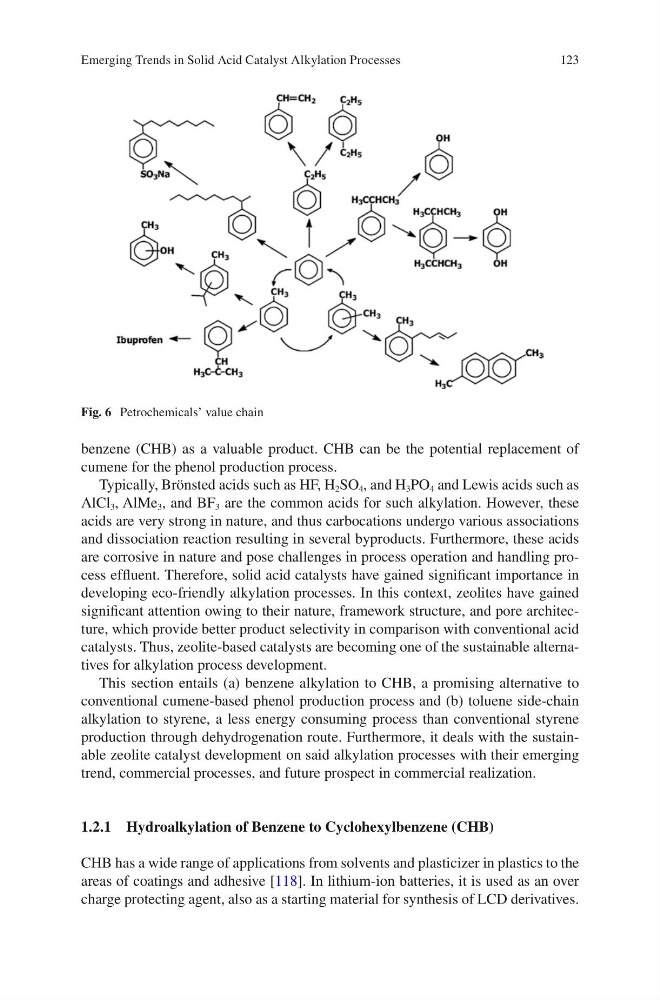
Fig. 6 Petrochemicals’ value chain
Emerging Trends in Solid Acid Catalyst Alkylation Processes
benzene (CHB) as a valuable product. CHB can be the potential replacement of
cumene for the phenol production process.
Typically, Brönsted acids such as HF, H 2 SO 4 , and H 3 PO 4 and Lewis acids such as
AlCl 3 , AlMe 3 , and BF 3 are the common acids for such alkylation. However, these
acids are very strong in nature, and thus carbocations undergo various associations
and dissociation reaction resulting in several byproducts. Furthermore, these acids
are corrosive in nature and pose challenges in process operation and handling process effluent. Therefore, solid acid catalysts have gained significant importance in
developing eco-friendly alkylation processes. In this context, zeolites have gained
significant attention owing to their nature, framework structure, and pore architecture, which provide better product selectivity in comparison with conventional acid
catalysts. Thus, zeolite-based catalysts are becoming one of the sustainable alternatives for alkylation process development.
This section entails (a) benzene alkylation to CHB, a promising alternative to
conventional cumene-based phenol production process and (b) toluene side-chain
alkylation to styrene, a less energy consuming process than conventional styrene
production through dehydrogenation route. Furthermore, it deals with the sustainable zeolite catalyst development on said alkylation processes with their emerging
trend, commercial processes, and future prospect in commercial realization.
1.2.1 Hydroalkylation of Benzene to Cyclohexylbenzene (CHB)
CHB has a wide range of applications from solvents and plasticizer in plastics to the
areas of coatings and adhesive [118]. In lithium-ion batteries, it is used as an over
charge protecting agent, also as a starting material for synthesis of LCD derivatives.
Fig. 6 Petrochemicals’ value chain
Emerging Trends in Solid Acid Catalyst Alkylation Processes