

124
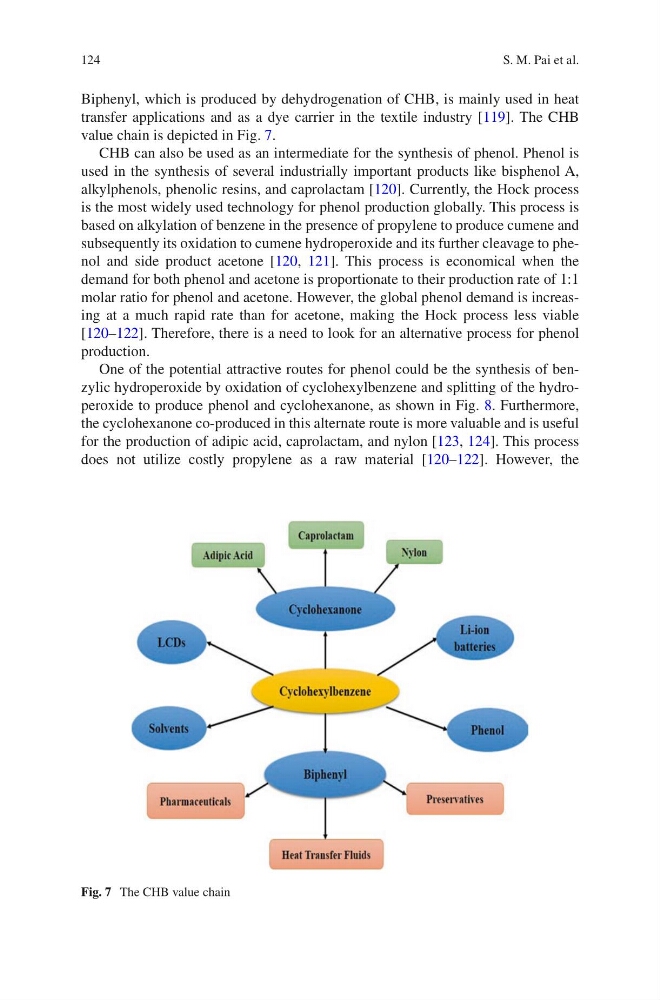
Biphenyl, which is produced by dehydrogenation of CHB, is mainly used in heat
transfer applications and as a dye carrier in the textile industry [119]. The CHB
value chain is depicted in Fig. 7.
CHB can also be used as an intermediate for the synthesis of phenol. Phenol is
used in the synthesis of several industrially important products like bisphenol A,
alkylphenols, phenolic resins, and caprolactam [120]. Currently, the Hock process
is the most widely used technology for phenol production globally. This process is
based on alkylation of benzene in the presence of propylene to produce cumene and
subsequently its oxidation to cumene hydroperoxide and its further cleavage to phenol and side product acetone [120, 121]. This process is economical when the
demand for both phenol and acetone is proportionate to their production rate of 1:1
molar ratio for phenol and acetone. However, the global phenol demand is increasing at a much rapid rate than for acetone, making the Hock process less viable
[120–122]. Therefore, there is a need to look for an alternative process for phenol
production.
One of the potential attractive routes for phenol could be the synthesis of benzylic hydroperoxide by oxidation of cyclohexylbenzene and splitting of the hydroperoxide to produce phenol and cyclohexanone, as shown in Fig. 8. Furthermore,
the cyclohexanone co-produced in this alternate route is more valuable and is useful
for the production of adipic acid, caprolactam, and nylon [123, 124]. This process
does not utilize costly propylene as a raw material [120–122]. However, the
Fig. 7 The CHB value chain
S. M. Pai et al.
Biphenyl, which is produced by dehydrogenation of CHB, is mainly used in heat
transfer applications and as a dye carrier in the textile industry [119]. The CHB
value chain is depicted in Fig. 7.
CHB can also be used as an intermediate for the synthesis of phenol. Phenol is
used in the synthesis of several industrially important products like bisphenol A,
alkylphenols, phenolic resins, and caprolactam [120]. Currently, the Hock process
is the most widely used technology for phenol production globally. This process is
based on alkylation of benzene in the presence of propylene to produce cumene and
subsequently its oxidation to cumene hydroperoxide and its further cleavage to phenol and side product acetone [120, 121]. This process is economical when the
demand for both phenol and acetone is proportionate to their production rate of 1:1
molar ratio for phenol and acetone. However, the global phenol demand is increasing at a much rapid rate than for acetone, making the Hock process less viable
[120–122]. Therefore, there is a need to look for an alternative process for phenol
production.
One of the potential attractive routes for phenol could be the synthesis of benzylic hydroperoxide by oxidation of cyclohexylbenzene and splitting of the hydroperoxide to produce phenol and cyclohexanone, as shown in Fig. 8. Furthermore,
the cyclohexanone co-produced in this alternate route is more valuable and is useful
for the production of adipic acid, caprolactam, and nylon [123, 124]. This process
does not utilize costly propylene as a raw material [120–122]. However, the
Fig. 7 The CHB value chain
S. M. Pai et al.