

121
KBR K-SAAT™ Process
The K-SAAT next-generation solid acid alkylation technology is developed jointly
by M/s KBR and Exelus. The key component of the K-SAAT technology is a highly
engineered zeolite Y-based ExSact catalyst, which provides superior alkylation performance by overcoming the occurrence of rapid deactivation in solid acid catalysts.
This highly engineered catalyst with regard to pore architecture and framework
acidity allows optimized reactions in the form of reduced mass transfer to prevent
pore blockage while promoting alkylation over polymerization and favors the formation of 2-butene from 1-butene and highly selective toward 2,2,3 and
2,3,4- trimethylpentane. It is characterized by higher activity, 24 h of cycle time, 5
years of catalyst life, high alkylate RON, and simplified process design. This
K-SAAT process is a highly efficient, cost-effective, environmentally benign, and
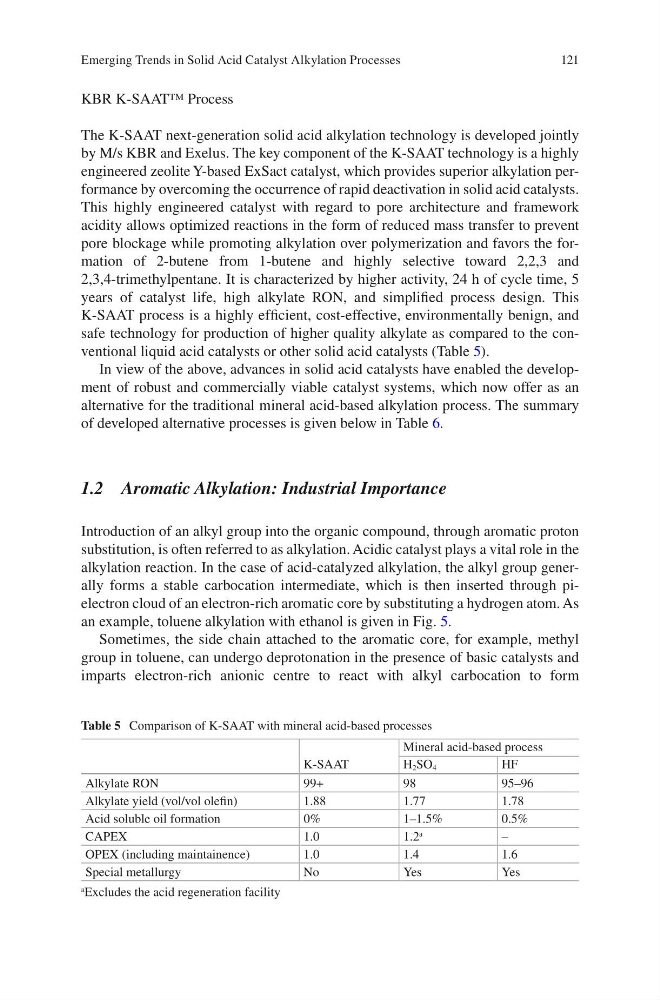
safe technology for production of higher quality alkylate as compared to the conventional liquid acid catalysts or other solid acid catalysts (Table 5).
In view of the above, advances in solid acid catalysts have enabled the development of robust and commercially viable catalyst systems, which now offer as an
alternative for the traditional mineral acid-based alkylation process. The summary
of developed alternative processes is given below in Table 6.
1.2 Aromatic Alkylation: Industrial Importance
Introduction of an alkyl group into the organic compound, through aromatic proton
substitution, is often referred to as alkylation. Acidic catalyst plays a vital role in the
alkylation reaction. In the case of acid-catalyzed alkylation, the alkyl group generally forms a stable carbocation intermediate, which is then inserted through pielectron cloud of an electron-rich aromatic core by substituting a hydrogen atom. As
an example, toluene alkylation with ethanol is given in Fig. 5.
Sometimes, the side chain attached to the aromatic core, for example, methyl
group in toluene, can undergo deprotonation in the presence of basic catalysts and
imparts electron-rich anionic centre to react with alkyl carbocation to form
Table 5 Comparison of K-SAAT with mineral acid-based processes
K-SAAT
Mineral acid-based process
H 2 SO 4
HF
Alkylate RON
99+
98
95–96
Alkylate yield (vol/vol olefin)
1.88
1.77
1.78
Acid soluble oil formation
0%
1–1.5%
0.5%
CAPEX
1.0
1.2
a
–
OPEX (including maintainence)
1.0
1.4
1.6
Special metallurgy
No
Yes
Yes
a
Excludes the acid regeneration facility
Emerging Trends in Solid Acid Catalyst Alkylation Processes
KBR K-SAAT™ Process
The K-SAAT next-generation solid acid alkylation technology is developed jointly
by M/s KBR and Exelus. The key component of the K-SAAT technology is a highly
engineered zeolite Y-based ExSact catalyst, which provides superior alkylation performance by overcoming the occurrence of rapid deactivation in solid acid catalysts.
This highly engineered catalyst with regard to pore architecture and framework
acidity allows optimized reactions in the form of reduced mass transfer to prevent
pore blockage while promoting alkylation over polymerization and favors the formation of 2-butene from 1-butene and highly selective toward 2,2,3 and
2,3,4- trimethylpentane. It is characterized by higher activity, 24 h of cycle time, 5
years of catalyst life, high alkylate RON, and simplified process design. This
K-SAAT process is a highly efficient, cost-effective, environmentally benign, and
safe technology for production of higher quality alkylate as compared to the conventional liquid acid catalysts or other solid acid catalysts (Table 5).
In view of the above, advances in solid acid catalysts have enabled the development of robust and commercially viable catalyst systems, which now offer as an
alternative for the traditional mineral acid-based alkylation process. The summary
of developed alternative processes is given below in Table 6.
1.2 Aromatic Alkylation: Industrial Importance
Introduction of an alkyl group into the organic compound, through aromatic proton
substitution, is often referred to as alkylation. Acidic catalyst plays a vital role in the
alkylation reaction. In the case of acid-catalyzed alkylation, the alkyl group generally forms a stable carbocation intermediate, which is then inserted through pielectron cloud of an electron-rich aromatic core by substituting a hydrogen atom. As
an example, toluene alkylation with ethanol is given in Fig. 5.
Sometimes, the side chain attached to the aromatic core, for example, methyl
group in toluene, can undergo deprotonation in the presence of basic catalysts and
imparts electron-rich anionic centre to react with alkyl carbocation to form
Table 5 Comparison of K-SAAT with mineral acid-based processes
K-SAAT
Mineral acid-based process
H 2 SO 4
HF
Alkylate RON
99+
98
95–96
Alkylate yield (vol/vol olefin)
1.88
1.77
1.78
Acid soluble oil formation
0%
1–1.5%
0.5%
CAPEX
1.0
1.2
a
–
OPEX (including maintainence)
1.0
1.4
1.6
Special metallurgy
No
Yes
Yes
a
Excludes the acid regeneration facility
Emerging Trends in Solid Acid Catalyst Alkylation Processes