

120
atmosphere, and the catalyst is partially regenerated at low temperature and fully
regenerated at high temperatures.
LURGI EUROFUEL
®
Process
A zeolite Y-catalyzed alkylation process termed as LURGI EUROFUEL
®
has been
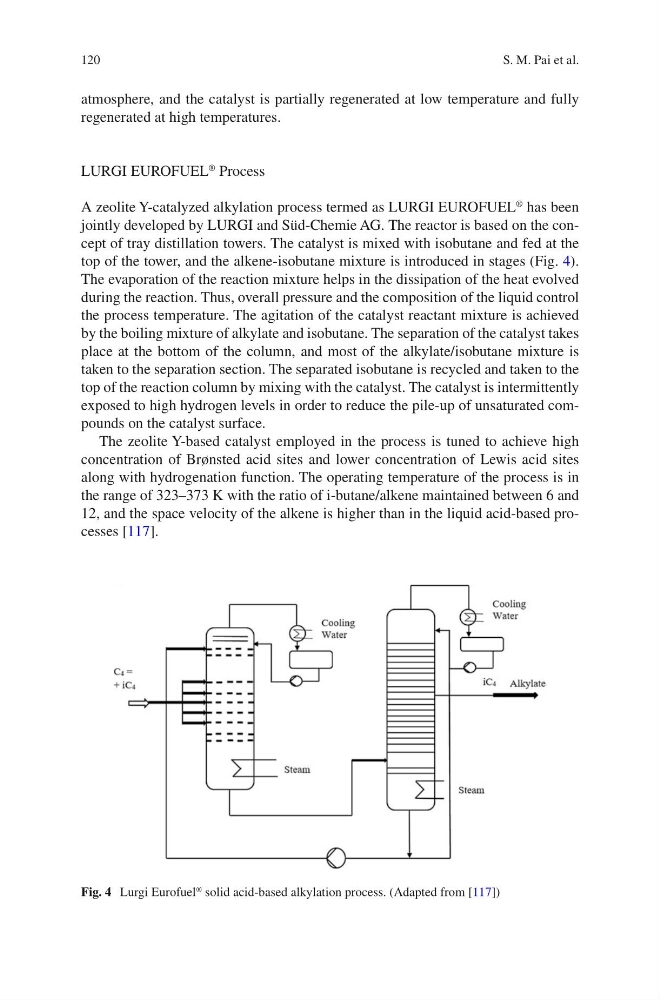
jointly developed by LURGI and Süd-Chemie AG. The reactor is based on the concept of tray distillation towers. The catalyst is mixed with isobutane and fed at the
top of the tower, and the alkene-isobutane mixture is introduced in stages (Fig. 4).
The evaporation of the reaction mixture helps in the dissipation of the heat evolved
during the reaction. Thus, overall pressure and the composition of the liquid control
the process temperature. The agitation of the catalyst reactant mixture is achieved
by the boiling mixture of alkylate and isobutane. The separation of the catalyst takes
place at the bottom of the column, and most of the alkylate/isobutane mixture is
taken to the separation section. The separated isobutane is recycled and taken to the
top of the reaction column by mixing with the catalyst. The catalyst is intermittently
exposed to high hydrogen levels in order to reduce the pile-up of unsaturated compounds on the catalyst surface.
The zeolite Y-based catalyst employed in the process is tuned to achieve high
concentration of Brønsted acid sites and lower concentration of Lewis acid sites
along with hydrogenation function. The operating temperature of the process is in
the range of 323–373 K with the ratio of i-butane/alkene maintained between 6 and
12, and the space velocity of the alkene is higher than in the liquid acid-based processes [117].
Fig. 4 Lurgi Eurofuel
® solid acid-based alkylation process. (Adapted from [117])
S. M. Pai et al.
atmosphere, and the catalyst is partially regenerated at low temperature and fully
regenerated at high temperatures.
LURGI EUROFUEL
®
Process
A zeolite Y-catalyzed alkylation process termed as LURGI EUROFUEL
®
has been
jointly developed by LURGI and Süd-Chemie AG. The reactor is based on the concept of tray distillation towers. The catalyst is mixed with isobutane and fed at the
top of the tower, and the alkene-isobutane mixture is introduced in stages (Fig. 4).
The evaporation of the reaction mixture helps in the dissipation of the heat evolved
during the reaction. Thus, overall pressure and the composition of the liquid control
the process temperature. The agitation of the catalyst reactant mixture is achieved
by the boiling mixture of alkylate and isobutane. The separation of the catalyst takes
place at the bottom of the column, and most of the alkylate/isobutane mixture is
taken to the separation section. The separated isobutane is recycled and taken to the
top of the reaction column by mixing with the catalyst. The catalyst is intermittently
exposed to high hydrogen levels in order to reduce the pile-up of unsaturated compounds on the catalyst surface.
The zeolite Y-based catalyst employed in the process is tuned to achieve high
concentration of Brønsted acid sites and lower concentration of Lewis acid sites
along with hydrogenation function. The operating temperature of the process is in
the range of 323–373 K with the ratio of i-butane/alkene maintained between 6 and
12, and the space velocity of the alkene is higher than in the liquid acid-based processes [117].
Fig. 4 Lurgi Eurofuel
® solid acid-based alkylation process. (Adapted from [117])
S. M. Pai et al.