

96
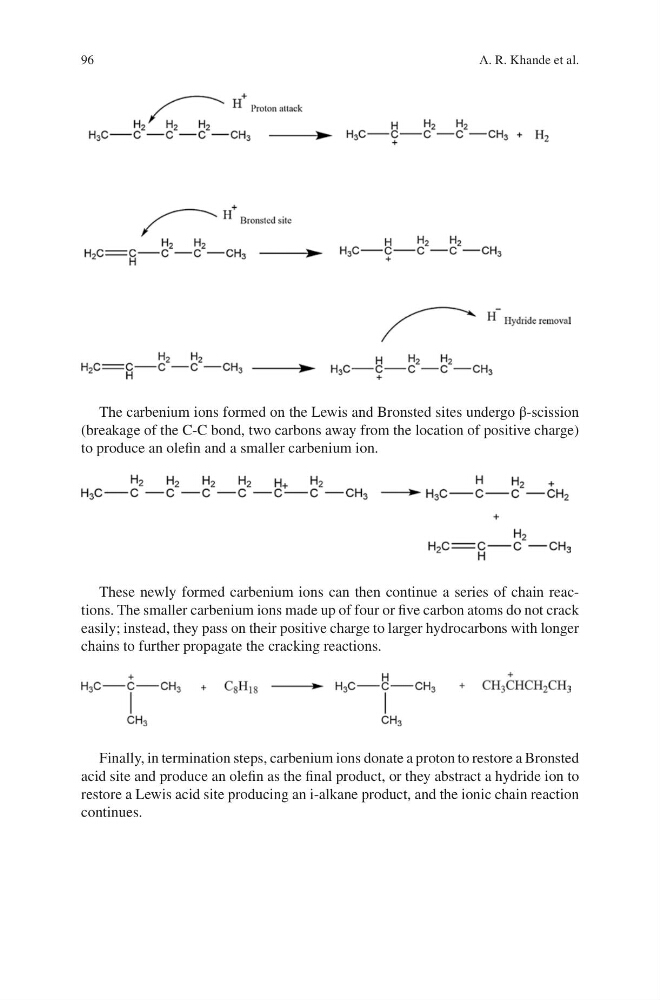
The carbenium ions formed on the Lewis and Bronsted sites undergo β-scission
(breakage of the C-C bond, two carbons away from the location of positive charge)
to produce an olefin and a smaller carbenium ion.
These newly formed carbenium ions can then continue a series of chain reactions. The smaller carbenium ions made up of four or five carbon atoms do not crack
easily; instead, they pass on their positive charge to larger hydrocarbons with longer
chains to further propagate the cracking reactions.
Finally, in termination steps, carbenium ions donate a proton to restore a Bronsted
acid site and produce an olefin as the final product, or they abstract a hydride ion to
restore a Lewis acid site producing an i-alkane product, and the ionic chain reaction
continues.
A. R. Khande et al.
The carbenium ions formed on the Lewis and Bronsted sites undergo β-scission
(breakage of the C-C bond, two carbons away from the location of positive charge)
to produce an olefin and a smaller carbenium ion.
These newly formed carbenium ions can then continue a series of chain reactions. The smaller carbenium ions made up of four or five carbon atoms do not crack
easily; instead, they pass on their positive charge to larger hydrocarbons with longer
chains to further propagate the cracking reactions.
Finally, in termination steps, carbenium ions donate a proton to restore a Bronsted
acid site and produce an olefin as the final product, or they abstract a hydride ion to
restore a Lewis acid site producing an i-alkane product, and the ionic chain reaction
continues.
A. R. Khande et al.