

97
6.2 Isomerization Reactions
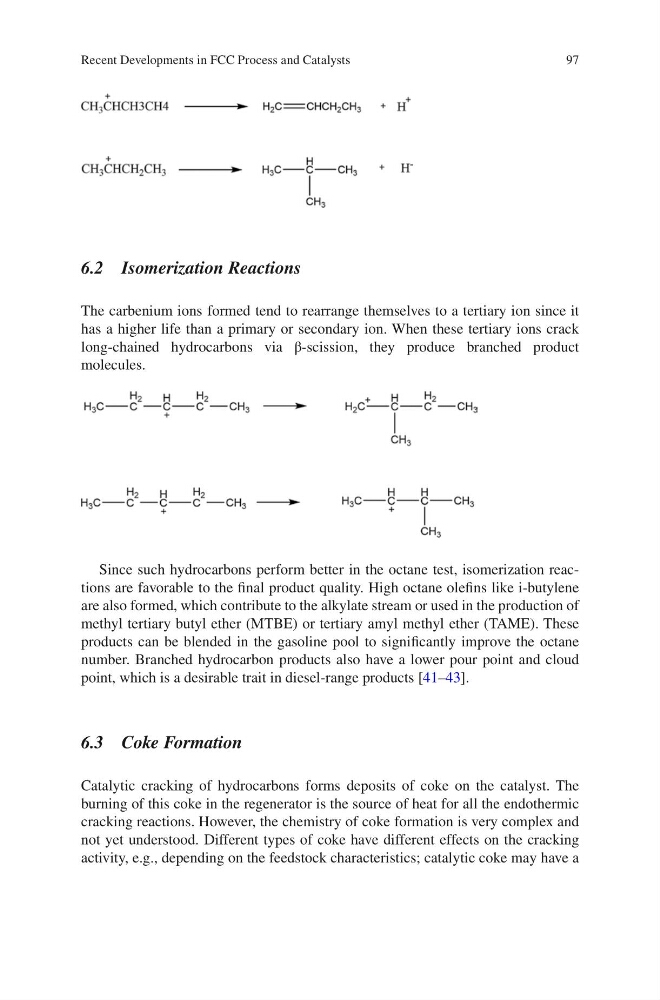
The carbenium ions formed tend to rearrange themselves to a tertiary ion since it
has a higher life than a primary or secondary ion. When these tertiary ions crack
long-chained hydrocarbons via β-scission, they produce branched product
molecules.
Since such hydrocarbons perform better in the octane test, isomerization reactions are favorable to the final product quality. High octane olefins like i-butylene
are also formed, which contribute to the alkylate stream or used in the production of
methyl tertiary butyl ether (MTBE) or tertiary amyl methyl ether (TAME). These
products can be blended in the gasoline pool to significantly improve the octane
number. Branched hydrocarbon products also have a lower pour point and cloud
point, which is a desirable trait in diesel-range products [41–43].
6.3 Coke Formation
Catalytic cracking of hydrocarbons forms deposits of coke on the catalyst. The
burning of this coke in the regenerator is the source of heat for all the endothermic
cracking reactions. However, the chemistry of coke formation is very complex and
not yet understood. Different types of coke have different effects on the cracking
activity, e.g., depending on the feedstock characteristics; catalytic coke may have a
Recent Developments in FCC Process and Catalysts
6.2 Isomerization Reactions
The carbenium ions formed tend to rearrange themselves to a tertiary ion since it
has a higher life than a primary or secondary ion. When these tertiary ions crack
long-chained hydrocarbons via β-scission, they produce branched product
molecules.
Since such hydrocarbons perform better in the octane test, isomerization reactions are favorable to the final product quality. High octane olefins like i-butylene
are also formed, which contribute to the alkylate stream or used in the production of
methyl tertiary butyl ether (MTBE) or tertiary amyl methyl ether (TAME). These
products can be blended in the gasoline pool to significantly improve the octane
number. Branched hydrocarbon products also have a lower pour point and cloud
point, which is a desirable trait in diesel-range products [41–43].
6.3 Coke Formation
Catalytic cracking of hydrocarbons forms deposits of coke on the catalyst. The
burning of this coke in the regenerator is the source of heat for all the endothermic
cracking reactions. However, the chemistry of coke formation is very complex and
not yet understood. Different types of coke have different effects on the cracking
activity, e.g., depending on the feedstock characteristics; catalytic coke may have a
Recent Developments in FCC Process and Catalysts