

95
Catalytic cracking is based on carbocation chemistry. A carbocation is a positively charged ion consisting of carbon functionality. Carbocations can be classified
as carbonium ions (CH 5
+
) or carbenium ions (R-CH 2
+
).
A carbonium ion is formed when a proton donated by a catalyst’s Bronsted site
attacks a paraffin molecule in the hydrocarbon feed.
CH H
CH
4
5
+
®
+
+
A carbenium ion is formed by adding a positive charge from a Bronsted site to an
olefin molecule in the hydrocarbon feed or removing a hydride by a Lewis site from
paraffin.
CH
CH H
C H H
C H
4
2 4
2
5
3
®
+
+
®
+
-
+
+
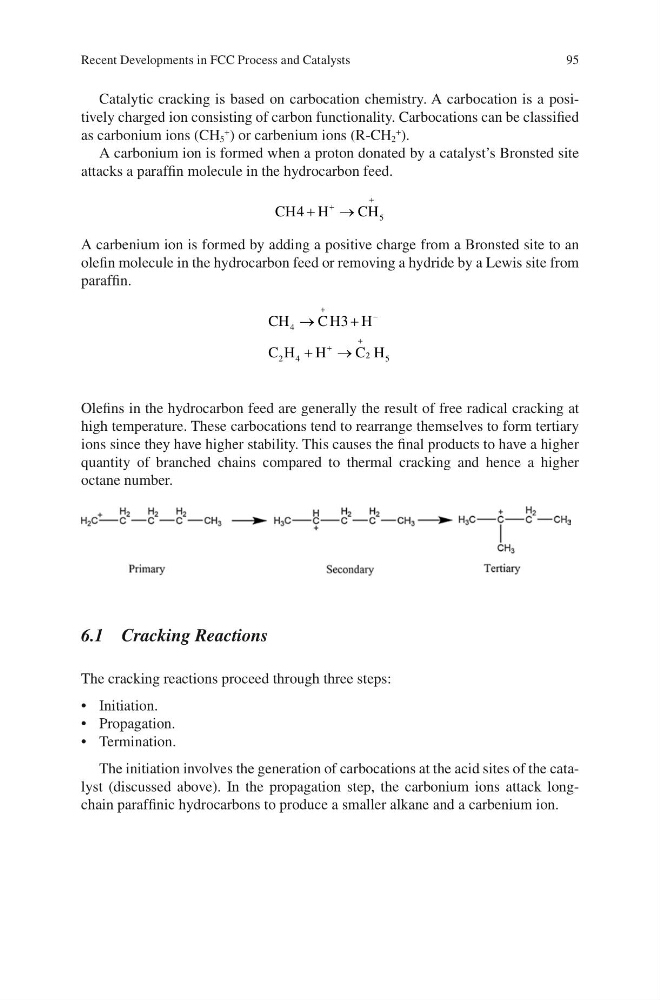
Olefins in the hydrocarbon feed are generally the result of free radical cracking at
high temperature. These carbocations tend to rearrange themselves to form tertiary
ions since they have higher stability. This causes the final products to have a higher
quantity of branched chains compared to thermal cracking and hence a higher
octane number.
6.1 Cracking Reactions
The cracking reactions proceed through three steps:
• Initiation.
• Propagation.
• Termination.
The initiation involves the generation of carbocations at the acid sites of the catalyst (discussed above). In the propagation step, the carbonium ions attack longchain paraffinic hydrocarbons to produce a smaller alkane and a carbenium ion.
Recent Developments in FCC Process and Catalysts
Catalytic cracking is based on carbocation chemistry. A carbocation is a positively charged ion consisting of carbon functionality. Carbocations can be classified
as carbonium ions (CH 5
+
) or carbenium ions (R-CH 2
+
).
A carbonium ion is formed when a proton donated by a catalyst’s Bronsted site
attacks a paraffin molecule in the hydrocarbon feed.
CH H
CH
4
5
+
®
+
+
A carbenium ion is formed by adding a positive charge from a Bronsted site to an
olefin molecule in the hydrocarbon feed or removing a hydride by a Lewis site from
paraffin.
CH
CH H
C H H
C H
4
2 4
2
5
3
®
+
+
®
+
-
+
+
Olefins in the hydrocarbon feed are generally the result of free radical cracking at
high temperature. These carbocations tend to rearrange themselves to form tertiary
ions since they have higher stability. This causes the final products to have a higher
quantity of branched chains compared to thermal cracking and hence a higher
octane number.
6.1 Cracking Reactions
The cracking reactions proceed through three steps:
• Initiation.
• Propagation.
• Termination.
The initiation involves the generation of carbocations at the acid sites of the catalyst (discussed above). In the propagation step, the carbonium ions attack longchain paraffinic hydrocarbons to produce a smaller alkane and a carbenium ion.
Recent Developments in FCC Process and Catalysts