

~ F ¼ dm
d ~ V
dt
!
set
ð3:39Þ
or
F
! ¼ dm
d V
!
dt
¼ dm u
@ V
!
@x
þ v
@ V
!
@y
þ
@ V
!
@z
þ
@ V
!
@t
"
#
ð3:40Þ
where u ¼
dx
dt ; v ¼
dy
dt ; and w ¼
dz
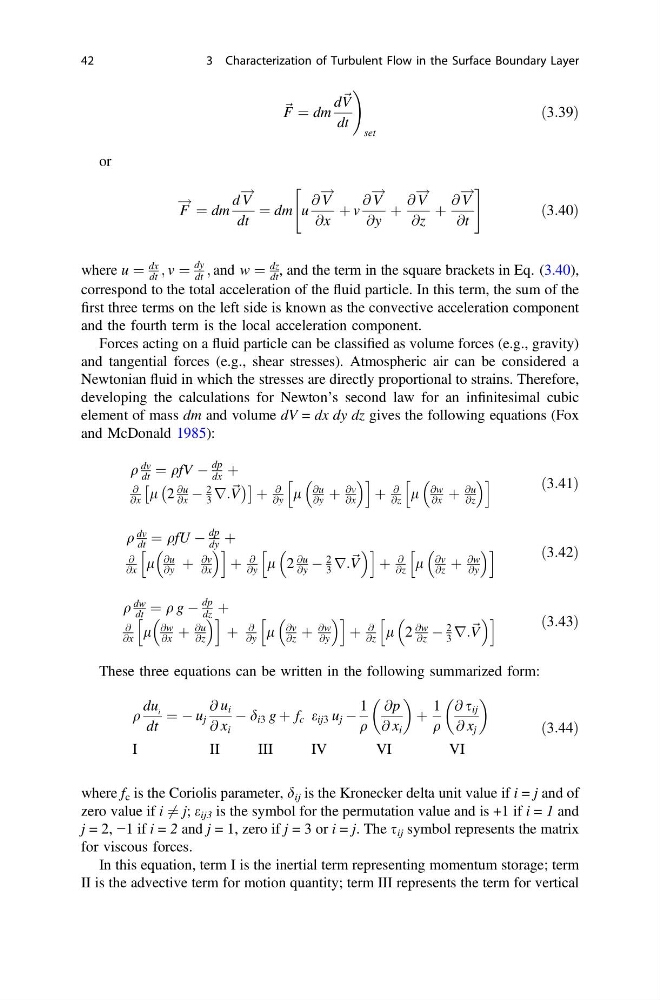
dt , and the term in the square brackets in Eq. (3.40),
correspond to the total acceleration of the fluid particle. In this term, the sum of the
first three terms on the left side is known as the convective acceleration component
and the fourth term is the local acceleration component.
Forces acting on a fluid particle can be classified as volume forces (e.g., gravity)
and tangential forces (e.g., shear stresses). Atmospheric air can be considered a
Newtonian fluid in which the stresses are directly proportional to strains. Therefore,
developing the calculations for Newton’s second law for an infinitesimal cubic
element of mass dm and volume dV = dx dy dz gives the following equations (Fox
and McDonald 1985):
q
dv
dt ¼ qfV À
dp
dx þ
@
@x l 2
@u
@x À
2
3 r: ~ V
À
Á
Â
à þ
@
@y l
@u
@y þ
@v
@x
h
i
þ
@
@z l
@w
@x þ
@u
@z
h
i
ð3:41Þ
q
dv
dt ¼ qfU À
dp
dy þ
@
@x l
@u
@y þ
@v
@x
h
i
þ
@
@y l 2
@u
@y À
2
3 r: ~ V
h
i
þ
@
@z l
@v
@z þ
@w
@y
h
i
ð3:42Þ
q
dw
dt ¼ q g À
dp
dz þ
@
@x l
@w
@x þ
@u
@z
h
i
þ
@
@y l
@v
@z þ
@w
@y
h
i
þ
@
@z l 2
@w
@z À
2
3 r: ~ V
h
i
ð3:43Þ
These three equations can be written in the following summarized form:
q
du i
dt
¼ À u j
@ u i
@ x i
À d i3 g þ f c e ij3 u j À
1
q
@p
@ x i
þ
1
q
@ s ij
@ x j
I
II
III
IV
VI
VI
ð3:44Þ
where f c is the Coriolis parameter, d ij is the Kronecker delta unit value if i = j and of
zero value if i 6 ¼ j; e ij3 is the symbol for the permutation value and is +1 if i = 1 and
j = 2, −1 if i = 2 and j = 1, zero if j = 3 or i = j. The s ij symbol represents the matrix
for viscous forces.
In this equation, term I is the inertial term representing momentum storage; term
II is the advective term for motion quantity; term III represents the term for vertical
42
3 Characterization of Turbulent Flow in the Surface Boundary Layer
d ~ V
dt
!
set
ð3:39Þ
or
F
! ¼ dm
d V
!
dt
¼ dm u
@ V
!
@x
þ v
@ V
!
@y
þ
@ V
!
@z
þ
@ V
!
@t
"
#
ð3:40Þ
where u ¼
dx
dt ; v ¼
dy
dt ; and w ¼
dz
dt , and the term in the square brackets in Eq. (3.40),
correspond to the total acceleration of the fluid particle. In this term, the sum of the
first three terms on the left side is known as the convective acceleration component
and the fourth term is the local acceleration component.
Forces acting on a fluid particle can be classified as volume forces (e.g., gravity)
and tangential forces (e.g., shear stresses). Atmospheric air can be considered a
Newtonian fluid in which the stresses are directly proportional to strains. Therefore,
developing the calculations for Newton’s second law for an infinitesimal cubic
element of mass dm and volume dV = dx dy dz gives the following equations (Fox
and McDonald 1985):
q
dv
dt ¼ qfV À
dp
dx þ
@
@x l 2
@u
@x À
2
3 r: ~ V
À
Á
Â
à þ
@
@y l
@u
@y þ
@v
@x
h
i
þ
@
@z l
@w
@x þ
@u
@z
h
i
ð3:41Þ
q
dv
dt ¼ qfU À
dp
dy þ
@
@x l
@u
@y þ
@v
@x
h
i
þ
@
@y l 2
@u
@y À
2
3 r: ~ V
h
i
þ
@
@z l
@v
@z þ
@w
@y
h
i
ð3:42Þ
q
dw
dt ¼ q g À
dp
dz þ
@
@x l
@w
@x þ
@u
@z
h
i
þ
@
@y l
@v
@z þ
@w
@y
h
i
þ
@
@z l 2
@w
@z À
2
3 r: ~ V
h
i
ð3:43Þ
These three equations can be written in the following summarized form:
q
du i
dt
¼ À u j
@ u i
@ x i
À d i3 g þ f c e ij3 u j À
1
q
@p
@ x i
þ
1
q
@ s ij
@ x j
I
II
III
IV
VI
VI
ð3:44Þ
where f c is the Coriolis parameter, d ij is the Kronecker delta unit value if i = j and of
zero value if i 6 ¼ j; e ij3 is the symbol for the permutation value and is +1 if i = 1 and
j = 2, −1 if i = 2 and j = 1, zero if j = 3 or i = j. The s ij symbol represents the matrix
for viscous forces.
In this equation, term I is the inertial term representing momentum storage; term
II is the advective term for motion quantity; term III represents the term for vertical
42
3 Characterization of Turbulent Flow in the Surface Boundary Layer