

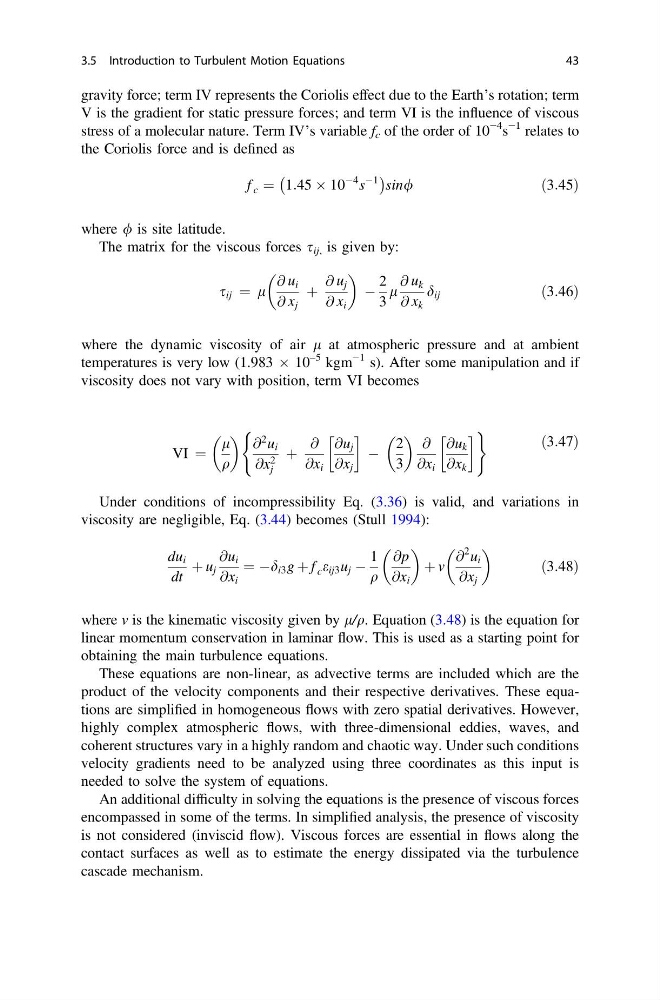
gravity force; term IV represents the Coriolis effect due to the Earth’s rotation; term
V is the gradient for static pressure forces; and term VI is the influence of viscous
stress of a molecular nature. Term IV’s variable f c of the order of 10
−4 s
−1 relates to
the Coriolis force and is defined as
f c ¼ 1:45 Â 10
À4 s
À1
À
Á
sin/
ð3:45Þ
where / is site latitude.
The matrix for the viscous forces s ij, is given by:
s ij ¼ l
@ u i
@ x j
þ
@ u j
@ x i
À
2
3
l
@ u k
@ x k
d ij
ð3:46Þ
where the dynamic viscosity of air l at atmospheric pressure and at ambient
temperatures is very low (1.983 Â 10
–5 kgm
−1 s). After some manipulation and if
viscosity does not vary with position, term VI becomes
VI ¼
l
q
@
2 u i
@x 2
j
þ
@
@x i
@u j
@x j
!
À
2
3
@
@x i
@u k
@x k
!
(
)
ð3:47Þ
Under conditions of incompressibility Eq. (3.36) is valid, and variations in
viscosity are negligible, Eq. (3.44) becomes (Stull 1994):
du i
dt
þ u j
@u i
@x i
¼ Àd i3 g þ f c e ij3 u j À
1
q
@p
@x i
þ v
@
2 u i
@x j
ð3:48Þ
where v is the kinematic viscosity given by l/q. Equation (3.48) is the equation for
linear momentum conservation in laminar flow. This is used as a starting point for
obtaining the main turbulence equations.
These equations are non-linear, as advective terms are included which are the
product of the velocity components and their respective derivatives. These equations are simplified in homogeneous flows with zero spatial derivatives. However,
highly complex atmospheric flows, with three-dimensional eddies, waves, and
coherent structures vary in a highly random and chaotic way. Under such conditions
velocity gradients need to be analyzed using three coordinates as this input is
needed to solve the system of equations.
An additional difficulty in solving the equations is the presence of viscous forces
encompassed in some of the terms. In simplified analysis, the presence of viscosity
is not considered (inviscid flow). Viscous forces are essential in flows along the
contact surfaces as well as to estimate the energy dissipated via the turbulence
cascade mechanism.
3.5 Introduction to Turbulent Motion Equations
43
V is the gradient for static pressure forces; and term VI is the influence of viscous
stress of a molecular nature. Term IV’s variable f c of the order of 10
−4 s
−1 relates to
the Coriolis force and is defined as
f c ¼ 1:45 Â 10
À4 s
À1
À
Á
sin/
ð3:45Þ
where / is site latitude.
The matrix for the viscous forces s ij, is given by:
s ij ¼ l
@ u i
@ x j
þ
@ u j
@ x i
À
2
3
l
@ u k
@ x k
d ij
ð3:46Þ
where the dynamic viscosity of air l at atmospheric pressure and at ambient
temperatures is very low (1.983 Â 10
–5 kgm
−1 s). After some manipulation and if
viscosity does not vary with position, term VI becomes
VI ¼
l
q
@
2 u i
@x 2
j
þ
@
@x i
@u j
@x j
!
À
2
3
@
@x i
@u k
@x k
!
(
)
ð3:47Þ
Under conditions of incompressibility Eq. (3.36) is valid, and variations in
viscosity are negligible, Eq. (3.44) becomes (Stull 1994):
du i
dt
þ u j
@u i
@x i
¼ Àd i3 g þ f c e ij3 u j À
1
q
@p
@x i
þ v
@
2 u i
@x j
ð3:48Þ
where v is the kinematic viscosity given by l/q. Equation (3.48) is the equation for
linear momentum conservation in laminar flow. This is used as a starting point for
obtaining the main turbulence equations.
These equations are non-linear, as advective terms are included which are the
product of the velocity components and their respective derivatives. These equations are simplified in homogeneous flows with zero spatial derivatives. However,
highly complex atmospheric flows, with three-dimensional eddies, waves, and
coherent structures vary in a highly random and chaotic way. Under such conditions
velocity gradients need to be analyzed using three coordinates as this input is
needed to solve the system of equations.
An additional difficulty in solving the equations is the presence of viscous forces
encompassed in some of the terms. In simplified analysis, the presence of viscosity
is not considered (inviscid flow). Viscous forces are essential in flows along the
contact surfaces as well as to estimate the energy dissipated via the turbulence
cascade mechanism.
3.5 Introduction to Turbulent Motion Equations
43