

R i ¼
z À d
ð
Þ
L
/ H
/
2
M
!
ð2:51Þ
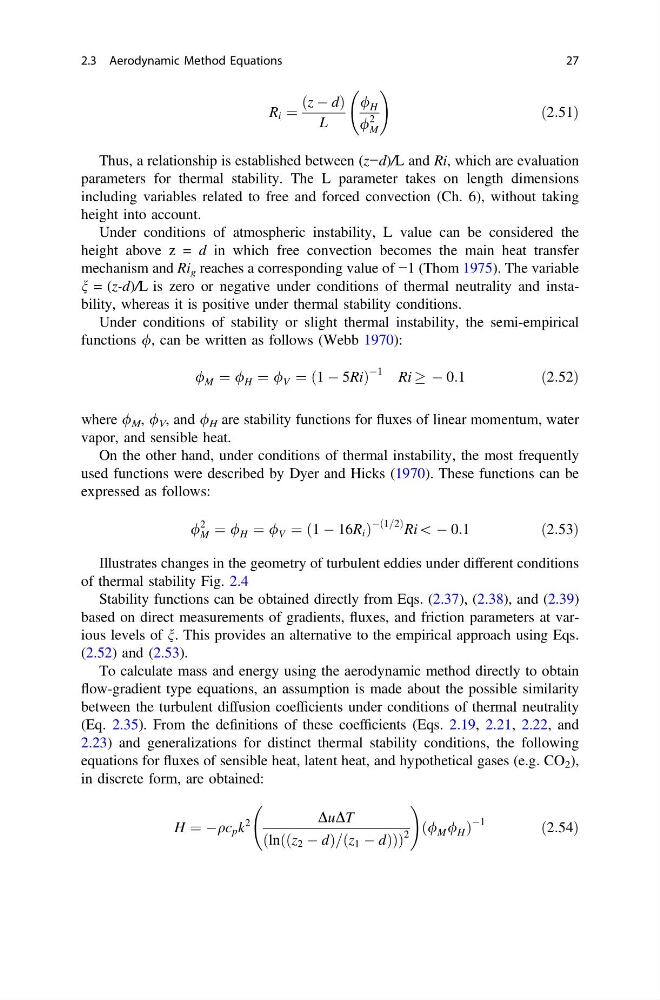
Thus, a relationship is established between (z−d)/L and Ri, which are evaluation
parameters for thermal stability. The L parameter takes on length dimensions
including variables related to free and forced convection (Ch. 6), without taking
height into account.
Under conditions of atmospheric instability, L value can be considered the
height above z = d in which free convection becomes the main heat transfer
mechanism and Ri g reaches a corresponding value of −1 (Thom 1975). The variable
n = (z-d)/L is zero or negative under conditions of thermal neutrality and instability, whereas it is positive under thermal stability conditions.
Under conditions of stability or slight thermal instability, the semi-empirical
functions /, can be written as follows (Webb 1970):
/ M ¼ / H ¼ / V ¼ 1 À 5Ri
ð
Þ
À1 Ri ! À 0:1
ð2:52Þ
where / M , / V , and / H are stability functions for fluxes of linear momentum, water
vapor, and sensible heat.
On the other hand, under conditions of thermal instability, the most frequently
used functions were described by Dyer and Hicks (1970). These functions can be
expressed as follows:
/
2
M ¼ / H ¼ / V ¼ 1 À 16R i
ð
Þ
À 1=2
ð
Þ Ri\ À 0:1
ð2:53Þ
Illustrates changes in the geometry of turbulent eddies under different conditions
of thermal stability Fig. 2.4
Stability functions can be obtained directly from Eqs. (2.37), (2.38), and (2.39)
based on direct measurements of gradients, fluxes, and friction parameters at various levels of n. This provides an alternative to the empirical approach using Eqs.
(2.52) and (2.53).
To calculate mass and energy using the aerodynamic method directly to obtain
flow-gradient type equations, an assumption is made about the possible similarity
between the turbulent diffusion coefficients under conditions of thermal neutrality
(Eq. 2.35). From the definitions of these coefficients (Eqs. 2.19, 2.21, 2.22, and
2.23) and generalizations for distinct thermal stability conditions, the following
equations for fluxes of sensible heat, latent heat, and hypothetical gases (e.g. CO 2 ),
in discrete form, are obtained:
H ¼ Àqc p k
2
DuDT
lnð z 2 À dÞ=ðz 1 À d
ð
Þ Þ
ð
Þ
2
!
/ M / H
ð
Þ
À1
ð2:54Þ
2.3 Aerodynamic Method Equations
27
z À d
ð
Þ
L
/ H
/
2
M
!
ð2:51Þ
Thus, a relationship is established between (z−d)/L and Ri, which are evaluation
parameters for thermal stability. The L parameter takes on length dimensions
including variables related to free and forced convection (Ch. 6), without taking
height into account.
Under conditions of atmospheric instability, L value can be considered the
height above z = d in which free convection becomes the main heat transfer
mechanism and Ri g reaches a corresponding value of −1 (Thom 1975). The variable
n = (z-d)/L is zero or negative under conditions of thermal neutrality and instability, whereas it is positive under thermal stability conditions.
Under conditions of stability or slight thermal instability, the semi-empirical
functions /, can be written as follows (Webb 1970):
/ M ¼ / H ¼ / V ¼ 1 À 5Ri
ð
Þ
À1 Ri ! À 0:1
ð2:52Þ
where / M , / V , and / H are stability functions for fluxes of linear momentum, water
vapor, and sensible heat.
On the other hand, under conditions of thermal instability, the most frequently
used functions were described by Dyer and Hicks (1970). These functions can be
expressed as follows:
/
2
M ¼ / H ¼ / V ¼ 1 À 16R i
ð
Þ
À 1=2
ð
Þ Ri\ À 0:1
ð2:53Þ
Illustrates changes in the geometry of turbulent eddies under different conditions
of thermal stability Fig. 2.4
Stability functions can be obtained directly from Eqs. (2.37), (2.38), and (2.39)
based on direct measurements of gradients, fluxes, and friction parameters at various levels of n. This provides an alternative to the empirical approach using Eqs.
(2.52) and (2.53).
To calculate mass and energy using the aerodynamic method directly to obtain
flow-gradient type equations, an assumption is made about the possible similarity
between the turbulent diffusion coefficients under conditions of thermal neutrality
(Eq. 2.35). From the definitions of these coefficients (Eqs. 2.19, 2.21, 2.22, and
2.23) and generalizations for distinct thermal stability conditions, the following
equations for fluxes of sensible heat, latent heat, and hypothetical gases (e.g. CO 2 ),
in discrete form, are obtained:
H ¼ Àqc p k
2
DuDT
lnð z 2 À dÞ=ðz 1 À d
ð
Þ Þ
ð
Þ
2
!
/ M / H
ð
Þ
À1
ð2:54Þ
2.3 Aerodynamic Method Equations
27