

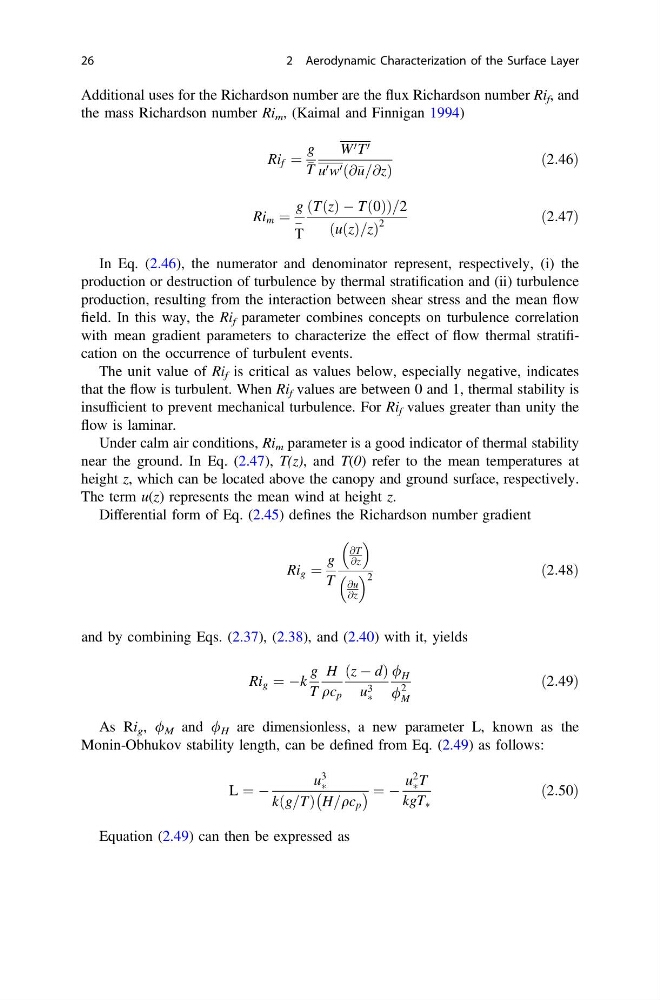
Additional uses for the Richardson number are the flux Richardson number Ri f , and
the mass Richardson number Ri m , (Kaimal and Finnigan 1994)
Ri f ¼
g
T
W 0 T 0
u 0 w 0 @ u=@z
ð
Þ
ð2:46Þ
Ri m ¼
g
À
T
T z
ð Þ À T 0
ð Þ
ð
Þ =2
u z
ð Þ=z
ð
Þ
2
ð2:47Þ
In Eq. (2.46), the numerator and denominator represent, respectively, (i) the
production or destruction of turbulence by thermal stratification and (ii) turbulence
production, resulting from the interaction between shear stress and the mean flow
field. In this way, the Ri f parameter combines concepts on turbulence correlation
with mean gradient parameters to characterize the effect of flow thermal stratification on the occurrence of turbulent events.
The unit value of Ri f is critical as values below, especially negative, indicates
that the flow is turbulent. When Ri f values are between 0 and 1, thermal stability is
insufficient to prevent mechanical turbulence. For Ri f values greater than unity the
flow is laminar.
Under calm air conditions, Ri m parameter is a good indicator of thermal stability
near the ground. In Eq. (2.47), T(z), and T(0) refer to the mean temperatures at
height z, which can be located above the canopy and ground surface, respectively.
The term u(z) represents the mean wind at height z.
Differential form of Eq. (2.45) defines the Richardson number gradient
Ri g ¼
g
T
@T
@z
@u
@z
2
ð2:48Þ
and by combining Eqs. (2.37), (2.38), and (2.40) with it, yields
Ri g ¼ Àk
g
T
H
qc p
z À d
ð
Þ
u 3
Ã
/ H
/
2
M
ð2:49Þ
As Ri g , / M and / H are dimensionless, a new parameter L, known as the
Monin-Obhukov stability length, can be defined from Eq. (2.49) as follows:
L ¼ À
u
3
Ã
k g=T
ð
Þ H=qc p
À
Á¼ À
u
2
à T
kgT Ã
ð2:50Þ
Equation (2.49) can then be expressed as
26
2 Aerodynamic Characterization of the Surface Layer
the mass Richardson number Ri m , (Kaimal and Finnigan 1994)
Ri f ¼
g
T
W 0 T 0
u 0 w 0 @ u=@z
ð
Þ
ð2:46Þ
Ri m ¼
g
À
T
T z
ð Þ À T 0
ð Þ
ð
Þ =2
u z
ð Þ=z
ð
Þ
2
ð2:47Þ
In Eq. (2.46), the numerator and denominator represent, respectively, (i) the
production or destruction of turbulence by thermal stratification and (ii) turbulence
production, resulting from the interaction between shear stress and the mean flow
field. In this way, the Ri f parameter combines concepts on turbulence correlation
with mean gradient parameters to characterize the effect of flow thermal stratification on the occurrence of turbulent events.
The unit value of Ri f is critical as values below, especially negative, indicates
that the flow is turbulent. When Ri f values are between 0 and 1, thermal stability is
insufficient to prevent mechanical turbulence. For Ri f values greater than unity the
flow is laminar.
Under calm air conditions, Ri m parameter is a good indicator of thermal stability
near the ground. In Eq. (2.47), T(z), and T(0) refer to the mean temperatures at
height z, which can be located above the canopy and ground surface, respectively.
The term u(z) represents the mean wind at height z.
Differential form of Eq. (2.45) defines the Richardson number gradient
Ri g ¼
g
T
@T
@z
@u
@z
2
ð2:48Þ
and by combining Eqs. (2.37), (2.38), and (2.40) with it, yields
Ri g ¼ Àk
g
T
H
qc p
z À d
ð
Þ
u 3
Ã
/ H
/
2
M
ð2:49Þ
As Ri g , / M and / H are dimensionless, a new parameter L, known as the
Monin-Obhukov stability length, can be defined from Eq. (2.49) as follows:
L ¼ À
u
3
Ã
k g=T
ð
Þ H=qc p
À
Á¼ À
u
2
à T
kgT Ã
ð2:50Þ
Equation (2.49) can then be expressed as
26
2 Aerodynamic Characterization of the Surface Layer