

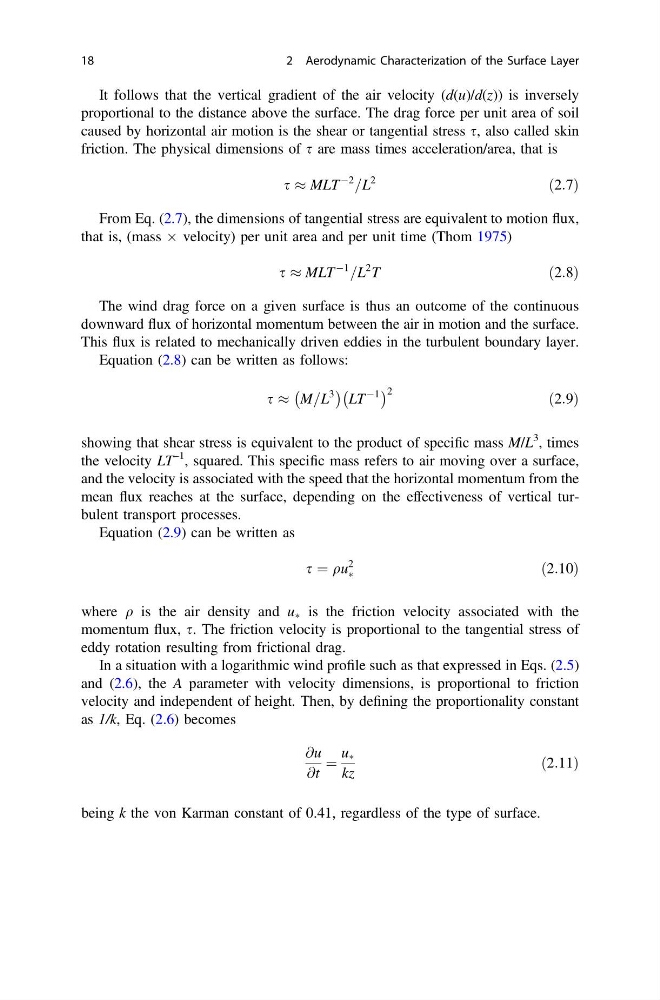
It follows that the vertical gradient of the air velocity (d(u)/d(z)) is inversely
proportional to the distance above the surface. The drag force per unit area of soil
caused by horizontal air motion is the shear or tangential stress s, also called skin
friction. The physical dimensions of s are mass times acceleration/area, that is
s % MLT
À2
=L
2
ð2:7Þ
From Eq. (2.7), the dimensions of tangential stress are equivalent to motion flux,
that is, (mass  velocity) per unit area and per unit time (Thom 1975)
s % MLT
À1
=L
2 T
ð2:8Þ
The wind drag force on a given surface is thus an outcome of the continuous
downward flux of horizontal momentum between the air in motion and the surface.
This flux is related to mechanically driven eddies in the turbulent boundary layer.
Equation (2.8) can be written as follows:
s % M=L
3
À
Á
LT
À1
À
Á 2
ð2:9Þ
showing that shear stress is equivalent to the product of specific mass M/L
3 , times
the velocity LT
–1 , squared. This specific mass refers to air moving over a surface,
and the velocity is associated with the speed that the horizontal momentum from the
mean flux reaches at the surface, depending on the effectiveness of vertical turbulent transport processes.
Equation (2.9) can be written as
s ¼ qu
2
Ã
ð2:10Þ
where q is the air density and u à is the friction velocity associated with the
momentum flux, s. The friction velocity is proportional to the tangential stress of
eddy rotation resulting from frictional drag.
In a situation with a logarithmic wind profile such as that expressed in Eqs. (2.5)
and (2.6), the A parameter with velocity dimensions, is proportional to friction
velocity and independent of height. Then, by defining the proportionality constant
as 1/k, Eq. (2.6) becomes
@u
@t
¼
u Ã
kz
ð2:11Þ
being k the von Karman constant of 0.41, regardless of the type of surface.
18
2 Aerodynamic Characterization of the Surface Layer
proportional to the distance above the surface. The drag force per unit area of soil
caused by horizontal air motion is the shear or tangential stress s, also called skin
friction. The physical dimensions of s are mass times acceleration/area, that is
s % MLT
À2
=L
2
ð2:7Þ
From Eq. (2.7), the dimensions of tangential stress are equivalent to motion flux,
that is, (mass  velocity) per unit area and per unit time (Thom 1975)
s % MLT
À1
=L
2 T
ð2:8Þ
The wind drag force on a given surface is thus an outcome of the continuous
downward flux of horizontal momentum between the air in motion and the surface.
This flux is related to mechanically driven eddies in the turbulent boundary layer.
Equation (2.8) can be written as follows:
s % M=L
3
À
Á
LT
À1
À
Á 2
ð2:9Þ
showing that shear stress is equivalent to the product of specific mass M/L
3 , times
the velocity LT
–1 , squared. This specific mass refers to air moving over a surface,
and the velocity is associated with the speed that the horizontal momentum from the
mean flux reaches at the surface, depending on the effectiveness of vertical turbulent transport processes.
Equation (2.9) can be written as
s ¼ qu
2
Ã
ð2:10Þ
where q is the air density and u à is the friction velocity associated with the
momentum flux, s. The friction velocity is proportional to the tangential stress of
eddy rotation resulting from frictional drag.
In a situation with a logarithmic wind profile such as that expressed in Eqs. (2.5)
and (2.6), the A parameter with velocity dimensions, is proportional to friction
velocity and independent of height. Then, by defining the proportionality constant
as 1/k, Eq. (2.6) becomes
@u
@t
¼
u Ã
kz
ð2:11Þ
being k the von Karman constant of 0.41, regardless of the type of surface.
18
2 Aerodynamic Characterization of the Surface Layer