

Quantification of the vertical flux of scalar quantities such as water vapor and
sensible heat is simpler using the aerodynamic model insofar that, unlike linear
momentum and in the absence of buoyancy, these do not interact with mean
velocity fields, being, therefore, passive elements subjected to fluid flow.
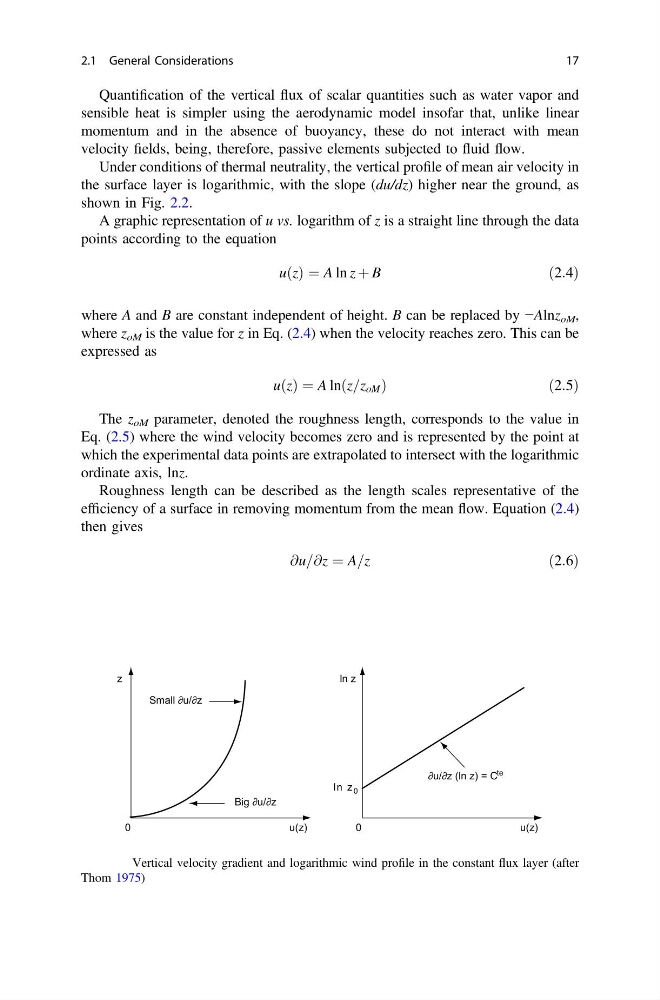
Under conditions of thermal neutrality, the vertical profile of mean air velocity in
the surface layer is logarithmic, with the slope (du/dz) higher near the ground, as
shown in Fig. 2.2.
A graphic representation of u vs. logarithm of z is a straight line through the data
points according to the equation
uðzÞ ¼ A ln z þ B
ð2:4Þ
where A and B are constant independent of height. B can be replaced by −Alnz oM ,
where z oM is the value for z in Eq. (2.4) when the velocity reaches zero. This can be
expressed as
uðzÞ ¼ A ln z=z oM
ð
Þ
ð2:5Þ
The z oM parameter, denoted the roughness length, corresponds to the value in
Eq. (2.5) where the wind velocity becomes zero and is represented by the point at
which the experimental data points are extrapolated to intersect with the logarithmic
ordinate axis, lnz.
Roughness length can be described as the length scales representative of the
efficiency of a surface in removing momentum from the mean flow. Equation (2.4)
then gives
@u=@z ¼ A=z
ð2:6Þ
Fig. 2.2 Vertical velocity gradient and logarithmic wind profile in the constant flux layer (after
Thom 1975)
2.1 General Considerations
17
sensible heat is simpler using the aerodynamic model insofar that, unlike linear
momentum and in the absence of buoyancy, these do not interact with mean
velocity fields, being, therefore, passive elements subjected to fluid flow.
Under conditions of thermal neutrality, the vertical profile of mean air velocity in
the surface layer is logarithmic, with the slope (du/dz) higher near the ground, as
shown in Fig. 2.2.
A graphic representation of u vs. logarithm of z is a straight line through the data
points according to the equation
uðzÞ ¼ A ln z þ B
ð2:4Þ
where A and B are constant independent of height. B can be replaced by −Alnz oM ,
where z oM is the value for z in Eq. (2.4) when the velocity reaches zero. This can be
expressed as
uðzÞ ¼ A ln z=z oM
ð
Þ
ð2:5Þ
The z oM parameter, denoted the roughness length, corresponds to the value in
Eq. (2.5) where the wind velocity becomes zero and is represented by the point at
which the experimental data points are extrapolated to intersect with the logarithmic
ordinate axis, lnz.
Roughness length can be described as the length scales representative of the
efficiency of a surface in removing momentum from the mean flow. Equation (2.4)
then gives
@u=@z ¼ A=z
ð2:6Þ
Fig. 2.2 Vertical velocity gradient and logarithmic wind profile in the constant flux layer (after
Thom 1975)
2.1 General Considerations
17