

The laminar sublayer remains on the surface and its thickness is dependent on-air
velocity and surface roughness. In this sublayer, there is no convection, and
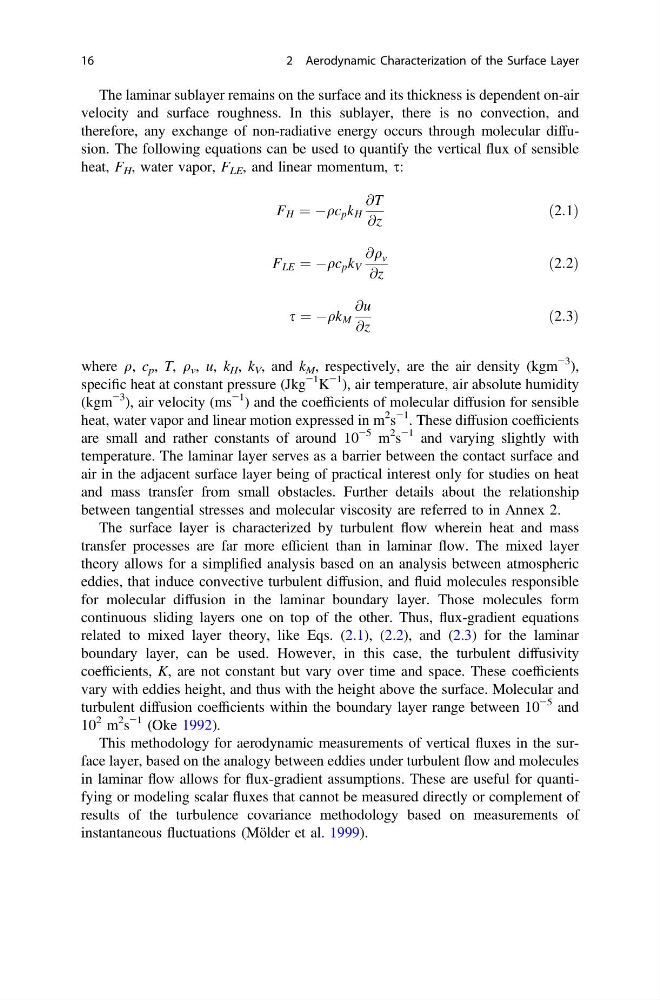
therefore, any exchange of non-radiative energy occurs through molecular diffusion. The following equations can be used to quantify the vertical flux of sensible
heat, F H , water vapor, F LE , and linear momentum, s:
F H ¼ Àqc p k H
@T
@z
ð2:1Þ
F LE ¼ Àqc p k V
@q v
@z
ð2:2Þ
s ¼ Àqk M
@u
@z
ð2:3Þ
where q, c p , T, q v , u, k H , k V , and k M , respectively, are the air density (kgm
−3 ),
specific heat at constant pressure (Jkg
−1 K
−1
), air temperature, air absolute humidity
(kgm
−3 ), air velocity (ms
−1 ) and the coefficients of molecular diffusion for sensible
heat, water vapor and linear motion expressed in m
2 s
−1 . These diffusion coefficients
are small and rather constants of around 10
−5 m
2 s
−1 and varying slightly with
temperature. The laminar layer serves as a barrier between the contact surface and
air in the adjacent surface layer being of practical interest only for studies on heat
and mass transfer from small obstacles. Further details about the relationship
between tangential stresses and molecular viscosity are referred to in Annex 2.
The surface layer is characterized by turbulent flow wherein heat and mass
transfer processes are far more efficient than in laminar flow. The mixed layer
theory allows for a simplified analysis based on an analysis between atmospheric
eddies, that induce convective turbulent diffusion, and fluid molecules responsible
for molecular diffusion in the laminar boundary layer. Those molecules form
continuous sliding layers one on top of the other. Thus, flux-gradient equations
related to mixed layer theory, like Eqs. (2.1), (2.2), and (2.3) for the laminar
boundary layer, can be used. However, in this case, the turbulent diffusivity
coefficients, K, are not constant but vary over time and space. These coefficients
vary with eddies height, and thus with the height above the surface. Molecular and
turbulent diffusion coefficients within the boundary layer range between 10
−5 and
10
2 m
2 s
−1 (Oke 1992).
This methodology for aerodynamic measurements of vertical fluxes in the surface layer, based on the analogy between eddies under turbulent flow and molecules
in laminar flow allows for flux-gradient assumptions. These are useful for quantifying or modeling scalar fluxes that cannot be measured directly or complement of
results of the turbulence covariance methodology based on measurements of
instantaneous fluctuations (Mölder et al. 1999).
16
2 Aerodynamic Characterization of the Surface Layer
velocity and surface roughness. In this sublayer, there is no convection, and
therefore, any exchange of non-radiative energy occurs through molecular diffusion. The following equations can be used to quantify the vertical flux of sensible
heat, F H , water vapor, F LE , and linear momentum, s:
F H ¼ Àqc p k H
@T
@z
ð2:1Þ
F LE ¼ Àqc p k V
@q v
@z
ð2:2Þ
s ¼ Àqk M
@u
@z
ð2:3Þ
where q, c p , T, q v , u, k H , k V , and k M , respectively, are the air density (kgm
−3 ),
specific heat at constant pressure (Jkg
−1 K
−1
), air temperature, air absolute humidity
(kgm
−3 ), air velocity (ms
−1 ) and the coefficients of molecular diffusion for sensible
heat, water vapor and linear motion expressed in m
2 s
−1 . These diffusion coefficients
are small and rather constants of around 10
−5 m
2 s
−1 and varying slightly with
temperature. The laminar layer serves as a barrier between the contact surface and
air in the adjacent surface layer being of practical interest only for studies on heat
and mass transfer from small obstacles. Further details about the relationship
between tangential stresses and molecular viscosity are referred to in Annex 2.
The surface layer is characterized by turbulent flow wherein heat and mass
transfer processes are far more efficient than in laminar flow. The mixed layer
theory allows for a simplified analysis based on an analysis between atmospheric
eddies, that induce convective turbulent diffusion, and fluid molecules responsible
for molecular diffusion in the laminar boundary layer. Those molecules form
continuous sliding layers one on top of the other. Thus, flux-gradient equations
related to mixed layer theory, like Eqs. (2.1), (2.2), and (2.3) for the laminar
boundary layer, can be used. However, in this case, the turbulent diffusivity
coefficients, K, are not constant but vary over time and space. These coefficients
vary with eddies height, and thus with the height above the surface. Molecular and
turbulent diffusion coefficients within the boundary layer range between 10
−5 and
10
2 m
2 s
−1 (Oke 1992).
This methodology for aerodynamic measurements of vertical fluxes in the surface layer, based on the analogy between eddies under turbulent flow and molecules
in laminar flow allows for flux-gradient assumptions. These are useful for quantifying or modeling scalar fluxes that cannot be measured directly or complement of
results of the turbulence covariance methodology based on measurements of
instantaneous fluctuations (Mölder et al. 1999).
16
2 Aerodynamic Characterization of the Surface Layer