

a container of water. If the air is not saturated, part of the gauze water will
evaporate, and its cooling, due to evaporation, is recorded continuously by the
temperature of the respective thermocouple (wet temperature). The system, which is
generally tubular, is isolated from the ambient radiation, for example by a silver
foil, and subjected to a steady flow of suction of indoor air by a fan. The difference
between the two temperatures is a function of the relative humidity of the air.
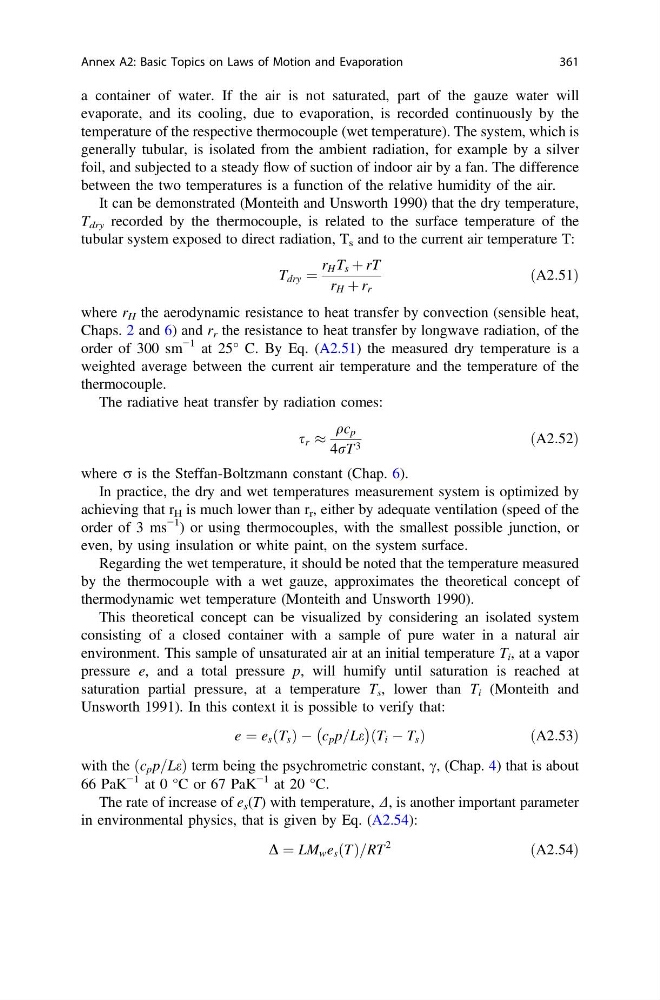
It can be demonstrated (Monteith and Unsworth 1990) that the dry temperature,
T dry recorded by the thermocouple, is related to the surface temperature of the
tubular system exposed to direct radiation, T s and to the current air temperature T:
T dry ¼
r H T s þ rT
r H þ r r
ðA2:51Þ
where r H the aerodynamic resistance to heat transfer by convection (sensible heat,
Chaps. 2 and 6) and r r the resistance to heat transfer by longwave radiation, of the
order of 300 sm
−1 at 25° C. By Eq. (A2.51) the measured dry temperature is a
weighted average between the current air temperature and the temperature of the
thermocouple.
The radiative heat transfer by radiation comes:
s r %
qc p
4rT 3
ðA2:52Þ
where r is the Steffan-Boltzmann constant (Chap. 6).
In practice, the dry and wet temperatures measurement system is optimized by
achieving that r H is much lower than r r , either by adequate ventilation (speed of the
order of 3 ms
−1 ) or using thermocouples, with the smallest possible junction, or
even, by using insulation or white paint, on the system surface.
Regarding the wet temperature, it should be noted that the temperature measured
by the thermocouple with a wet gauze, approximates the theoretical concept of
thermodynamic wet temperature (Monteith and Unsworth 1990).
This theoretical concept can be visualized by considering an isolated system
consisting of a closed container with a sample of pure water in a natural air
environment. This sample of unsaturated air at an initial temperature T i , at a vapor
pressure e, and a total pressure p, will humify until saturation is reached at
saturation partial pressure, at a temperature T s , lower than T i (Monteith and
Unsworth 1991). In this context it is possible to verify that:
e ¼ e s T s
ð Þ À c p p=Le
À
Á
T i À T s
ð
Þ
ðA2:53Þ
with the ðc p p=LeÞ term being the psychrometric constant, c, (Chap. 4) that is about
66 PaK
−1 at 0 °C or 67 PaK
−1 at 20 °C.
The rate of increase of e s (T) with temperature, D, is another important parameter
in environmental physics, that is given by Eq. (A2.54):
D ¼ LM w e s ðTÞ=RT
2
ðA2:54Þ
Annex A2: Basic Topics on Laws of Motion and Evaporation
361
evaporate, and its cooling, due to evaporation, is recorded continuously by the
temperature of the respective thermocouple (wet temperature). The system, which is
generally tubular, is isolated from the ambient radiation, for example by a silver
foil, and subjected to a steady flow of suction of indoor air by a fan. The difference
between the two temperatures is a function of the relative humidity of the air.
It can be demonstrated (Monteith and Unsworth 1990) that the dry temperature,
T dry recorded by the thermocouple, is related to the surface temperature of the
tubular system exposed to direct radiation, T s and to the current air temperature T:
T dry ¼
r H T s þ rT
r H þ r r
ðA2:51Þ
where r H the aerodynamic resistance to heat transfer by convection (sensible heat,
Chaps. 2 and 6) and r r the resistance to heat transfer by longwave radiation, of the
order of 300 sm
−1 at 25° C. By Eq. (A2.51) the measured dry temperature is a
weighted average between the current air temperature and the temperature of the
thermocouple.
The radiative heat transfer by radiation comes:
s r %
qc p
4rT 3
ðA2:52Þ
where r is the Steffan-Boltzmann constant (Chap. 6).
In practice, the dry and wet temperatures measurement system is optimized by
achieving that r H is much lower than r r , either by adequate ventilation (speed of the
order of 3 ms
−1 ) or using thermocouples, with the smallest possible junction, or
even, by using insulation or white paint, on the system surface.
Regarding the wet temperature, it should be noted that the temperature measured
by the thermocouple with a wet gauze, approximates the theoretical concept of
thermodynamic wet temperature (Monteith and Unsworth 1990).
This theoretical concept can be visualized by considering an isolated system
consisting of a closed container with a sample of pure water in a natural air
environment. This sample of unsaturated air at an initial temperature T i , at a vapor
pressure e, and a total pressure p, will humify until saturation is reached at
saturation partial pressure, at a temperature T s , lower than T i (Monteith and
Unsworth 1991). In this context it is possible to verify that:
e ¼ e s T s
ð Þ À c p p=Le
À
Á
T i À T s
ð
Þ
ðA2:53Þ
with the ðc p p=LeÞ term being the psychrometric constant, c, (Chap. 4) that is about
66 PaK
−1 at 0 °C or 67 PaK
−1 at 20 °C.
The rate of increase of e s (T) with temperature, D, is another important parameter
in environmental physics, that is given by Eq. (A2.54):
D ¼ LM w e s ðTÞ=RT
2
ðA2:54Þ
Annex A2: Basic Topics on Laws of Motion and Evaporation
361