

molecules can delay the time required to reach a new equilibrium. So, the
equilibriums for evaporation in the atmosphere and in the vacuum will occur at the
same vapor pressure. If the water container is large or open, the water may
evaporate completely without reaching the saturation of the surrounding air (e.g.,
Giancoli 2000).
The dryness of the ambient climate depends on the moisture content of the air. In
the atmospheric air, there is a mixture of gases, including water vapor, and the total
(atmospheric) pressure is the sum of the partial pressures of the constituent gases.
The partial pressure of each gas is equivalent to the total pressure that gas would
exert if it were isolated in the same control volume. The partial pressure of the water
vapor can thus vary from zero to a maximum value equal to the saturation pressure
of water vapor at the same temperature. For example, the water vapor saturation
pressure is 3.17 kPa at 25 °C.
If the partial pressure of water vapor exceeds the saturation pressure, as it can
happen in night cooling conditions, the atmosphere is said to be supersaturated and
the excess water vapor condenses in the form of dew (or under peculiar physical
conditions such as fog) or precipitation). When a portion of humid air, in isolation
conditions, is cooled, the temperature will drop to such an extent that the partial
pressure of water vapor is equivalent to the saturation pressure. This temperature
value is known as the dew point.
The measurement of the dew point is one of the methods that allow the
determination of the relative humidity of the air. For this purpose, for example, a
polished metal surface subjected to a cooling process, in contact with the moist air,
may be used. If, for example, the ambient temperature is 30 °C and the dew point
temperature is 10 °C, the original vapor pressure will be 1.23 kPa (saturation
pressure at the dew point temperature), the saturation pressure will be of 4.24 kPa
and the relative humidity will be 1.23/4.24 or 29%.
Another process for evaluating the relative humidity of the air, consists of using
an aspiration psychrometer, (Appendix A1) whose principle is based on the
measurement of two temperatures, dry and wet, by applying appropriate sensors, for
example, thermocouples, under normal conditions and soaking in gauze, dipped in
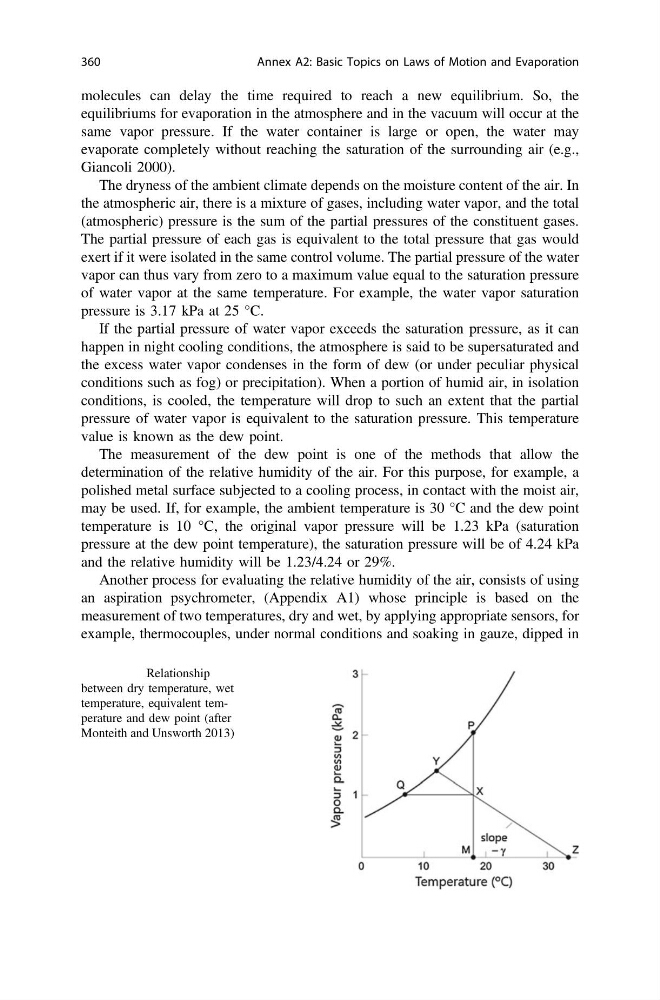
Fig. A2.10 Relationship
between dry temperature, wet
temperature, equivalent temperature and dew point (after
Monteith and Unsworth 2013)
360
Annex A2: Basic Topics on Laws of Motion and Evaporation
equilibriums for evaporation in the atmosphere and in the vacuum will occur at the
same vapor pressure. If the water container is large or open, the water may
evaporate completely without reaching the saturation of the surrounding air (e.g.,
Giancoli 2000).
The dryness of the ambient climate depends on the moisture content of the air. In
the atmospheric air, there is a mixture of gases, including water vapor, and the total
(atmospheric) pressure is the sum of the partial pressures of the constituent gases.
The partial pressure of each gas is equivalent to the total pressure that gas would
exert if it were isolated in the same control volume. The partial pressure of the water
vapor can thus vary from zero to a maximum value equal to the saturation pressure
of water vapor at the same temperature. For example, the water vapor saturation
pressure is 3.17 kPa at 25 °C.
If the partial pressure of water vapor exceeds the saturation pressure, as it can
happen in night cooling conditions, the atmosphere is said to be supersaturated and
the excess water vapor condenses in the form of dew (or under peculiar physical
conditions such as fog) or precipitation). When a portion of humid air, in isolation
conditions, is cooled, the temperature will drop to such an extent that the partial
pressure of water vapor is equivalent to the saturation pressure. This temperature
value is known as the dew point.
The measurement of the dew point is one of the methods that allow the
determination of the relative humidity of the air. For this purpose, for example, a
polished metal surface subjected to a cooling process, in contact with the moist air,
may be used. If, for example, the ambient temperature is 30 °C and the dew point
temperature is 10 °C, the original vapor pressure will be 1.23 kPa (saturation
pressure at the dew point temperature), the saturation pressure will be of 4.24 kPa
and the relative humidity will be 1.23/4.24 or 29%.
Another process for evaluating the relative humidity of the air, consists of using
an aspiration psychrometer, (Appendix A1) whose principle is based on the
measurement of two temperatures, dry and wet, by applying appropriate sensors, for
example, thermocouples, under normal conditions and soaking in gauze, dipped in
Fig. A2.10 Relationship
between dry temperature, wet
temperature, equivalent temperature and dew point (after
Monteith and Unsworth 2013)
360
Annex A2: Basic Topics on Laws of Motion and Evaporation