

The pressure difference induces a force gradient directed towards the smaller
diameter zone, inducing an acceleration (increase in velocity) of the volume of
water. In turn, when the fluid enters the larger diameter zone, there will be a
decrease in the flow velocity and a pressure difference, now oriented in the opposite
direction to the displacement of the water, justify the decrease in its velocity and,
consequently an increase in pressure.
A2.4.5 Viscosity and Newtonian Fluids
Under real conditions fluids exert friction or viscosity due to resistance of the fluid
during laminar flow. Fluids (e.g. oils, water or gases) display viscosity in varying
extents. To visualize viscosity, suppose that a thin layer of fluid is placed between
two infinite smooth plates, whereby the upper plate moves with a movement, du,
and the lower plate is immobile. The layers of fluid in contact with each of the
plates adhere to their surfaces due to forces between the molecules of the fluid and
the molecules of the plates. In this way, the upper fluid layer moves with the same
velocity of the upper plate and the lower fluid layer remains immobile.
The lower layer of fluid exerts a retarding effect on the top of the adjacent layer
of fluid and this process is repeated until the layer contacts the uppermost layer. The
velocity of the fluid will vary from 0 to du, according to a gradient du/l, where l is
the distance between the plates. A force, F is needed to move the top plate, so that
for a given fluid, the required force is proportional to the area of fluid, in contact
with each plate, A, at velocity du and inversely proportional to the separation
distance, l of the plates. For different fluids, the higher the viscosity, the greater the
plate displacement force. The coefficient of absolute or dynamic viscosity of a fluid
l, can be defined from the equation:
F ¼ lA
du
l
ðA2:47Þ
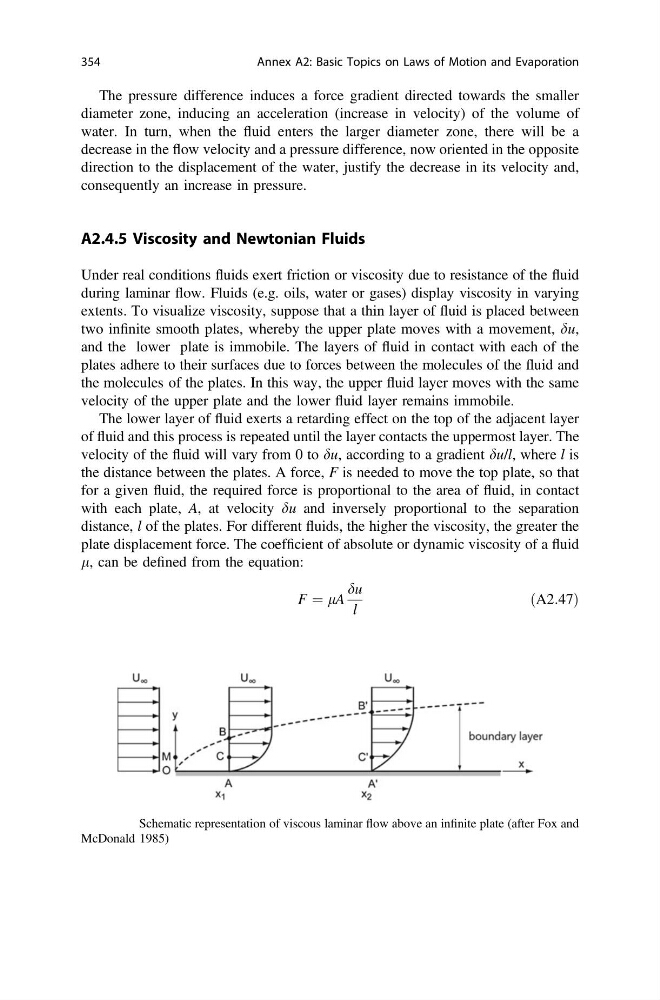
Fig. A2.8 Schematic representation of viscous laminar flow above an infinite plate (after Fox and
McDonald 1985)
354
Annex A2: Basic Topics on Laws of Motion and Evaporation
diameter zone, inducing an acceleration (increase in velocity) of the volume of
water. In turn, when the fluid enters the larger diameter zone, there will be a
decrease in the flow velocity and a pressure difference, now oriented in the opposite
direction to the displacement of the water, justify the decrease in its velocity and,
consequently an increase in pressure.
A2.4.5 Viscosity and Newtonian Fluids
Under real conditions fluids exert friction or viscosity due to resistance of the fluid
during laminar flow. Fluids (e.g. oils, water or gases) display viscosity in varying
extents. To visualize viscosity, suppose that a thin layer of fluid is placed between
two infinite smooth plates, whereby the upper plate moves with a movement, du,
and the lower plate is immobile. The layers of fluid in contact with each of the
plates adhere to their surfaces due to forces between the molecules of the fluid and
the molecules of the plates. In this way, the upper fluid layer moves with the same
velocity of the upper plate and the lower fluid layer remains immobile.
The lower layer of fluid exerts a retarding effect on the top of the adjacent layer
of fluid and this process is repeated until the layer contacts the uppermost layer. The
velocity of the fluid will vary from 0 to du, according to a gradient du/l, where l is
the distance between the plates. A force, F is needed to move the top plate, so that
for a given fluid, the required force is proportional to the area of fluid, in contact
with each plate, A, at velocity du and inversely proportional to the separation
distance, l of the plates. For different fluids, the higher the viscosity, the greater the
plate displacement force. The coefficient of absolute or dynamic viscosity of a fluid
l, can be defined from the equation:
F ¼ lA
du
l
ðA2:47Þ
Fig. A2.8 Schematic representation of viscous laminar flow above an infinite plate (after Fox and
McDonald 1985)
354
Annex A2: Basic Topics on Laws of Motion and Evaporation