

The measurement of the static pressure of a theoretical fluid without viscosity,
moving in a horizontal tube, is based on the principle, which can be demonstrated,
that in a flow with horizontal and parallel current lines there is no pressure variation
in the direction perpendicular to the flow (e.g. Fox and McDonald 1985). The
measurement can then be made through a small hole, inserted in the wall of the
tube, with the axis perpendicular to the surface of the tube.
Bernoulli’s principle is best illustrated with an example (Asimov 1993). In a
column of water flowing over a horizontal tube of constant diameter (Fig. A2.6),
water moves at the same rate at all points. Water is under static pressure (otherwise
it would not flow) and the pressure is uniform in the pipe. This can be proved using
a horizontal tube drilled at several points and with vertical tubes inserted in each
outlet. In this condition, the water would rise at the same height in each tube.
The flow of water in a horizontal pipe of variable cross-section with a smaller
diameter zone, located in a constricted area of the pipe, and the diameter of the rest
of the pipe is similar to that of the pipe in the upper Fig. A2.6. As it is not possible
for water to accumulate in any section of the tube, a given volume of water would
have to pass through the smaller diameter tube area, in a time interval equal to what
would be required to pass through an equal length of a tube of normal diameter. For
the volume of water to cross the smaller and normal diameter zones in the same
time interval, its velocity must increase as it enters the smaller diameter zone. The
result of the increase in speed due to the increase in pressure in the fluid coming
from the zone of normal diameter, represents a reduction in pressure in the zone of
smaller diameter and, consequently, a smaller rise in the water.
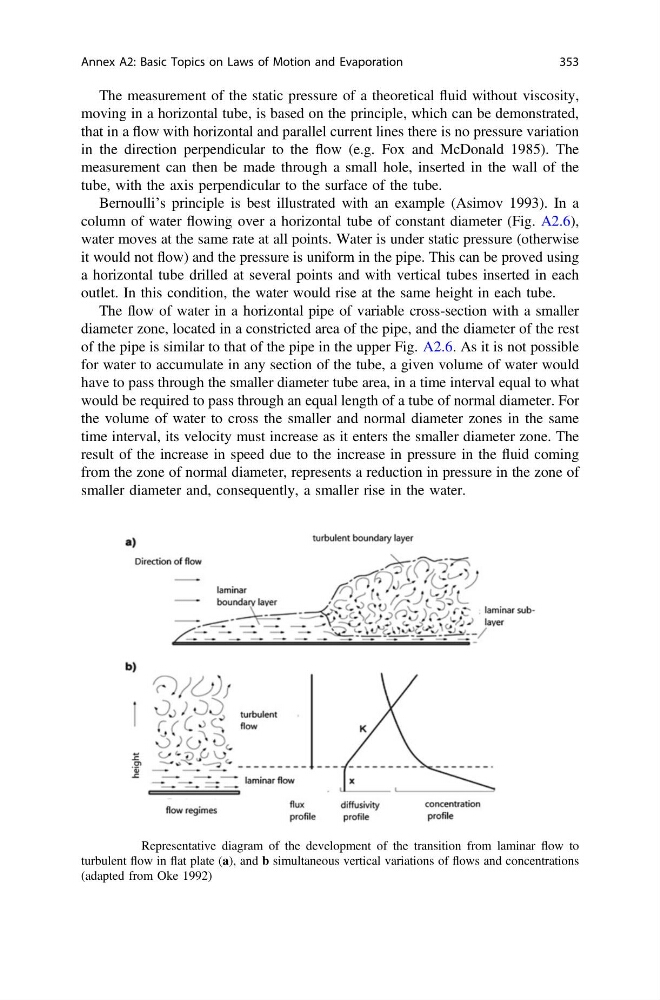
Fig. A2.7 Representative diagram of the development of the transition from laminar flow to
turbulent flow in flat plate (a), and b simultaneous vertical variations of flows and concentrations
(adapted from Oke 1992)
Annex A2: Basic Topics on Laws of Motion and Evaporation
353
moving in a horizontal tube, is based on the principle, which can be demonstrated,
that in a flow with horizontal and parallel current lines there is no pressure variation
in the direction perpendicular to the flow (e.g. Fox and McDonald 1985). The
measurement can then be made through a small hole, inserted in the wall of the
tube, with the axis perpendicular to the surface of the tube.
Bernoulli’s principle is best illustrated with an example (Asimov 1993). In a
column of water flowing over a horizontal tube of constant diameter (Fig. A2.6),
water moves at the same rate at all points. Water is under static pressure (otherwise
it would not flow) and the pressure is uniform in the pipe. This can be proved using
a horizontal tube drilled at several points and with vertical tubes inserted in each
outlet. In this condition, the water would rise at the same height in each tube.
The flow of water in a horizontal pipe of variable cross-section with a smaller
diameter zone, located in a constricted area of the pipe, and the diameter of the rest
of the pipe is similar to that of the pipe in the upper Fig. A2.6. As it is not possible
for water to accumulate in any section of the tube, a given volume of water would
have to pass through the smaller diameter tube area, in a time interval equal to what
would be required to pass through an equal length of a tube of normal diameter. For
the volume of water to cross the smaller and normal diameter zones in the same
time interval, its velocity must increase as it enters the smaller diameter zone. The
result of the increase in speed due to the increase in pressure in the fluid coming
from the zone of normal diameter, represents a reduction in pressure in the zone of
smaller diameter and, consequently, a smaller rise in the water.
Fig. A2.7 Representative diagram of the development of the transition from laminar flow to
turbulent flow in flat plate (a), and b simultaneous vertical variations of flows and concentrations
(adapted from Oke 1992)
Annex A2: Basic Topics on Laws of Motion and Evaporation
353