

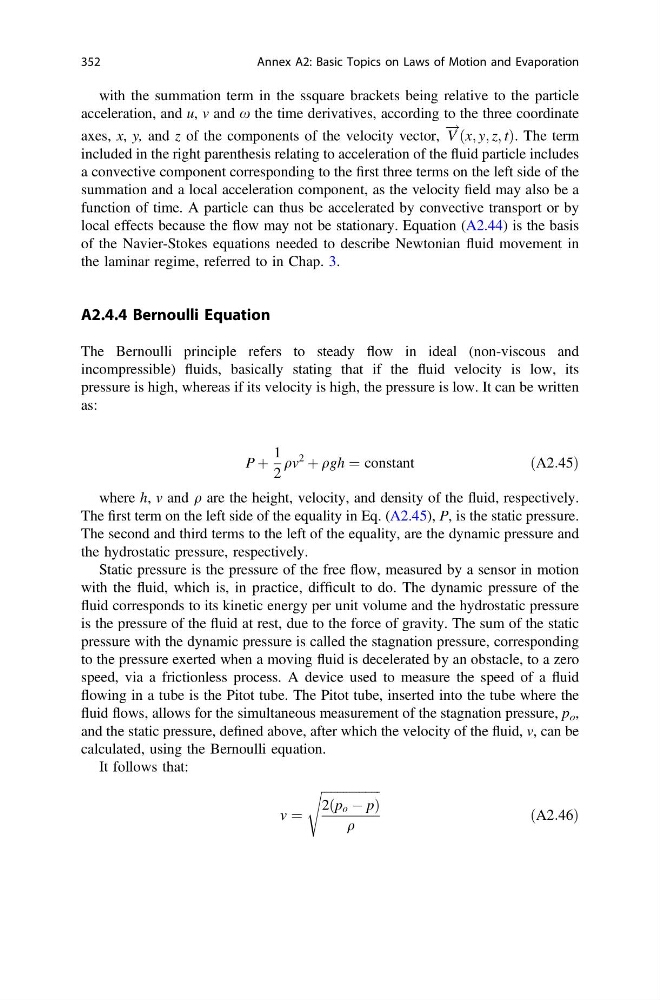
with the summation term in the ssquare brackets being relative to the particle
acceleration, and u, v and x the time derivatives, according to the three coordinate
axes, x, y, and z of the components of the velocity vector, V
!
ðx; y; z; tÞ. The term
included in the right parenthesis relating to acceleration of the fluid particle includes
a convective component corresponding to the first three terms on the left side of the
summation and a local acceleration component, as the velocity field may also be a
function of time. A particle can thus be accelerated by convective transport or by
local effects because the flow may not be stationary. Equation (A2.44) is the basis
of the Navier-Stokes equations needed to describe Newtonian fluid movement in
the laminar regime, referred to in Chap. 3.
A2.4.4 Bernoulli Equation
The Bernoulli principle refers to steady flow in ideal (non-viscous and
incompressible) fluids, basically stating that if the fluid velocity is low, its
pressure is high, whereas if its velocity is high, the pressure is low. It can be written
as:
P þ
1
2
qv
2
þ qgh ¼ constant
ðA2:45Þ
where h, v and q are the height, velocity, and density of the fluid, respectively.
The first term on the left side of the equality in Eq. (A2.45), P, is the static pressure.
The second and third terms to the left of the equality, are the dynamic pressure and
the hydrostatic pressure, respectively.
Static pressure is the pressure of the free flow, measured by a sensor in motion
with the fluid, which is, in practice, difficult to do. The dynamic pressure of the
fluid corresponds to its kinetic energy per unit volume and the hydrostatic pressure
is the pressure of the fluid at rest, due to the force of gravity. The sum of the static
pressure with the dynamic pressure is called the stagnation pressure, corresponding
to the pressure exerted when a moving fluid is decelerated by an obstacle, to a zero
speed, via a frictionless process. A device used to measure the speed of a fluid
flowing in a tube is the Pitot tube. The Pitot tube, inserted into the tube where the
fluid flows, allows for the simultaneous measurement of the stagnation pressure, p o ,
and the static pressure, defined above, after which the velocity of the fluid, v, can be
calculated, using the Bernoulli equation.
It follows that:
v ¼
ffiffiffiffiffiffiffiffiffiffiffiffiffiffiffiffiffiffiffi
2ðp o À pÞ
q
s
ðA2:46Þ
352
Annex A2: Basic Topics on Laws of Motion and Evaporation
acceleration, and u, v and x the time derivatives, according to the three coordinate
axes, x, y, and z of the components of the velocity vector, V
!
ðx; y; z; tÞ. The term
included in the right parenthesis relating to acceleration of the fluid particle includes
a convective component corresponding to the first three terms on the left side of the
summation and a local acceleration component, as the velocity field may also be a
function of time. A particle can thus be accelerated by convective transport or by
local effects because the flow may not be stationary. Equation (A2.44) is the basis
of the Navier-Stokes equations needed to describe Newtonian fluid movement in
the laminar regime, referred to in Chap. 3.
A2.4.4 Bernoulli Equation
The Bernoulli principle refers to steady flow in ideal (non-viscous and
incompressible) fluids, basically stating that if the fluid velocity is low, its
pressure is high, whereas if its velocity is high, the pressure is low. It can be written
as:
P þ
1
2
qv
2
þ qgh ¼ constant
ðA2:45Þ
where h, v and q are the height, velocity, and density of the fluid, respectively.
The first term on the left side of the equality in Eq. (A2.45), P, is the static pressure.
The second and third terms to the left of the equality, are the dynamic pressure and
the hydrostatic pressure, respectively.
Static pressure is the pressure of the free flow, measured by a sensor in motion
with the fluid, which is, in practice, difficult to do. The dynamic pressure of the
fluid corresponds to its kinetic energy per unit volume and the hydrostatic pressure
is the pressure of the fluid at rest, due to the force of gravity. The sum of the static
pressure with the dynamic pressure is called the stagnation pressure, corresponding
to the pressure exerted when a moving fluid is decelerated by an obstacle, to a zero
speed, via a frictionless process. A device used to measure the speed of a fluid
flowing in a tube is the Pitot tube. The Pitot tube, inserted into the tube where the
fluid flows, allows for the simultaneous measurement of the stagnation pressure, p o ,
and the static pressure, defined above, after which the velocity of the fluid, v, can be
calculated, using the Bernoulli equation.
It follows that:
v ¼
ffiffiffiffiffiffiffiffiffiffiffiffiffiffiffiffiffiffiffi
2ðp o À pÞ
q
s
ðA2:46Þ
352
Annex A2: Basic Topics on Laws of Motion and Evaporation