

Viscosity in SI units is expressed by Nsm
−2 (newton-second per square meter) or
Pa.s (pascal-second). Typical values of the absolute viscosity coefficient in Pa.s are
1 Â 10
−3 for water at 20 °C, 4 Â10
−3 for blood at 37 °C 200 Â10
−3 for automotive
oil at 30 °C, and 1500 Â 10
−3 for glycerol (Giancoli 2000). Gases, such as air or
water vapor, typical have lower viscosity of about 0.0018 Â 10
−3 or 0.0013 Â 10
−3 ,
respectively. The viscosity of liquids decreases with increasing temperature.
The force, F, applied to the upper plate, directly proportional to the viscosity of
the fluid, is a tangential force to the fluid layers and, therefore, normal to the
perpendicular to the surface of the plates. This induces a tangential deformation of
the fluid, characterized, as mentioned, by the tangential movement of some layers of
the fluid relative to the others.
This tangential deformation enables fluids to adopt the geometry of the container.
A fluid can be defined as a substance that is continuously deformed under tangential
force or tension, regardless of its magnitude. The fluid is said to be Newtonian when
due to fluid’s viscosity, the tangential stress is directly proportional to the velocity
gradient (Eq. A2.46). Tangential stresses, perpendicular to normal or pressure forces
or stresses, are also referred to as shear stresses.
To the shear stress, F in the present case, a notation of type s yx can be applied, in
which the first subscript y refers to the plane in which the tension s acts,
corresponding to the direction normal to the plane, and the second subscript
corresponds to the direction of the tension acting.
Equation (A2.47) can be written in a differential form, per unit area of surface:
s yx ¼ l
du
dy
ðA2:48Þ
The tangential deformation of the fluid is angular. It can be shown that the
angular deformation rate, da/dt is equal to the vertical velocity gradient du/dy (e.g.
Fox and McDonald 1985). Concerning flow over smooth plates, Monteith and
Unsworth (2013) refer the frictional force per unit surface, s, as:
s ¼ 0:66qVðVn=lÞ
0:5
ðA2:49Þ
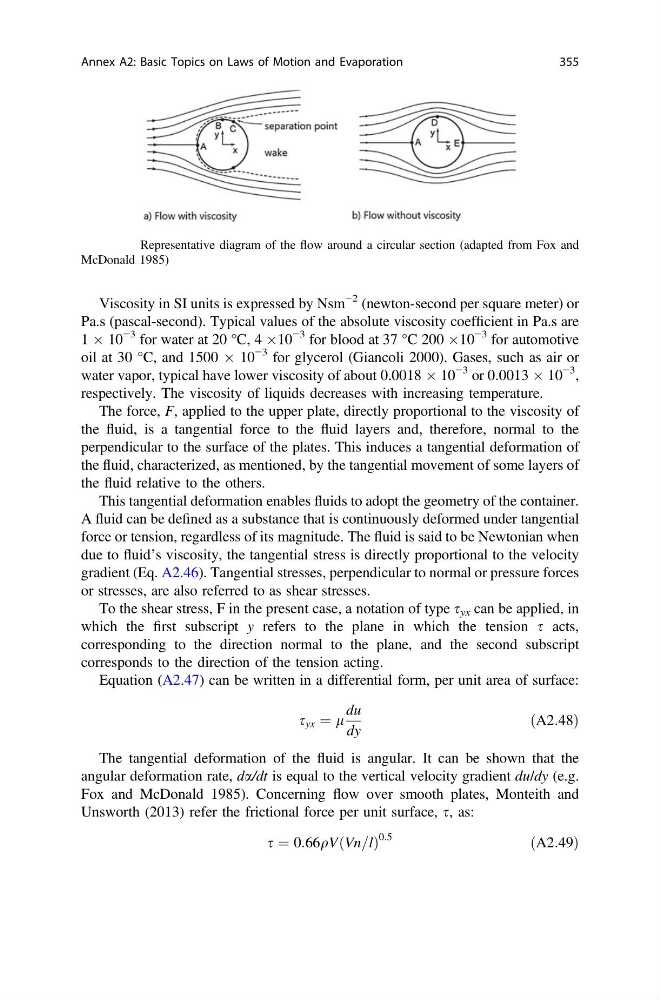
Fig. A2.9 Representative diagram of the flow around a circular section (adapted from Fox and
McDonald 1985)
Annex A2: Basic Topics on Laws of Motion and Evaporation
355
−2 (newton-second per square meter) or
Pa.s (pascal-second). Typical values of the absolute viscosity coefficient in Pa.s are
1 Â 10
−3 for water at 20 °C, 4 Â10
−3 for blood at 37 °C 200 Â10
−3 for automotive
oil at 30 °C, and 1500 Â 10
−3 for glycerol (Giancoli 2000). Gases, such as air or
water vapor, typical have lower viscosity of about 0.0018 Â 10
−3 or 0.0013 Â 10
−3 ,
respectively. The viscosity of liquids decreases with increasing temperature.
The force, F, applied to the upper plate, directly proportional to the viscosity of
the fluid, is a tangential force to the fluid layers and, therefore, normal to the
perpendicular to the surface of the plates. This induces a tangential deformation of
the fluid, characterized, as mentioned, by the tangential movement of some layers of
the fluid relative to the others.
This tangential deformation enables fluids to adopt the geometry of the container.
A fluid can be defined as a substance that is continuously deformed under tangential
force or tension, regardless of its magnitude. The fluid is said to be Newtonian when
due to fluid’s viscosity, the tangential stress is directly proportional to the velocity
gradient (Eq. A2.46). Tangential stresses, perpendicular to normal or pressure forces
or stresses, are also referred to as shear stresses.
To the shear stress, F in the present case, a notation of type s yx can be applied, in
which the first subscript y refers to the plane in which the tension s acts,
corresponding to the direction normal to the plane, and the second subscript
corresponds to the direction of the tension acting.
Equation (A2.47) can be written in a differential form, per unit area of surface:
s yx ¼ l
du
dy
ðA2:48Þ
The tangential deformation of the fluid is angular. It can be shown that the
angular deformation rate, da/dt is equal to the vertical velocity gradient du/dy (e.g.
Fox and McDonald 1985). Concerning flow over smooth plates, Monteith and
Unsworth (2013) refer the frictional force per unit surface, s, as:
s ¼ 0:66qVðVn=lÞ
0:5
ðA2:49Þ
Fig. A2.9 Representative diagram of the flow around a circular section (adapted from Fox and
McDonald 1985)
Annex A2: Basic Topics on Laws of Motion and Evaporation
355