

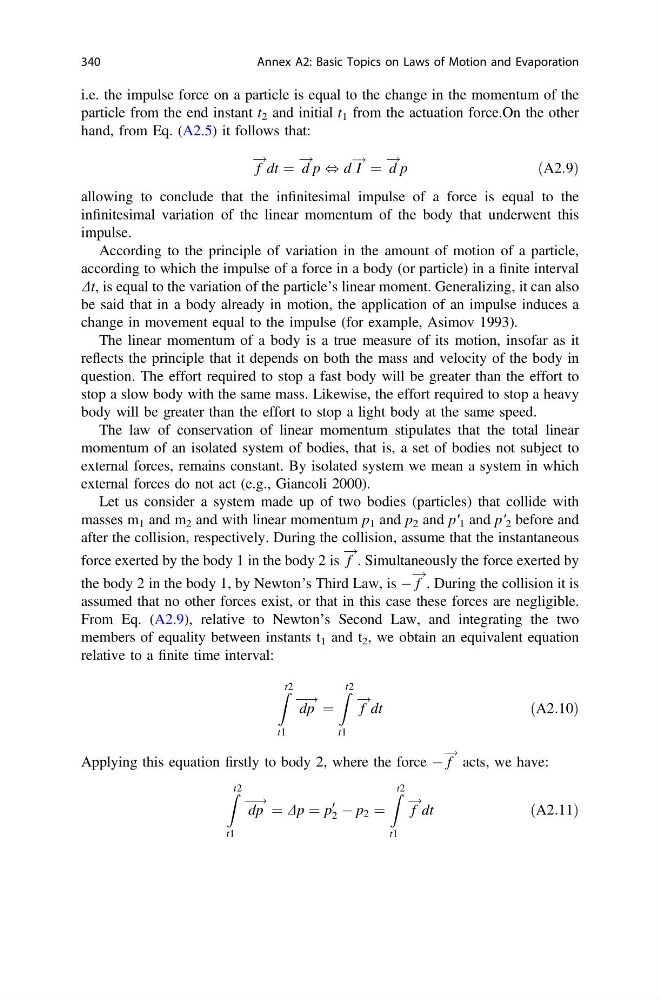
i.e. the impulse force on a particle is equal to the change in the momentum of the
particle from the end instant t 2 and initial t 1 from the actuation force.On the other
hand, from Eq. (A2.5) it follows that:
f
!
dt ¼ d
!
p , d I
! ¼ d
!
p
ðA2:9Þ
allowing to conclude that the infinitesimal impulse of a force is equal to the
infinitesimal variation of the linear momentum of the body that underwent this
impulse.
According to the principle of variation in the amount of motion of a particle,
according to which the impulse of a force in a body (or particle) in a finite interval
Dt, is equal to the variation of the particle’s linear moment. Generalizing, it can also
be said that in a body already in motion, the application of an impulse induces a
change in movement equal to the impulse (for example, Asimov 1993).
The linear momentum of a body is a true measure of its motion, insofar as it
reflects the principle that it depends on both the mass and velocity of the body in
question. The effort required to stop a fast body will be greater than the effort to
stop a slow body with the same mass. Likewise, the effort required to stop a heavy
body will be greater than the effort to stop a light body at the same speed.
The law of conservation of linear momentum stipulates that the total linear
momentum of an isolated system of bodies, that is, a set of bodies not subject to
external forces, remains constant. By isolated system we mean a system in which
external forces do not act (e.g., Giancoli 2000).
Let us consider a system made up of two bodies (particles) that collide with
masses m 1 and m 2 and with linear momentum p 1 and p 2 and p′ 1 and p′ 2 before and
after the collision, respectively. During the collision, assume that the instantaneous
force exerted by the body 1 in the body 2 is f
!
. Simultaneously the force exerted by
the body 2 in the body 1, by Newton’s Third Law, is À f
!
. During the collision it is
assumed that no other forces exist, or that in this case these forces are negligible.
From Eq. (A2.9), relative to Newton’s Second Law, and integrating the two
members of equality between instants t 1 and t 2 , we obtain an equivalent equation
relative to a finite time interval:
Z t2
t1
dp
! ¼
Z t2
t1
f
!
dt
ðA2:10Þ
Applying this equation firstly to body 2, where the force À f
! acts, we have:
Z t2
t1
dp
! ¼ Dp ¼ p
0
2 À p 2 ¼
Z t2
t1
f
!
dt
ðA2:11Þ
340
Annex A2: Basic Topics on Laws of Motion and Evaporation
particle from the end instant t 2 and initial t 1 from the actuation force.On the other
hand, from Eq. (A2.5) it follows that:
f
!
dt ¼ d
!
p , d I
! ¼ d
!
p
ðA2:9Þ
allowing to conclude that the infinitesimal impulse of a force is equal to the
infinitesimal variation of the linear momentum of the body that underwent this
impulse.
According to the principle of variation in the amount of motion of a particle,
according to which the impulse of a force in a body (or particle) in a finite interval
Dt, is equal to the variation of the particle’s linear moment. Generalizing, it can also
be said that in a body already in motion, the application of an impulse induces a
change in movement equal to the impulse (for example, Asimov 1993).
The linear momentum of a body is a true measure of its motion, insofar as it
reflects the principle that it depends on both the mass and velocity of the body in
question. The effort required to stop a fast body will be greater than the effort to
stop a slow body with the same mass. Likewise, the effort required to stop a heavy
body will be greater than the effort to stop a light body at the same speed.
The law of conservation of linear momentum stipulates that the total linear
momentum of an isolated system of bodies, that is, a set of bodies not subject to
external forces, remains constant. By isolated system we mean a system in which
external forces do not act (e.g., Giancoli 2000).
Let us consider a system made up of two bodies (particles) that collide with
masses m 1 and m 2 and with linear momentum p 1 and p 2 and p′ 1 and p′ 2 before and
after the collision, respectively. During the collision, assume that the instantaneous
force exerted by the body 1 in the body 2 is f
!
. Simultaneously the force exerted by
the body 2 in the body 1, by Newton’s Third Law, is À f
!
. During the collision it is
assumed that no other forces exist, or that in this case these forces are negligible.
From Eq. (A2.9), relative to Newton’s Second Law, and integrating the two
members of equality between instants t 1 and t 2 , we obtain an equivalent equation
relative to a finite time interval:
Z t2
t1
dp
! ¼
Z t2
t1
f
!
dt
ðA2:10Þ
Applying this equation firstly to body 2, where the force À f
! acts, we have:
Z t2
t1
dp
! ¼ Dp ¼ p
0
2 À p 2 ¼
Z t2
t1
f
!
dt
ðA2:11Þ
340
Annex A2: Basic Topics on Laws of Motion and Evaporation