

between bodies at its surface. That is, the Earth attracts all bodies to its surface,
without the gravitational interactions between them being noticed, since the Earth is
the only present body capable of producing a significant gravitational force to be
noticeable.
A2.3 Conservation of Linear Momentum
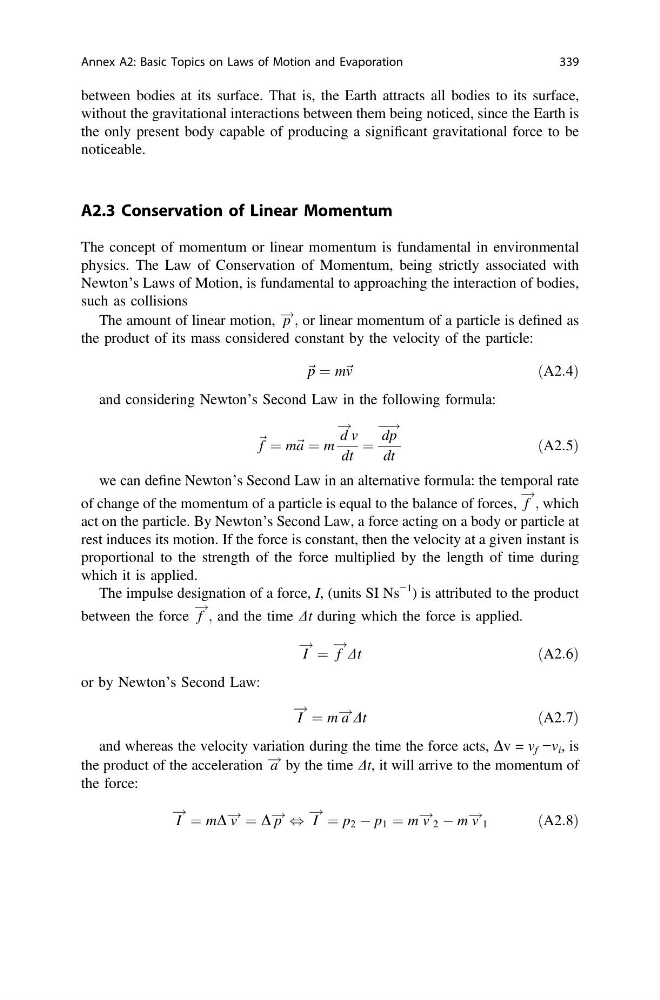
The concept of momentum or linear momentum is fundamental in environmental
physics. The Law of Conservation of Momentum, being strictly associated with
Newton’s Laws of Motion, is fundamental to approaching the interaction of bodies,
such as collisions
The amount of linear motion, p
! ; or linear momentum of a particle is defined as
the product of its mass considered constant by the velocity of the particle:
~ p ¼ m~ v
ðA2:4Þ
and considering Newton’s Second Law in the following formula:
~ f ¼ m~ a ¼ m
d
!
v
dt
¼
dp
!
dt
ðA2:5Þ
we can define Newton’s Second Law in an alternative formula: the temporal rate
of change of the momentum of a particle is equal to the balance of forces, f
!
; which
act on the particle. By Newton’s Second Law, a force acting on a body or particle at
rest induces its motion. If the force is constant, then the velocity at a given instant is
proportional to the strength of the force multiplied by the length of time during
which it is applied.
The impulse designation of a force, I, (units SI Ns
−1 ) is attributed to the product
between the force f
!
; and the time Dt during which the force is applied.
I
! ¼ f
!
Dt
ðA2:6Þ
or by Newton’s Second Law:
I
! ¼ m a
! Dt
ðA2:7Þ
and whereas the velocity variation during the time the force acts, Dv = v f −v i , is
the product of the acceleration a
! by the time Dt, it will arrive to the momentum of
the force:
I
! ¼ mD v
! ¼ D p
! , I
! ¼ p 2 À p 1 ¼ m v
!
2 À m v
!
1
ðA2:8Þ
Annex A2: Basic Topics on Laws of Motion and Evaporation
339
without the gravitational interactions between them being noticed, since the Earth is
the only present body capable of producing a significant gravitational force to be
noticeable.
A2.3 Conservation of Linear Momentum
The concept of momentum or linear momentum is fundamental in environmental
physics. The Law of Conservation of Momentum, being strictly associated with
Newton’s Laws of Motion, is fundamental to approaching the interaction of bodies,
such as collisions
The amount of linear motion, p
! ; or linear momentum of a particle is defined as
the product of its mass considered constant by the velocity of the particle:
~ p ¼ m~ v
ðA2:4Þ
and considering Newton’s Second Law in the following formula:
~ f ¼ m~ a ¼ m
d
!
v
dt
¼
dp
!
dt
ðA2:5Þ
we can define Newton’s Second Law in an alternative formula: the temporal rate
of change of the momentum of a particle is equal to the balance of forces, f
!
; which
act on the particle. By Newton’s Second Law, a force acting on a body or particle at
rest induces its motion. If the force is constant, then the velocity at a given instant is
proportional to the strength of the force multiplied by the length of time during
which it is applied.
The impulse designation of a force, I, (units SI Ns
−1 ) is attributed to the product
between the force f
!
; and the time Dt during which the force is applied.
I
! ¼ f
!
Dt
ðA2:6Þ
or by Newton’s Second Law:
I
! ¼ m a
! Dt
ðA2:7Þ
and whereas the velocity variation during the time the force acts, Dv = v f −v i , is
the product of the acceleration a
! by the time Dt, it will arrive to the momentum of
the force:
I
! ¼ mD v
! ¼ D p
! , I
! ¼ p 2 À p 1 ¼ m v
!
2 À m v
!
1
ðA2:8Þ
Annex A2: Basic Topics on Laws of Motion and Evaporation
339