

small, as the force of attraction between objects of common use, while existing, is
in practice undetectable. The value of G was obtained by Henry Cavendish in 1798,
about 100 years after Newton established Eq. (A2.2). It is currently given by 6,67 X
10
−11 Nm
2 kg
−2 .
The force of gravity imposes acceleration, according to Newton’s Second Law,
of 9.8 ms
−2 to bodies at the surface of Earth. This acceleration of 9.8 ms
−2 is valid
for all bodies under vacuum conditions, regardless of its masses, and regardless of
air resistance to lighter bodies with large surface (e.g., feathers).
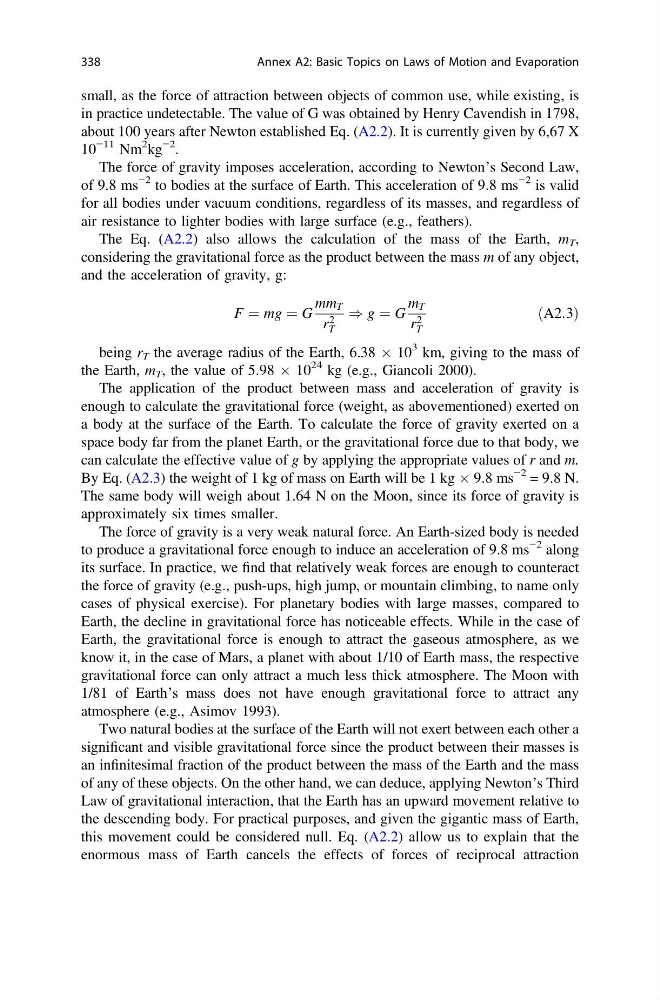
The Eq. (A2.2) also allows the calculation of the mass of the Earth, m T ,
considering the gravitational force as the product between the mass m of any object,
and the acceleration of gravity, g:
F ¼ mg ¼ G
mm T
r 2
T
) g ¼ G
m T
r 2
T
ðA2:3Þ
being r T the average radius of the Earth, 6.38 Â 10
3 km, giving to the mass of
the Earth, m T , the value of 5.98 Â 10
24 kg (e.g., Giancoli 2000).
The application of the product between mass and acceleration of gravity is
enough to calculate the gravitational force (weight, as abovementioned) exerted on
a body at the surface of the Earth. To calculate the force of gravity exerted on a
space body far from the planet Earth, or the gravitational force due to that body, we
can calculate the effective value of g by applying the appropriate values of r and m.
By Eq. (A2.3) the weight of 1 kg of mass on Earth will be 1 kg  9.8 ms
−2 = 9.8 N.
The same body will weigh about 1.64 N on the Moon, since its force of gravity is
approximately six times smaller.
The force of gravity is a very weak natural force. An Earth-sized body is needed
to produce a gravitational force enough to induce an acceleration of 9.8 ms
−2 along
its surface. In practice, we find that relatively weak forces are enough to counteract
the force of gravity (e.g., push-ups, high jump, or mountain climbing, to name only
cases of physical exercise). For planetary bodies with large masses, compared to
Earth, the decline in gravitational force has noticeable effects. While in the case of
Earth, the gravitational force is enough to attract the gaseous atmosphere, as we
know it, in the case of Mars, a planet with about 1/10 of Earth mass, the respective
gravitational force can only attract a much less thick atmosphere. The Moon with
1/81 of Earth’s mass does not have enough gravitational force to attract any
atmosphere (e.g., Asimov 1993).
Two natural bodies at the surface of the Earth will not exert between each other a
significant and visible gravitational force since the product between their masses is
an infinitesimal fraction of the product between the mass of the Earth and the mass
of any of these objects. On the other hand, we can deduce, applying Newton’s Third
Law of gravitational interaction, that the Earth has an upward movement relative to
the descending body. For practical purposes, and given the gigantic mass of Earth,
this movement could be considered null. Eq. (A2.2) allow us to explain that the
enormous mass of Earth cancels the effects of forces of reciprocal attraction
338
Annex A2: Basic Topics on Laws of Motion and Evaporation
in practice undetectable. The value of G was obtained by Henry Cavendish in 1798,
about 100 years after Newton established Eq. (A2.2). It is currently given by 6,67 X
10
−11 Nm
2 kg
−2 .
The force of gravity imposes acceleration, according to Newton’s Second Law,
of 9.8 ms
−2 to bodies at the surface of Earth. This acceleration of 9.8 ms
−2 is valid
for all bodies under vacuum conditions, regardless of its masses, and regardless of
air resistance to lighter bodies with large surface (e.g., feathers).
The Eq. (A2.2) also allows the calculation of the mass of the Earth, m T ,
considering the gravitational force as the product between the mass m of any object,
and the acceleration of gravity, g:
F ¼ mg ¼ G
mm T
r 2
T
) g ¼ G
m T
r 2
T
ðA2:3Þ
being r T the average radius of the Earth, 6.38 Â 10
3 km, giving to the mass of
the Earth, m T , the value of 5.98 Â 10
24 kg (e.g., Giancoli 2000).
The application of the product between mass and acceleration of gravity is
enough to calculate the gravitational force (weight, as abovementioned) exerted on
a body at the surface of the Earth. To calculate the force of gravity exerted on a
space body far from the planet Earth, or the gravitational force due to that body, we
can calculate the effective value of g by applying the appropriate values of r and m.
By Eq. (A2.3) the weight of 1 kg of mass on Earth will be 1 kg  9.8 ms
−2 = 9.8 N.
The same body will weigh about 1.64 N on the Moon, since its force of gravity is
approximately six times smaller.
The force of gravity is a very weak natural force. An Earth-sized body is needed
to produce a gravitational force enough to induce an acceleration of 9.8 ms
−2 along
its surface. In practice, we find that relatively weak forces are enough to counteract
the force of gravity (e.g., push-ups, high jump, or mountain climbing, to name only
cases of physical exercise). For planetary bodies with large masses, compared to
Earth, the decline in gravitational force has noticeable effects. While in the case of
Earth, the gravitational force is enough to attract the gaseous atmosphere, as we
know it, in the case of Mars, a planet with about 1/10 of Earth mass, the respective
gravitational force can only attract a much less thick atmosphere. The Moon with
1/81 of Earth’s mass does not have enough gravitational force to attract any
atmosphere (e.g., Asimov 1993).
Two natural bodies at the surface of the Earth will not exert between each other a
significant and visible gravitational force since the product between their masses is
an infinitesimal fraction of the product between the mass of the Earth and the mass
of any of these objects. On the other hand, we can deduce, applying Newton’s Third
Law of gravitational interaction, that the Earth has an upward movement relative to
the descending body. For practical purposes, and given the gigantic mass of Earth,
this movement could be considered null. Eq. (A2.2) allow us to explain that the
enormous mass of Earth cancels the effects of forces of reciprocal attraction
338
Annex A2: Basic Topics on Laws of Motion and Evaporation