

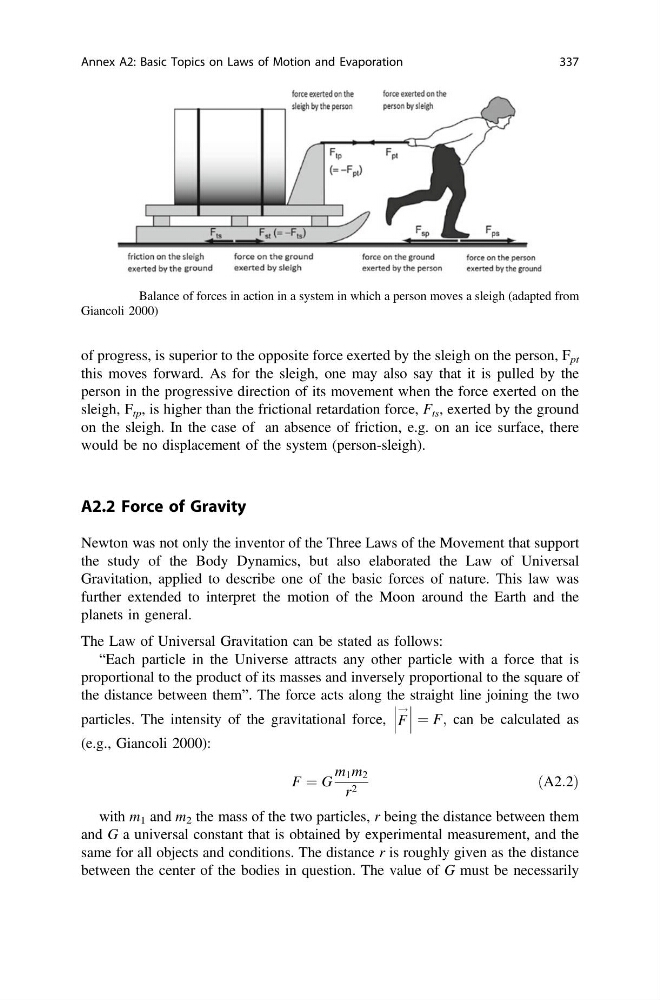
of progress, is superior to the opposite force exerted by the sleigh on the person, F pt
this moves forward. As for the sleigh, one may also say that it is pulled by the
person in the progressive direction of its movement when the force exerted on the
sleigh, F tp , is higher than the frictional retardation force, F ts , exerted by the ground
on the sleigh. In the case of an absence of friction, e.g. on an ice surface, there
would be no displacement of the system (person-sleigh).
A2.2 Force of Gravity
Newton was not only the inventor of the Three Laws of the Movement that support
the study of the Body Dynamics, but also elaborated the Law of Universal
Gravitation, applied to describe one of the basic forces of nature. This law was
further extended to interpret the motion of the Moon around the Earth and the
planets in general.
The Law of Universal Gravitation can be stated as follows:
“Each particle in the Universe attracts any other particle with a force that is
proportional to the product of its masses and inversely proportional to the square of
the distance between them”. The force acts along the straight line joining the two
particles. The intensity of the gravitational force, F
!
¼ F; can be calculated as
(e.g., Giancoli 2000):
F ¼ G
m 1 m 2
r 2
ðA2:2Þ
with m 1 and m 2 the mass of the two particles, r being the distance between them
and G a universal constant that is obtained by experimental measurement, and the
same for all objects and conditions. The distance r is roughly given as the distance
between the center of the bodies in question. The value of G must be necessarily
Fig. A2.1 Balance of forces in action in a system in which a person moves a sleigh (adapted from
Giancoli 2000)
Annex A2: Basic Topics on Laws of Motion and Evaporation
337
this moves forward. As for the sleigh, one may also say that it is pulled by the
person in the progressive direction of its movement when the force exerted on the
sleigh, F tp , is higher than the frictional retardation force, F ts , exerted by the ground
on the sleigh. In the case of an absence of friction, e.g. on an ice surface, there
would be no displacement of the system (person-sleigh).
A2.2 Force of Gravity
Newton was not only the inventor of the Three Laws of the Movement that support
the study of the Body Dynamics, but also elaborated the Law of Universal
Gravitation, applied to describe one of the basic forces of nature. This law was
further extended to interpret the motion of the Moon around the Earth and the
planets in general.
The Law of Universal Gravitation can be stated as follows:
“Each particle in the Universe attracts any other particle with a force that is
proportional to the product of its masses and inversely proportional to the square of
the distance between them”. The force acts along the straight line joining the two
particles. The intensity of the gravitational force, F
!
¼ F; can be calculated as
(e.g., Giancoli 2000):
F ¼ G
m 1 m 2
r 2
ðA2:2Þ
with m 1 and m 2 the mass of the two particles, r being the distance between them
and G a universal constant that is obtained by experimental measurement, and the
same for all objects and conditions. The distance r is roughly given as the distance
between the center of the bodies in question. The value of G must be necessarily
Fig. A2.1 Balance of forces in action in a system in which a person moves a sleigh (adapted from
Giancoli 2000)
Annex A2: Basic Topics on Laws of Motion and Evaporation
337