

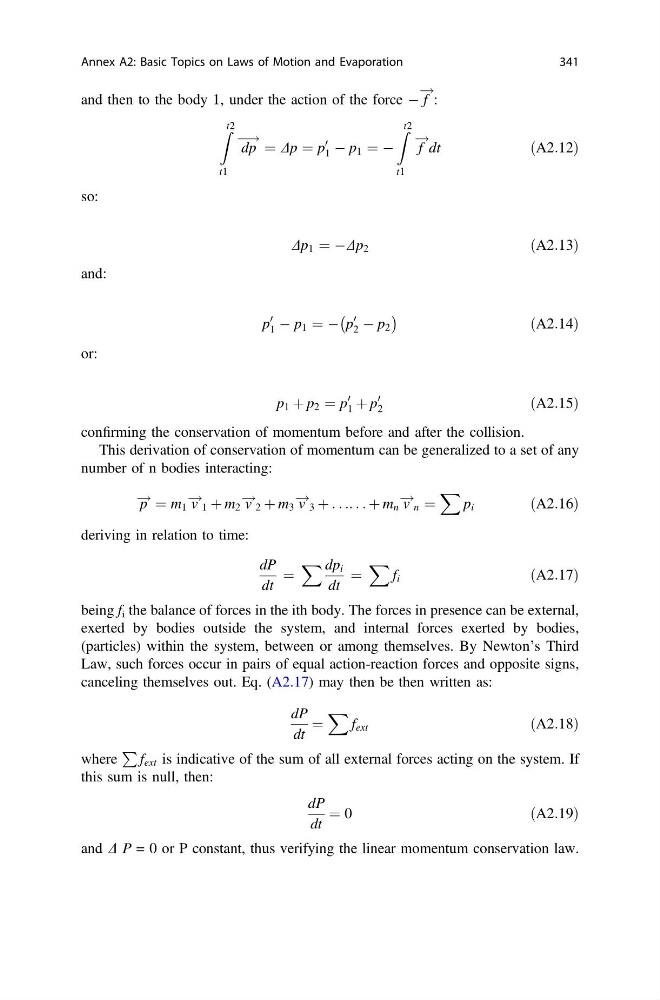
and then to the body 1, under the action of the force À f
!
:
Z t2
t1
dp
! ¼ Dp ¼ p
0
1 À p 1 ¼ À
Z t2
t1
f
!
dt
ðA2:12Þ
so:
Dp 1 ¼ ÀDp 2
ðA2:13Þ
and:
p
0
1 À p 1 ¼ À p
0
2 À p 2
À
Á
ðA2:14Þ
or:
p 1 þ p 2 ¼ p
0
1 þ p
0
2
ðA2:15Þ
confirming the conservation of momentum before and after the collision.
This derivation of conservation of momentum can be generalized to a set of any
number of n bodies interacting:
p
! ¼ m 1 v
!
1 þ m 2 v
!
2 þ m 3 v
!
3 þ . . .. . . þ m n v
!
n ¼
X
p i
ðA2:16Þ
deriving in relation to time:
dP
dt
¼
X dp i
dt
¼
X
f i
ðA2:17Þ
being f i the balance of forces in the ith body. The forces in presence can be external,
exerted by bodies outside the system, and internal forces exerted by bodies,
(particles) within the system, between or among themselves. By Newton’s Third
Law, such forces occur in pairs of equal action-reaction forces and opposite signs,
canceling themselves out. Eq. (A2.17) may then be then written as:
dP
dt
¼
X
f ext
ðA2:18Þ
where
P
f ext is indicative of the sum of all external forces acting on the system. If
this sum is null, then:
dP
dt
¼ 0
ðA2:19Þ
and D P = 0 or P constant, thus verifying the linear momentum conservation law.
Annex A2: Basic Topics on Laws of Motion and Evaporation
341
!
:
Z t2
t1
dp
! ¼ Dp ¼ p
0
1 À p 1 ¼ À
Z t2
t1
f
!
dt
ðA2:12Þ
so:
Dp 1 ¼ ÀDp 2
ðA2:13Þ
and:
p
0
1 À p 1 ¼ À p
0
2 À p 2
À
Á
ðA2:14Þ
or:
p 1 þ p 2 ¼ p
0
1 þ p
0
2
ðA2:15Þ
confirming the conservation of momentum before and after the collision.
This derivation of conservation of momentum can be generalized to a set of any
number of n bodies interacting:
p
! ¼ m 1 v
!
1 þ m 2 v
!
2 þ m 3 v
!
3 þ . . .. . . þ m n v
!
n ¼
X
p i
ðA2:16Þ
deriving in relation to time:
dP
dt
¼
X dp i
dt
¼
X
f i
ðA2:17Þ
being f i the balance of forces in the ith body. The forces in presence can be external,
exerted by bodies outside the system, and internal forces exerted by bodies,
(particles) within the system, between or among themselves. By Newton’s Third
Law, such forces occur in pairs of equal action-reaction forces and opposite signs,
canceling themselves out. Eq. (A2.17) may then be then written as:
dP
dt
¼
X
f ext
ðA2:18Þ
where
P
f ext is indicative of the sum of all external forces acting on the system. If
this sum is null, then:
dP
dt
¼ 0
ðA2:19Þ
and D P = 0 or P constant, thus verifying the linear momentum conservation law.
Annex A2: Basic Topics on Laws of Motion and Evaporation
341