

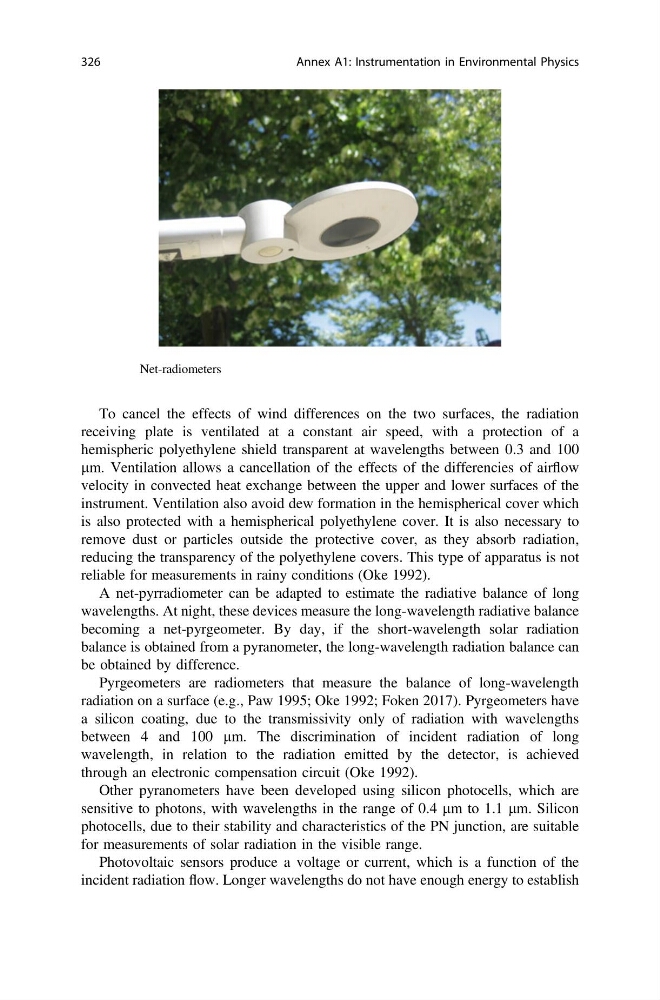
To cancel the effects of wind differences on the two surfaces, the radiation
receiving plate is ventilated at a constant air speed, with a protection of a
hemispheric polyethylene shield transparent at wavelengths between 0.3 and 100
lm. Ventilation allows a cancellation of the effects of the differencies of airflow
velocity in convected heat exchange between the upper and lower surfaces of the
instrument. Ventilation also avoid dew formation in the hemispherical cover which
is also protected with a hemispherical polyethylene cover. It is also necessary to
remove dust or particles outside the protective cover, as they absorb radiation,
reducing the transparency of the polyethylene covers. This type of apparatus is not
reliable for measurements in rainy conditions (Oke 1992).
A net-pyrradiometer can be adapted to estimate the radiative balance of long
wavelengths. At night, these devices measure the long-wavelength radiative balance
becoming a net-pyrgeometer. By day, if the short-wavelength solar radiation
balance is obtained from a pyranometer, the long-wavelength radiation balance can
be obtained by difference.
Pyrgeometers are radiometers that measure the balance of long-wavelength
radiation on a surface (e.g., Paw 1995; Oke 1992; Foken 2017). Pyrgeometers have
a silicon coating, due to the transmissivity only of radiation with wavelengths
between 4 and 100 lm. The discrimination of incident radiation of long
wavelength, in relation to the radiation emitted by the detector, is achieved
through an electronic compensation circuit (Oke 1992).
Other pyranometers have been developed using silicon photocells, which are
sensitive to photons, with wavelengths in the range of 0.4 lm to 1.1 lm. Silicon
photocells, due to their stability and characteristics of the PN junction, are suitable
for measurements of solar radiation in the visible range.
Photovoltaic sensors produce a voltage or current, which is a function of the
incident radiation flow. Longer wavelengths do not have enough energy to establish
Fig. A1.9 Net-radiometers
326
Annex A1: Instrumentation in Environmental Physics
receiving plate is ventilated at a constant air speed, with a protection of a
hemispheric polyethylene shield transparent at wavelengths between 0.3 and 100
lm. Ventilation allows a cancellation of the effects of the differencies of airflow
velocity in convected heat exchange between the upper and lower surfaces of the
instrument. Ventilation also avoid dew formation in the hemispherical cover which
is also protected with a hemispherical polyethylene cover. It is also necessary to
remove dust or particles outside the protective cover, as they absorb radiation,
reducing the transparency of the polyethylene covers. This type of apparatus is not
reliable for measurements in rainy conditions (Oke 1992).
A net-pyrradiometer can be adapted to estimate the radiative balance of long
wavelengths. At night, these devices measure the long-wavelength radiative balance
becoming a net-pyrgeometer. By day, if the short-wavelength solar radiation
balance is obtained from a pyranometer, the long-wavelength radiation balance can
be obtained by difference.
Pyrgeometers are radiometers that measure the balance of long-wavelength
radiation on a surface (e.g., Paw 1995; Oke 1992; Foken 2017). Pyrgeometers have
a silicon coating, due to the transmissivity only of radiation with wavelengths
between 4 and 100 lm. The discrimination of incident radiation of long
wavelength, in relation to the radiation emitted by the detector, is achieved
through an electronic compensation circuit (Oke 1992).
Other pyranometers have been developed using silicon photocells, which are
sensitive to photons, with wavelengths in the range of 0.4 lm to 1.1 lm. Silicon
photocells, due to their stability and characteristics of the PN junction, are suitable
for measurements of solar radiation in the visible range.
Photovoltaic sensors produce a voltage or current, which is a function of the
incident radiation flow. Longer wavelengths do not have enough energy to establish
Fig. A1.9 Net-radiometers
326
Annex A1: Instrumentation in Environmental Physics