

electron transport in the photocell. The photovoltaic effect is proportional to the
number of photons absorbed by the photocell (Paw 1985). Diffusion plates or disks
are added to the photovoltaic device so that it is sensitive to desirable radiation
ranges (e.g., visible). This type of pyranometer shows substantial errors in cloudy
sky conditions, due to calibration needs (Paw 1985; Campbell 1997). A parallel
resistance, (shunt) can be integrated into the sensor structure, for the purpose of
optimizing its linear response to the incident radiation regardless of its temperature.
In the past 10–15 years, significant progress has been made on the accuracy of
radiation sensors. This progress was based on the classification of sensors by the
World Meteorological Organization (WMO), standard indicators of error limits
(Foken 2017), as well as the publication of the Basic Surface Radiation Network
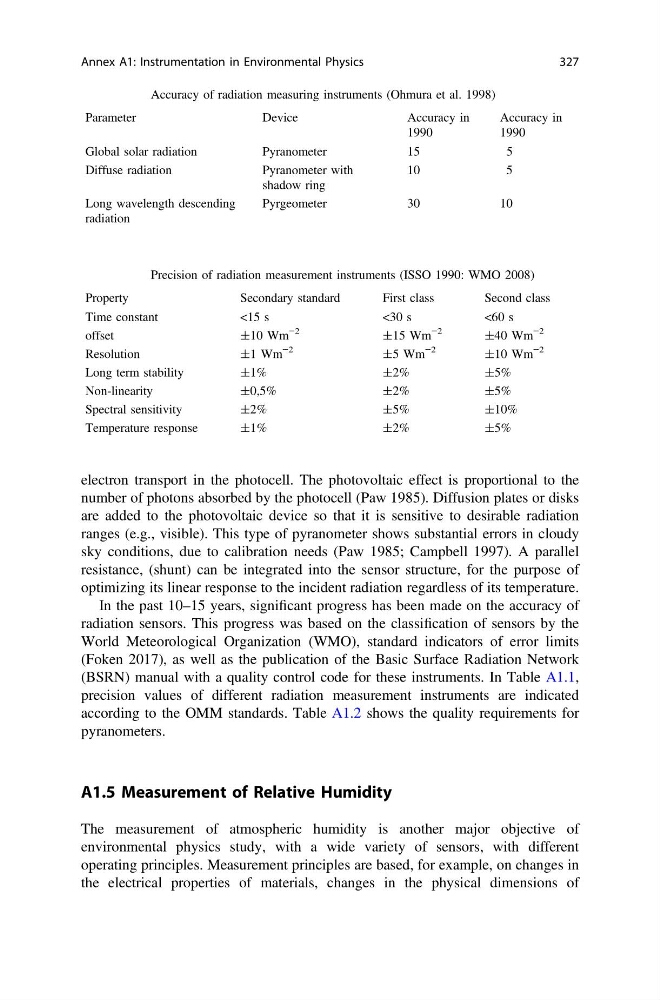
(BSRN) manual with a quality control code for these instruments. In Table A1.1,
precision values of different radiation measurement instruments are indicated
according to the OMM standards. Table A1.2 shows the quality requirements for
pyranometers.
A1.5 Measurement of Relative Humidity
The measurement of atmospheric humidity is another major objective of
environmental physics study, with a wide variety of sensors, with different
operating principles. Measurement principles are based, for example, on changes in
the electrical properties of materials, changes in the physical dimensions of
Table A1.1 Accuracy of radiation measuring instruments (Ohmura et al. 1998)
Parameter
Device
Accuracy in
1990
Accuracy in
1990
Global solar radiation
Pyranometer
15
5
Diffuse radiation
Pyranometer with
shadow ring
10
5
Long wavelength descending
radiation
Pyrgeometer
30
10
Table A1.2 Precision of radiation measurement instruments (ISSO 1990: WMO 2008)
Property
Secondary standard
First class
Second class
Time constant
<15 s
<30 s
<60 s
offset
±10 Wm
−2
±15 Wm
−2
±40 Wm
−2
Resolution
±1 Wm
−2
±5 Wm
−2
±10 Wm
−2
Long term stability
±1%
±2%
±5%
Non-linearity
±0,5%
±2%
±5%
Spectral sensitivity
±2%
±5%
±10%
Temperature response
±1%
±2%
±5%
Annex A1: Instrumentation in Environmental Physics
327
number of photons absorbed by the photocell (Paw 1985). Diffusion plates or disks
are added to the photovoltaic device so that it is sensitive to desirable radiation
ranges (e.g., visible). This type of pyranometer shows substantial errors in cloudy
sky conditions, due to calibration needs (Paw 1985; Campbell 1997). A parallel
resistance, (shunt) can be integrated into the sensor structure, for the purpose of
optimizing its linear response to the incident radiation regardless of its temperature.
In the past 10–15 years, significant progress has been made on the accuracy of
radiation sensors. This progress was based on the classification of sensors by the
World Meteorological Organization (WMO), standard indicators of error limits
(Foken 2017), as well as the publication of the Basic Surface Radiation Network
(BSRN) manual with a quality control code for these instruments. In Table A1.1,
precision values of different radiation measurement instruments are indicated
according to the OMM standards. Table A1.2 shows the quality requirements for
pyranometers.
A1.5 Measurement of Relative Humidity
The measurement of atmospheric humidity is another major objective of
environmental physics study, with a wide variety of sensors, with different
operating principles. Measurement principles are based, for example, on changes in
the electrical properties of materials, changes in the physical dimensions of
Table A1.1 Accuracy of radiation measuring instruments (Ohmura et al. 1998)
Parameter
Device
Accuracy in
1990
Accuracy in
1990
Global solar radiation
Pyranometer
15
5
Diffuse radiation
Pyranometer with
shadow ring
10
5
Long wavelength descending
radiation
Pyrgeometer
30
10
Table A1.2 Precision of radiation measurement instruments (ISSO 1990: WMO 2008)
Property
Secondary standard
First class
Second class
Time constant
<15 s
<30 s
<60 s
offset
±10 Wm
−2
±15 Wm
−2
±40 Wm
−2
Resolution
±1 Wm
−2
±5 Wm
−2
±10 Wm
−2
Long term stability
±1%
±2%
±5%
Non-linearity
±0,5%
±2%
±5%
Spectral sensitivity
±2%
±5%
±10%
Temperature response
±1%
±2%
±5%
Annex A1: Instrumentation in Environmental Physics
327