

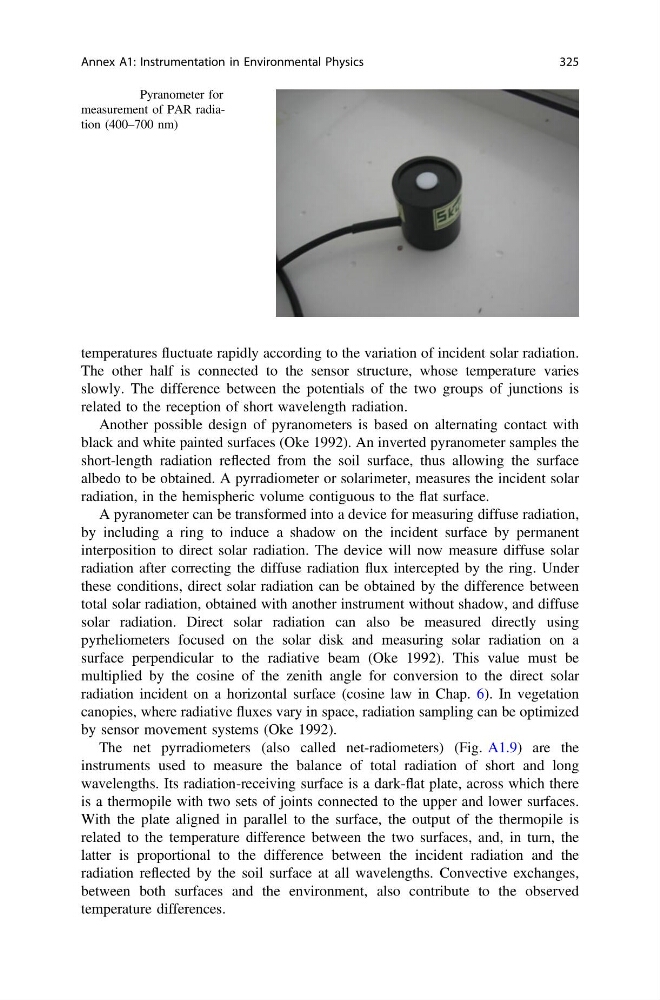
Fig. A1.8 Pyranometer for
measurement of PAR radiation (400–700 nm)
temperatures fluctuate rapidly according to the variation of incident solar radiation.
The other half is connected to the sensor structure, whose temperature varies
slowly. The difference between the potentials of the two groups of junctions is
related to the reception of short wavelength radiation.
Another possible design of pyranometers is based on alternating contact with
black and white painted surfaces (Oke 1992). An inverted pyranometer samples the
short-length radiation reflected from the soil surface, thus allowing the surface
albedo to be obtained. A pyrradiometer or solarimeter, measures the incident solar
radiation, in the hemispheric volume contiguous to the flat surface.
A pyranometer can be transformed into a device for measuring diffuse radiation,
by including a ring to induce a shadow on the incident surface by permanent
interposition to direct solar radiation. The device will now measure diffuse solar
radiation after correcting the diffuse radiation flux intercepted by the ring. Under
these conditions, direct solar radiation can be obtained by the difference between
total solar radiation, obtained with another instrument without shadow, and diffuse
solar radiation. Direct solar radiation can also be measured directly using
pyrheliometers focused on the solar disk and measuring solar radiation on a
surface perpendicular to the radiative beam (Oke 1992). This value must be
multiplied by the cosine of the zenith angle for conversion to the direct solar
radiation incident on a horizontal surface (cosine law in Chap. 6). In vegetation
canopies, where radiative fluxes vary in space, radiation sampling can be optimized
by sensor movement systems (Oke 1992).
The net pyrradiometers (also called net-radiometers) (Fig. A1.9) are the
instruments used to measure the balance of total radiation of short and long
wavelengths. Its radiation-receiving surface is a dark-flat plate, across which there
is a thermopile with two sets of joints connected to the upper and lower surfaces.
With the plate aligned in parallel to the surface, the output of the thermopile is
related to the temperature difference between the two surfaces, and, in turn, the
latter is proportional to the difference between the incident radiation and the
radiation reflected by the soil surface at all wavelengths. Convective exchanges,
between both surfaces and the environment, also contribute to the observed
temperature differences.
Annex A1: Instrumentation in Environmental Physics
325
measurement of PAR radiation (400–700 nm)
temperatures fluctuate rapidly according to the variation of incident solar radiation.
The other half is connected to the sensor structure, whose temperature varies
slowly. The difference between the potentials of the two groups of junctions is
related to the reception of short wavelength radiation.
Another possible design of pyranometers is based on alternating contact with
black and white painted surfaces (Oke 1992). An inverted pyranometer samples the
short-length radiation reflected from the soil surface, thus allowing the surface
albedo to be obtained. A pyrradiometer or solarimeter, measures the incident solar
radiation, in the hemispheric volume contiguous to the flat surface.
A pyranometer can be transformed into a device for measuring diffuse radiation,
by including a ring to induce a shadow on the incident surface by permanent
interposition to direct solar radiation. The device will now measure diffuse solar
radiation after correcting the diffuse radiation flux intercepted by the ring. Under
these conditions, direct solar radiation can be obtained by the difference between
total solar radiation, obtained with another instrument without shadow, and diffuse
solar radiation. Direct solar radiation can also be measured directly using
pyrheliometers focused on the solar disk and measuring solar radiation on a
surface perpendicular to the radiative beam (Oke 1992). This value must be
multiplied by the cosine of the zenith angle for conversion to the direct solar
radiation incident on a horizontal surface (cosine law in Chap. 6). In vegetation
canopies, where radiative fluxes vary in space, radiation sampling can be optimized
by sensor movement systems (Oke 1992).
The net pyrradiometers (also called net-radiometers) (Fig. A1.9) are the
instruments used to measure the balance of total radiation of short and long
wavelengths. Its radiation-receiving surface is a dark-flat plate, across which there
is a thermopile with two sets of joints connected to the upper and lower surfaces.
With the plate aligned in parallel to the surface, the output of the thermopile is
related to the temperature difference between the two surfaces, and, in turn, the
latter is proportional to the difference between the incident radiation and the
radiation reflected by the soil surface at all wavelengths. Convective exchanges,
between both surfaces and the environment, also contribute to the observed
temperature differences.
Annex A1: Instrumentation in Environmental Physics
325