

radiation is guaranteed by the reflection of the white colour of the shelter surface
which is usually doubled. Inconvenient convection exchanges between
environment and sensor device are controlled e.g. by forced ventilation or by
minimization of sensor dimension.
The several types of equipment for temperature measurement have different
kinds of performance. A thermocouple, for instance, with a very small junction will
detect very fast fluctuations of temperature. Alternatively, thermometers with higher
dimension will allow an expedite evaluation of average temperatures and simplified
outputs which are easier to process. In many situations temperature differences in
air are more relevant than the absolute values (Oke 1992) e.g. for applications of
aerodynamic methods. As aforementioned data acquisition of temperature
differences of about 0.01 is easily achievable by differential measurements
ascribing a fixe level of measurements to an absolute temperature threshold.
The measurements of soil temperature are also subjected to errors, mainly due to
the heat conduction between soil and wires and cables of temperature sensors. Soil
temperature change at a slower rate than air temperatures and heat conduction
prevail, since radiative and convective exchanges are minimal in soil. Sensors used
in measurements in air temperature are overall applied for soil temperature
measurements (e.g., Oke 1992). Special attention should be paid to changes in soil
structure when installing the instruments. Ideally, the installation should be
horizontal, from a pit excavated at an intended deepness, so that longitudinal
conduction and soil moisture flow as well are minimized.
Measurements of surface temperatures (e.g., leaves) can be carried out with very
thin thermocouples, although in practice the design of a representative temperature
sampling can be a very complext ask. The use of a radiation thermometer is an
expedite methodology for surface temperature measurements. This kind of device is
based on the measurement of longwave radiation, ranging between 8 lm–14 lm,
emitted by the surfaces and detected in its hemispherical view. The radiation detected
by the device is composed by longwave radiation emitted from the surface and
downward solar radiation which is reflected from the ground. The reflected
component can be neglected and only considered the emitted longwave radiation
component as follows:
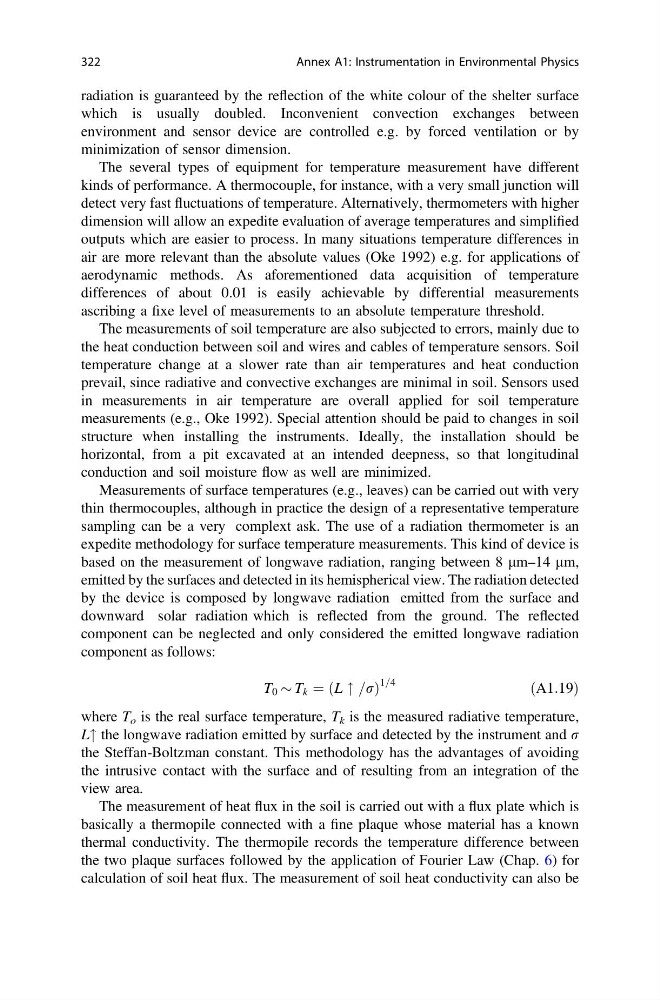
T 0 $ T k ¼ ðL " =rÞ
1=4
ðA1:19Þ
where T o is the real surface temperature, T k is the measured radiative temperature,
L" the longwave radiation emitted by surface and detected by the instrument and r
the Steffan-Boltzman constant. This methodology has the advantages of avoiding
the intrusive contact with the surface and of resulting from an integration of the
view area.
The measurement of heat flux in the soil is carried out with a flux plate which is
basically a thermopile connected with a fine plaque whose material has a known
thermal conductivity. The thermopile records the temperature difference between
the two plaque surfaces followed by the application of Fourier Law (Chap. 6) for
calculation of soil heat flux. The measurement of soil heat conductivity can also be
322
Annex A1: Instrumentation in Environmental Physics
which is usually doubled. Inconvenient convection exchanges between
environment and sensor device are controlled e.g. by forced ventilation or by
minimization of sensor dimension.
The several types of equipment for temperature measurement have different
kinds of performance. A thermocouple, for instance, with a very small junction will
detect very fast fluctuations of temperature. Alternatively, thermometers with higher
dimension will allow an expedite evaluation of average temperatures and simplified
outputs which are easier to process. In many situations temperature differences in
air are more relevant than the absolute values (Oke 1992) e.g. for applications of
aerodynamic methods. As aforementioned data acquisition of temperature
differences of about 0.01 is easily achievable by differential measurements
ascribing a fixe level of measurements to an absolute temperature threshold.
The measurements of soil temperature are also subjected to errors, mainly due to
the heat conduction between soil and wires and cables of temperature sensors. Soil
temperature change at a slower rate than air temperatures and heat conduction
prevail, since radiative and convective exchanges are minimal in soil. Sensors used
in measurements in air temperature are overall applied for soil temperature
measurements (e.g., Oke 1992). Special attention should be paid to changes in soil
structure when installing the instruments. Ideally, the installation should be
horizontal, from a pit excavated at an intended deepness, so that longitudinal
conduction and soil moisture flow as well are minimized.
Measurements of surface temperatures (e.g., leaves) can be carried out with very
thin thermocouples, although in practice the design of a representative temperature
sampling can be a very complext ask. The use of a radiation thermometer is an
expedite methodology for surface temperature measurements. This kind of device is
based on the measurement of longwave radiation, ranging between 8 lm–14 lm,
emitted by the surfaces and detected in its hemispherical view. The radiation detected
by the device is composed by longwave radiation emitted from the surface and
downward solar radiation which is reflected from the ground. The reflected
component can be neglected and only considered the emitted longwave radiation
component as follows:
T 0 $ T k ¼ ðL " =rÞ
1=4
ðA1:19Þ
where T o is the real surface temperature, T k is the measured radiative temperature,
L" the longwave radiation emitted by surface and detected by the instrument and r
the Steffan-Boltzman constant. This methodology has the advantages of avoiding
the intrusive contact with the surface and of resulting from an integration of the
view area.
The measurement of heat flux in the soil is carried out with a flux plate which is
basically a thermopile connected with a fine plaque whose material has a known
thermal conductivity. The thermopile records the temperature difference between
the two plaque surfaces followed by the application of Fourier Law (Chap. 6) for
calculation of soil heat flux. The measurement of soil heat conductivity can also be
322
Annex A1: Instrumentation in Environmental Physics