

carried out under Fourier Law principles, by insertion of a soil sample in a heated
connected probe subjected to electric heating with the transversal temperature
gradient measured with a set of thermocouples.
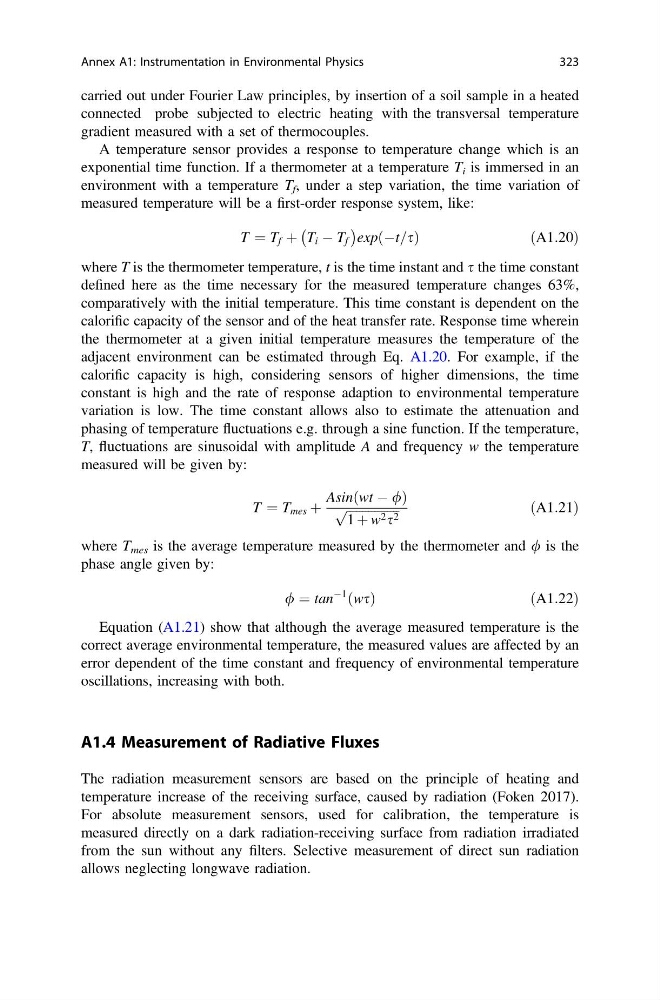
A temperature sensor provides a response to temperature change which is an
exponential time function. If a thermometer at a temperature T i is immersed in an
environment with a temperature T f , under a step variation, the time variation of
measured temperature will be a first-order response system, like:
T ¼ T f þ T i À T f
À
Á
expðÀt=sÞ
ð A1:20Þ
where T is the thermometer temperature, t is the time instant and s the time constant
defined here as the time necessary for the measured temperature changes 63%,
comparatively with the initial temperature. This time constant is dependent on the
calorific capacity of the sensor and of the heat transfer rate. Response time wherein
the thermometer at a given initial temperature measures the temperature of the
adjacent environment can be estimated through Eq. A1.20. For example, if the
calorific capacity is high, considering sensors of higher dimensions, the time
constant is high and the rate of response adaption to environmental temperature
variation is low. The time constant allows also to estimate the attenuation and
phasing of temperature fluctuations e.g. through a sine function. If the temperature,
T, fluctuations are sinusoidal with amplitude A and frequency w the temperature
measured will be given by:
T ¼ T mes þ
Asinðwt À /Þ
ffiffiffiffiffiffiffiffiffiffiffiffiffiffiffiffiffi
1 þ w 2 s 2
p
ðA1:21Þ
where T mes is the average temperature measured by the thermometer and / is the
phase angle given by:
/ ¼ tan
À1
ðwsÞ
ð A1:22Þ
Equation (A1.21) show that although the average measured temperature is the
correct average environmental temperature, the measured values are affected by an
error dependent of the time constant and frequency of environmental temperature
oscillations, increasing with both.
A1.4 Measurement of Radiative Fluxes
The radiation measurement sensors are based on the principle of heating and
temperature increase of the receiving surface, caused by radiation (Foken 2017).
For absolute measurement sensors, used for calibration, the temperature is
measured directly on a dark radiation-receiving surface from radiation irradiated
from the sun without any filters. Selective measurement of direct sun radiation
allows neglecting longwave radiation.
Annex A1: Instrumentation in Environmental Physics
323
connected probe subjected to electric heating with the transversal temperature
gradient measured with a set of thermocouples.
A temperature sensor provides a response to temperature change which is an
exponential time function. If a thermometer at a temperature T i is immersed in an
environment with a temperature T f , under a step variation, the time variation of
measured temperature will be a first-order response system, like:
T ¼ T f þ T i À T f
À
Á
expðÀt=sÞ
ð A1:20Þ
where T is the thermometer temperature, t is the time instant and s the time constant
defined here as the time necessary for the measured temperature changes 63%,
comparatively with the initial temperature. This time constant is dependent on the
calorific capacity of the sensor and of the heat transfer rate. Response time wherein
the thermometer at a given initial temperature measures the temperature of the
adjacent environment can be estimated through Eq. A1.20. For example, if the
calorific capacity is high, considering sensors of higher dimensions, the time
constant is high and the rate of response adaption to environmental temperature
variation is low. The time constant allows also to estimate the attenuation and
phasing of temperature fluctuations e.g. through a sine function. If the temperature,
T, fluctuations are sinusoidal with amplitude A and frequency w the temperature
measured will be given by:
T ¼ T mes þ
Asinðwt À /Þ
ffiffiffiffiffiffiffiffiffiffiffiffiffiffiffiffiffi
1 þ w 2 s 2
p
ðA1:21Þ
where T mes is the average temperature measured by the thermometer and / is the
phase angle given by:
/ ¼ tan
À1
ðwsÞ
ð A1:22Þ
Equation (A1.21) show that although the average measured temperature is the
correct average environmental temperature, the measured values are affected by an
error dependent of the time constant and frequency of environmental temperature
oscillations, increasing with both.
A1.4 Measurement of Radiative Fluxes
The radiation measurement sensors are based on the principle of heating and
temperature increase of the receiving surface, caused by radiation (Foken 2017).
For absolute measurement sensors, used for calibration, the temperature is
measured directly on a dark radiation-receiving surface from radiation irradiated
from the sun without any filters. Selective measurement of direct sun radiation
allows neglecting longwave radiation.
Annex A1: Instrumentation in Environmental Physics
323