

The main errors for temperature measurements with thermocouples are due
conditions of turbulence and radiation, being indeed much greater, ranging between
401 K and 0.05 K, than the most recent electrical measurement techniques (−0.001
K) (e.g., Foken 2017).
The radiation error is due to additional heating by the absorption of radiation by
the sensor and is a function of the radiation balance at the sensor surface, and of the
heat transfer properties. The principles of heat transfer through conduction, forced
convection and radiation, presented in Chap. 6, are therefore involved. Radiation
errors are minimal for very thin thermocouples. For thin platinum wires, under
forced convection and incident solar radiation of 800 Wm
−2 , radiation errors of
below 0.1 K are possible for wire diameters lower than 20 lm. The sensitivity
drastically improves, to values below 0.05 K, for increasing wind velocities in the
range between 1 ms
−1 and 10 ms
−1 (Foken 2017).
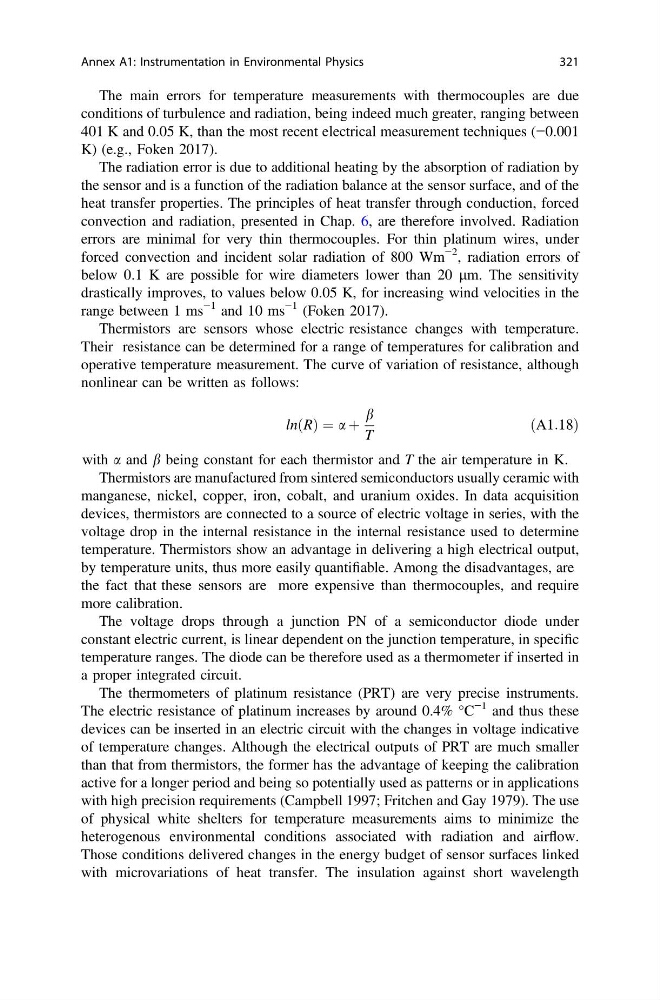
Thermistors are sensors whose electric resistance changes with temperature.
Their resistance can be determined for a range of temperatures for calibration and
operative temperature measurement. The curve of variation of resistance, although
nonlinear can be written as follows:
lnðRÞ ¼ a þ
b
T
ðA1:18Þ
with a and b being constant for each thermistor and T the air temperature in K.
Thermistors are manufactured from sintered semiconductors usually ceramic with
manganese, nickel, copper, iron, cobalt, and uranium oxides. In data acquisition
devices, thermistors are connected to a source of electric voltage in series, with the
voltage drop in the internal resistance in the internal resistance used to determine
temperature. Thermistors show an advantage in delivering a high electrical output,
by temperature units, thus more easily quantifiable. Among the disadvantages, are
the fact that these sensors are more expensive than thermocouples, and require
more calibration.
The voltage drops through a junction PN of a semiconductor diode under
constant electric current, is linear dependent on the junction temperature, in specific
temperature ranges. The diode can be therefore used as a thermometer if inserted in
a proper integrated circuit.
The thermometers of platinum resistance (PRT) are very precise instruments.
The electric resistance of platinum increases by around 0.4% °C
−1 and thus these
devices can be inserted in an electric circuit with the changes in voltage indicative
of temperature changes. Although the electrical outputs of PRT are much smaller
than that from thermistors, the former has the advantage of keeping the calibration
active for a longer period and being so potentially used as patterns or in applications
with high precision requirements (Campbell 1997; Fritchen and Gay 1979). The use
of physical white shelters for temperature measurements aims to minimize the
heterogenous environmental conditions associated with radiation and airflow.
Those conditions delivered changes in the energy budget of sensor surfaces linked
with microvariations of heat transfer. The insulation against short wavelength
Annex A1: Instrumentation in Environmental Physics
321
conditions of turbulence and radiation, being indeed much greater, ranging between
401 K and 0.05 K, than the most recent electrical measurement techniques (−0.001
K) (e.g., Foken 2017).
The radiation error is due to additional heating by the absorption of radiation by
the sensor and is a function of the radiation balance at the sensor surface, and of the
heat transfer properties. The principles of heat transfer through conduction, forced
convection and radiation, presented in Chap. 6, are therefore involved. Radiation
errors are minimal for very thin thermocouples. For thin platinum wires, under
forced convection and incident solar radiation of 800 Wm
−2 , radiation errors of
below 0.1 K are possible for wire diameters lower than 20 lm. The sensitivity
drastically improves, to values below 0.05 K, for increasing wind velocities in the
range between 1 ms
−1 and 10 ms
−1 (Foken 2017).
Thermistors are sensors whose electric resistance changes with temperature.
Their resistance can be determined for a range of temperatures for calibration and
operative temperature measurement. The curve of variation of resistance, although
nonlinear can be written as follows:
lnðRÞ ¼ a þ
b
T
ðA1:18Þ
with a and b being constant for each thermistor and T the air temperature in K.
Thermistors are manufactured from sintered semiconductors usually ceramic with
manganese, nickel, copper, iron, cobalt, and uranium oxides. In data acquisition
devices, thermistors are connected to a source of electric voltage in series, with the
voltage drop in the internal resistance in the internal resistance used to determine
temperature. Thermistors show an advantage in delivering a high electrical output,
by temperature units, thus more easily quantifiable. Among the disadvantages, are
the fact that these sensors are more expensive than thermocouples, and require
more calibration.
The voltage drops through a junction PN of a semiconductor diode under
constant electric current, is linear dependent on the junction temperature, in specific
temperature ranges. The diode can be therefore used as a thermometer if inserted in
a proper integrated circuit.
The thermometers of platinum resistance (PRT) are very precise instruments.
The electric resistance of platinum increases by around 0.4% °C
−1 and thus these
devices can be inserted in an electric circuit with the changes in voltage indicative
of temperature changes. Although the electrical outputs of PRT are much smaller
than that from thermistors, the former has the advantage of keeping the calibration
active for a longer period and being so potentially used as patterns or in applications
with high precision requirements (Campbell 1997; Fritchen and Gay 1979). The use
of physical white shelters for temperature measurements aims to minimize the
heterogenous environmental conditions associated with radiation and airflow.
Those conditions delivered changes in the energy budget of sensor surfaces linked
with microvariations of heat transfer. The insulation against short wavelength
Annex A1: Instrumentation in Environmental Physics
321