

The commonest thermocouples are based on chromel (90% of nickel plus 10%
of chromium) and alumel (95% of nickel plus 2% of manganese plus 2% of
aluminium and 1% of silica), being used in a large scope of objectives with a
sensitivity of 41 lV °C
−1 and applied under a range of temperatures between −200
1300 °C.
Thermocouples are robust and cheap sensors, of easy use and manufacturing,
and not needing of external electric power for the measurements, because they
produce a voltage by themselves. Usually, thermocouples don’t require internal
calibration, except for very precise work, and deliver an output voltage which has a
very stable linear variation with temperature.
For obtaining absolute temperature, one of the junctions must be referenced to
equilibrium with known constant temperature, e.g. ice. For example, if for a
thermocouple copper-constantan, with a sensitivity of 40 lV °C
−1 , the reference
junction is at 0 °C for measurement of 1000 lV the junction temperature will be of
0 °C + 1000/45 % 22 °C. Thus, for the temperature measurement with a
thermocouple, using Eq. A1.16, it is necessary to know the value of a 1 constant and
measure DV with a device e.g. voltmeter.
The low values of DV signals, around 10
−3 and 10
−6 , require equipment of high
quality for data acquisition. The problem can be simplified by connecting the
number of the junction is series forming a so-called thermopile, so that the outputs
can be summed. Thermopiles can be used in applications wherein the differences in
air temperature, through differential measurements, are more relevant than the
absolute values. This is the case e.g. in the quantification of vertical fluxes of
sensible heat via flux-gradient methodologies.
The modern data acquisition devices measure the temperature of the connection
between thermocouples and thermistors or PRT and add this temperature by digital
or analogue means to the temperature reported from voltage measurements.
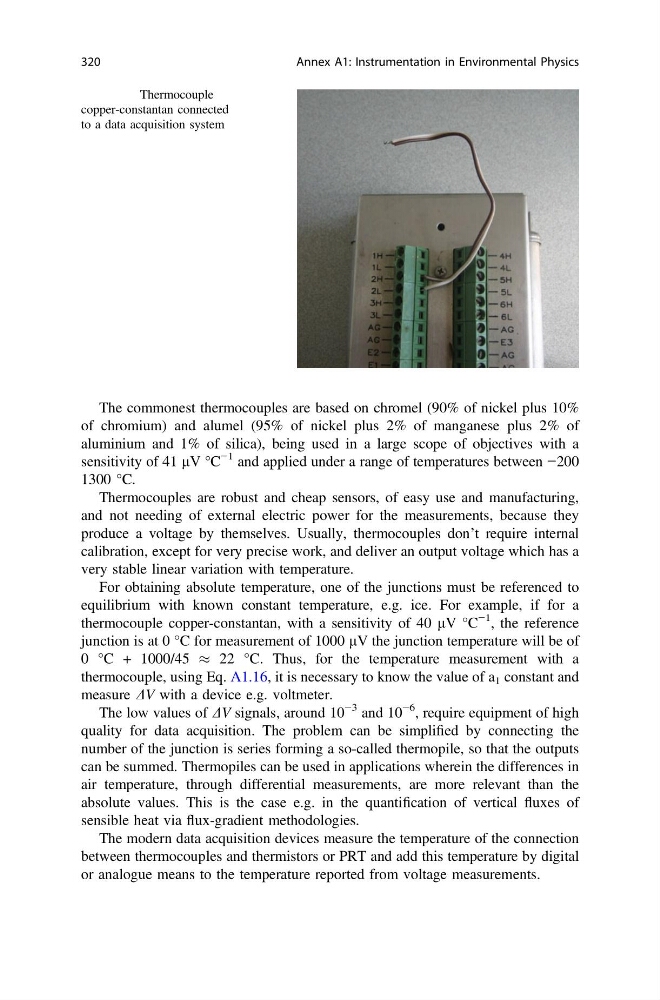
Fig. A1.7 Thermocouple
copper-constantan connected
to a data acquisition system
320
Annex A1: Instrumentation in Environmental Physics
of chromium) and alumel (95% of nickel plus 2% of manganese plus 2% of
aluminium and 1% of silica), being used in a large scope of objectives with a
sensitivity of 41 lV °C
−1 and applied under a range of temperatures between −200
1300 °C.
Thermocouples are robust and cheap sensors, of easy use and manufacturing,
and not needing of external electric power for the measurements, because they
produce a voltage by themselves. Usually, thermocouples don’t require internal
calibration, except for very precise work, and deliver an output voltage which has a
very stable linear variation with temperature.
For obtaining absolute temperature, one of the junctions must be referenced to
equilibrium with known constant temperature, e.g. ice. For example, if for a
thermocouple copper-constantan, with a sensitivity of 40 lV °C
−1 , the reference
junction is at 0 °C for measurement of 1000 lV the junction temperature will be of
0 °C + 1000/45 % 22 °C. Thus, for the temperature measurement with a
thermocouple, using Eq. A1.16, it is necessary to know the value of a 1 constant and
measure DV with a device e.g. voltmeter.
The low values of DV signals, around 10
−3 and 10
−6 , require equipment of high
quality for data acquisition. The problem can be simplified by connecting the
number of the junction is series forming a so-called thermopile, so that the outputs
can be summed. Thermopiles can be used in applications wherein the differences in
air temperature, through differential measurements, are more relevant than the
absolute values. This is the case e.g. in the quantification of vertical fluxes of
sensible heat via flux-gradient methodologies.
The modern data acquisition devices measure the temperature of the connection
between thermocouples and thermistors or PRT and add this temperature by digital
or analogue means to the temperature reported from voltage measurements.
Fig. A1.7 Thermocouple
copper-constantan connected
to a data acquisition system
320
Annex A1: Instrumentation in Environmental Physics