

where k is the gain constant or instrument’s static sensitivity. The output signal
follows the input signal without distortion or delay.
The potentiometer is an example of a zero-order, linear instrument used for
measuring displacement, where the change in the potential difference across the
element is proportional to the displacement. The measuring instrument zero-order
displays ideal dynamic behaviour without any phasing. The instrument is zero-order
when static output is produced in response to a static entry.
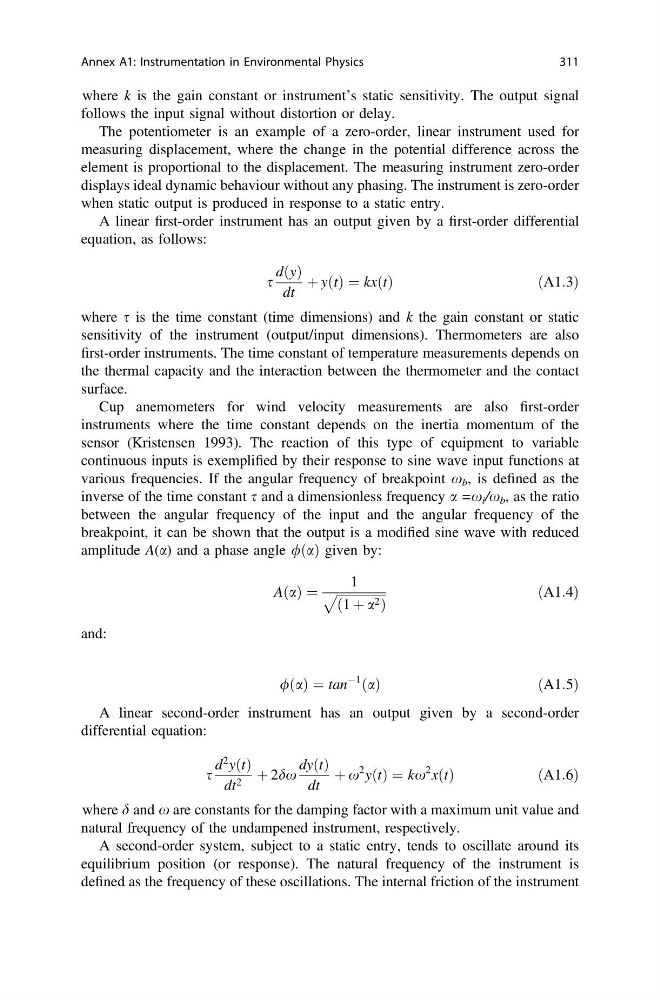
A linear first-order instrument has an output given by a first-order differential
equation, as follows:
s
dðyÞ
dt
þ yðtÞ ¼ kxðtÞ
ð A1:3Þ
where s is the time constant (time dimensions) and k the gain constant or static
sensitivity of the instrument (output/input dimensions). Thermometers are also
first-order instruments. The time constant of temperature measurements depends on
the thermal capacity and the interaction between the thermometer and the contact
surface.
Cup anemometers for wind velocity measurements are also first-order
instruments where the time constant depends on the inertia momentum of the
sensor (Kristensen 1993). The reaction of this type of equipment to variable
continuous inputs is exemplified by their response to sine wave input functions at
various frequencies. If the angular frequency of breakpoint x b , is defined as the
inverse of the time constant s and a dimensionless frequency a =x i /x b , as the ratio
between the angular frequency of the input and the angular frequency of the
breakpoint, it can be shown that the output is a modified sine wave with reduced
amplitude A(a) and a phase angle /ðaÞ given by:
AðaÞ ¼
1
ffiffiffiffiffiffiffiffiffiffiffiffiffiffiffiffi
ð1 þ a 2 Þ
p
ðA1:4Þ
and:
/ðaÞ ¼ tan
À1
ðaÞ
ð A1:5Þ
A linear second-order instrument has an output given by a second-order
differential equation:
s
d
2 yðtÞ
dt 2 þ 2dx
dyðtÞ
dt
þ x
2 yðtÞ ¼ kx
2 xðtÞ
ð A1:6Þ
where d and x are constants for the damping factor with a maximum unit value and
natural frequency of the undampened instrument, respectively.
A second-order system, subject to a static entry, tends to oscillate around its
equilibrium position (or response). The natural frequency of the instrument is
defined as the frequency of these oscillations. The internal friction of the instrument
Annex A1: Instrumentation in Environmental Physics
311
follows the input signal without distortion or delay.
The potentiometer is an example of a zero-order, linear instrument used for
measuring displacement, where the change in the potential difference across the
element is proportional to the displacement. The measuring instrument zero-order
displays ideal dynamic behaviour without any phasing. The instrument is zero-order
when static output is produced in response to a static entry.
A linear first-order instrument has an output given by a first-order differential
equation, as follows:
s
dðyÞ
dt
þ yðtÞ ¼ kxðtÞ
ð A1:3Þ
where s is the time constant (time dimensions) and k the gain constant or static
sensitivity of the instrument (output/input dimensions). Thermometers are also
first-order instruments. The time constant of temperature measurements depends on
the thermal capacity and the interaction between the thermometer and the contact
surface.
Cup anemometers for wind velocity measurements are also first-order
instruments where the time constant depends on the inertia momentum of the
sensor (Kristensen 1993). The reaction of this type of equipment to variable
continuous inputs is exemplified by their response to sine wave input functions at
various frequencies. If the angular frequency of breakpoint x b , is defined as the
inverse of the time constant s and a dimensionless frequency a =x i /x b , as the ratio
between the angular frequency of the input and the angular frequency of the
breakpoint, it can be shown that the output is a modified sine wave with reduced
amplitude A(a) and a phase angle /ðaÞ given by:
AðaÞ ¼
1
ffiffiffiffiffiffiffiffiffiffiffiffiffiffiffiffi
ð1 þ a 2 Þ
p
ðA1:4Þ
and:
/ðaÞ ¼ tan
À1
ðaÞ
ð A1:5Þ
A linear second-order instrument has an output given by a second-order
differential equation:
s
d
2 yðtÞ
dt 2 þ 2dx
dyðtÞ
dt
þ x
2 yðtÞ ¼ kx
2 xðtÞ
ð A1:6Þ
where d and x are constants for the damping factor with a maximum unit value and
natural frequency of the undampened instrument, respectively.
A second-order system, subject to a static entry, tends to oscillate around its
equilibrium position (or response). The natural frequency of the instrument is
defined as the frequency of these oscillations. The internal friction of the instrument
Annex A1: Instrumentation in Environmental Physics
311